



 For all latest news, follow the Daily Sun's Google News channel.


On a Friday afternoon at Mohammadpur Town Hall Shaheed Park, a handful of children were kicking a football around while their parents looked on from benches at the edge of the field.
It was, locals noted, a rare sight.
Muntahina Rashid, whose son was among those playing, explained why it only happens once a week.
“Neither our apartment block nor his school has a playground. I’m a working parent, so Friday is the only day I can bring him.”
Even then, she has reservations. Drug users frequent the ground on a regular basis, she said, making it feel unsafe. And yet she persists. “I do it every week so that sport doesn’t mean only mobile games to him.”
Her concern proved well-founded. As dusk settled over the park, the sharp smell of cannabis drifted across from the furniture market on the western side – an almost nightly occurrence, residents say.
“In our childhood we made friends on playgrounds,” Rashid added.
“We played in groups and learned how to accept victory and defeat. Today’s children are deprived of this. They are more familiar with virtual friends than real ones.”
That deprivation is strikingly visible across Dhaka.
A visit to Lalmatia and Mohammadpur areas in the city revealed that of Lalmatia’s three playgrounds, only one is in any meaningful condition for use.
Of Mohammadpur’s six – spread across Iqbal Road, Town Hall, Salimullah Road and Tajmahal Road – just two are considered even partially functional.
Entire residential colonies nearby, including Mohammadi Housing, Ekota Housing, Nobinagar Housing and several others, have no playground or park of any kind.
The scale of the shortfall is difficult to overstate.
Standard planning criteria call for one playground for every 3,000-5,000 residents, covering children from age three through to adulthood.
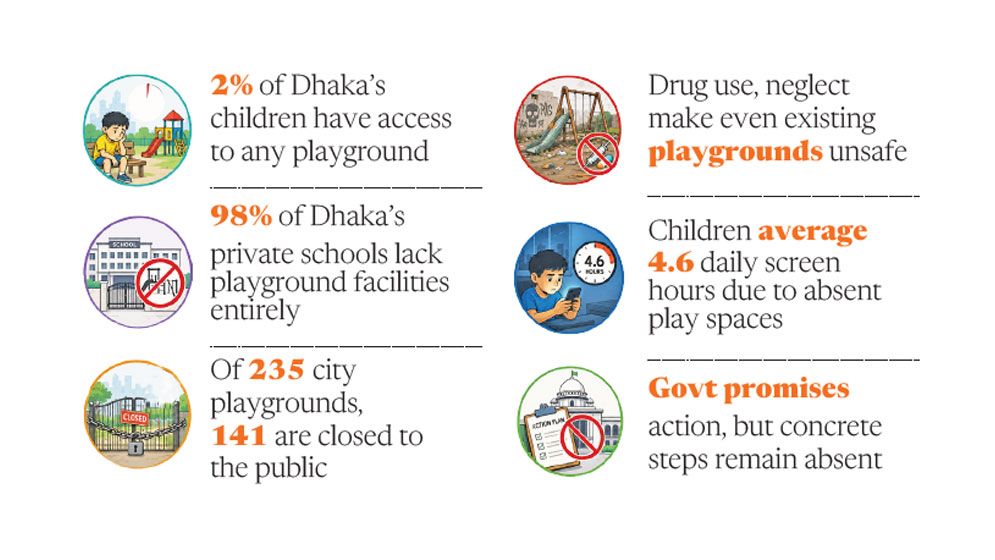
A study by the Bangladesh Institute of Planners found that Dhaka has 235 playgrounds in total – but 141 of these are institutional grounds, closed off to the general public.
Many of the remaining spaces are controlled by clubs, rented out for fairs and commercial events, or effectively inaccessible.
A survey by the Bangladesh Bureau of Statistics and the Power and Participation Research Centre found that just 2% of children in the capital have access to a playground.
The Institute for Planning and Development (IPD) puts the shortfall in starker terms still: Dhaka needs an additional 795 playgrounds on top of the existing 235 simply to meet demand.
The consequences are playing out in classrooms and clinics alike.
Research by the International Centre for Diarrhoeal Disease Research, Bangladesh (icddr,b) found that school children in Dhaka spend an average of 4.6 hours a day in front of screens – mobile phones, televisions, tablets, computers.
More than a third suffer from eye problems; 80% frequently experience headaches.
Children logging more than two hours of daily screen time sleep an average of only 7.3 hours, well below the 8-10 hours recommended for healthy development.
Dhaka’s children are managing less than a fraction of that.
IPD Executive Director Dr Adil Mohammed Khan is blunt about where responsibility lies.
“Our whole development philosophy is directed in the wrong direction. We are doing everything for our next generation without considering their needs. We have no plan regarding recreational facilities for our children, let alone any serious thought about health infrastructure. We are failing to create new playgrounds for them – and the existing fields have remained inaccessible.”
The education system is barely compensating.
According to the Department of Primary and Mass Education, Dhaka has 338 primary schools, 450 NGO-run schools and more than 11,000 kindergartens – with 98% of private schools lacking playground facilities.
Children, in other words, are denied the opportunity to play both at school and at home.
Professor Md Kamal Uddin of the psychology department at the University of Dhaka, whose research has examined cyber aggression among high school students and parent-child relationships, argues that the solution requires action on two fronts.
“You have to offer suitable options for recreation to young people. If you cannot offer the opportunity to spend time in safe playgrounds, they will look for alternatives.”
He called on both parents to monitor children’s device use more carefully, and on government to mandate playground provision when approving new schools.
Officials at the Local Government Division say they share the concern.
Parimal Sarkar, joint secretary of its Urban Development Wing, told the Daily Sun, “We feel the same way as we also have children. We have been working to bring children into playgrounds and build more such facilities for them. The prime minister has clear instructions for this. We will try to resolve this problem on the basis of the political assurance made by him.”