


 For all latest news, follow the Daily Sun's Google News channel.


42% revenue growth target ‘near-impossible’: Experts
Analysts warn ambitious revenue targets could severely constrain development spending in FY27 budget
Daily Sun Report, Dhaka
Published: 19 May 2026, 12:00 AM
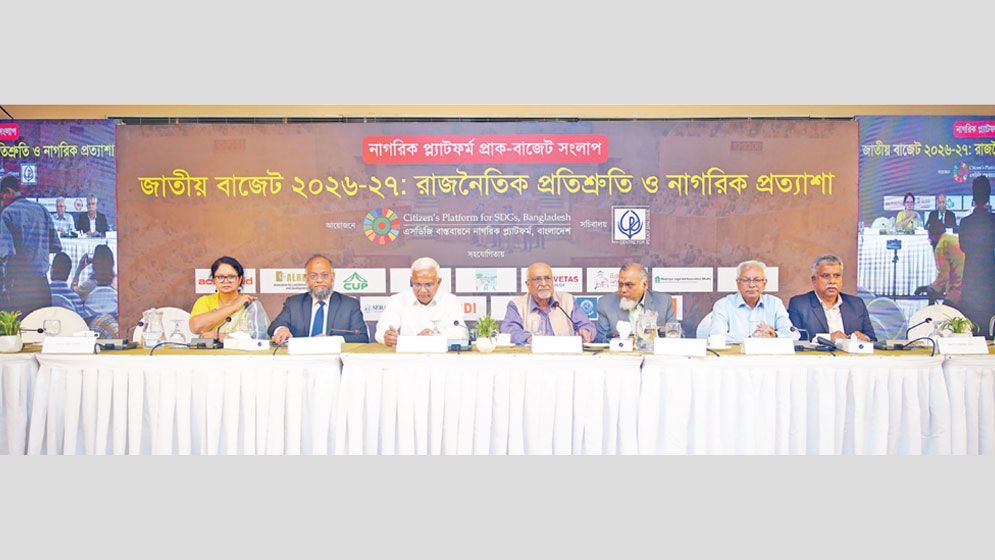
The national budget for the 2026-27 fiscal year faces what analysts described as a “near-impossible” revenue target, as fiscal pressures intensify amid rising wage demands, subsidy burdens and development financing needs, according to the Citizen’s Platform for SDGs, Bangladesh.
The government aims to mobilise Tk6.95 lakh crore in FY27, implying a 42% increase over the revised FY26 target – a pace experts say has no historical precedent.
“The numbers simply do not align with Bangladesh’s revenue history,” said Towfiqul Islam Khan, additional research director of the Centre for Policy Dialogue (CPD), while presenting at a pre-budget dialogue organised by the Citizen’s Platform at a hotel in Gulshan on Monday.
He noted that even the strongest sustained revenue performance between FY01 and FY19 averaged annual growth of 15.6%, which would still leave an estimated shortfall of around Tk1.3 lakh crore.
Tax collection data further illustrate the challenge. The National Board of Revenue (NBR) collected Tk2.89 lakh crore during the first nine months of FY26 against a revised annual target of Tk5.03 lakh crore, implying nearly 96% growth would be required in the final quarter to meet the goal.
Analysts said such a backloaded surge is “virtually impossible” under the current administrative and economic conditions.
Pay reform pressure adds fiscal strain
The proposed recommendations of the Ninth Pay Commission could significantly increase public expenditure by sharply raising government salaries.
The recommendations include increasing the minimum monthly public sector salary from Tk8,250 to Tk20,000 and the maximum salary to Tk1.60 lakh.
The additional fiscal burden is estimated at more than Tk1.06 lakh crore beyond the current annual wage and pension expenditure of Tk1.31 lakh crore.
“Bangladesh forgoes nearly as much as it collects,” Khan said, adding that direct tax exemptions alone exceeded 148% of direct tax revenue in FY21.
The International Monetary Fund (IMF) has advised Bangladesh to begin gradually phasing out tax exemptions from FY27.
The CPD recommended a phased approach, retaining incentives on remittances and standard income deductions while reducing concessions for selected industrial and financial sectors.
Debt servicing crowding out development
Debt sustainability indicators are also coming under increasing pressure.
The IMF has downgraded Bangladesh to a “moderate risk” category for debt distress.
According to the presentation, debt servicing accounted for 26% of total government expenditure in FY24, exceeding the entire Annual Development Programme (ADP) allocation by 15%.
The debt service-to-revenue ratio stood at 33.4%, nearly double the IMF’s 18% threshold for countries with comparable economic capacity.
Welfare programmes show implementation gaps
Field assessments conducted across 18 districts between 2 and 11 May identified implementation weaknesses in several flagship social protection schemes, including the Family Card, Farmers Card, mid-day meal programmes and free school uniform initiatives.
Reported issues included unclear beneficiary selection processes, weak grievance mechanisms and complaints over food quality in school feeding programmes.
The Family Card programme, targeting 50 lakh households with Tk2,500 monthly support, is estimated to cost Tk14,500 crore annually.
Meanwhile, the Farmers Card programme for 42.5 lakh beneficiaries is projected to cost around Tk1,062 crore each year.
Fiscal crossroads ahead
The Citizen’s Platform said the FY27 budget reflects a growing collision between macroeconomic stabilisation goals and political delivery commitments.
Revenue mobilisation needs to rise sharply, debt servicing is approaching peak levels, and IMF-backed reforms require the gradual withdrawal of tax exemptions, while the government simultaneously faces mounting pressure for salary increases, subsidies and election-related commitments.
“The challenge is not only technical, but structural and political,” Khan said.
The platform urged the government to publish the findings of the Ninth Pay Commission, disclose FY25 tax expenditure estimates and ensure greater transparency in Annual Development Programme project documents.
The dialogue was held ahead of the national budget presentation next month and brought together policymakers, economists and civil society representatives.