


 For all latest news, follow the Daily Sun's Google News channel.


An eight-year-old girl was raped and murdered in Dhaka’s Pallabi area on 19 May. A four-year-old was killed in Thakurgaon five days earlier. A ten-year-old was strangled to death in Munshiganj the day after that.
These were not separate crises – they were a single week in Bangladesh.
The people most likely to harm a child, crime analysts and rights activists warn, are not strangers lurking in the shadows. They are teachers, relatives, and neighbours – figures of trust who exploit proximity and authority. And they largely escape accountability, because the families of victims fear social ruin more than they trust the justice system to deliver any meaningful result.
A young boy – referred to here as Habib to protect his identity – was enrolled as a residential student at a Qawmi madrasah in Jalkuri, Fatullah, Narayanganj.
A teacher there allegedly raped him. When the assault came to light, the teacher fled.
Habib’s father never went to the police, never approached a court. The social stigma, he said, was too great a price to pay.
In Chattogram’s Satkania, a teacher at a government primary school allegedly raped a five-year-old girl, luring her with chocolate. That case at least reached court.
In Feni, an eight-year-old residential student Rabbi (not his real name) was allegedly assaulted by his madrasah teacher around five years ago. His family, too, chose silence. The fear of losing social standing outweighed any expectation of justice.
These are not aberrations. They are, by every available measure, the norm.
A toll that keeps rising
The recent case of Ramisa Akhter – the eight-year-old murdered in Pallabi – has ignited nationwide fury.
The suspect, Sohel Rana, was arrested and gave a confessional statement before a Dhaka court.
But for all the public outrage her case has generated, Ramisa is one of scores of children lost in just the past few months.
The Human Rights Support Society recorded that a ten-year-old was raped and strangled to death in Munshiganj on 16 May.
On 14 May, a four-year-old was raped and killed in Thakurgaon’s Ranishankail upazila.
On the morning of 6 May, a four-year-old was strangled following an attempted rape in Sylhet’s Jalalabad area.
The cumulative figures are staggering.
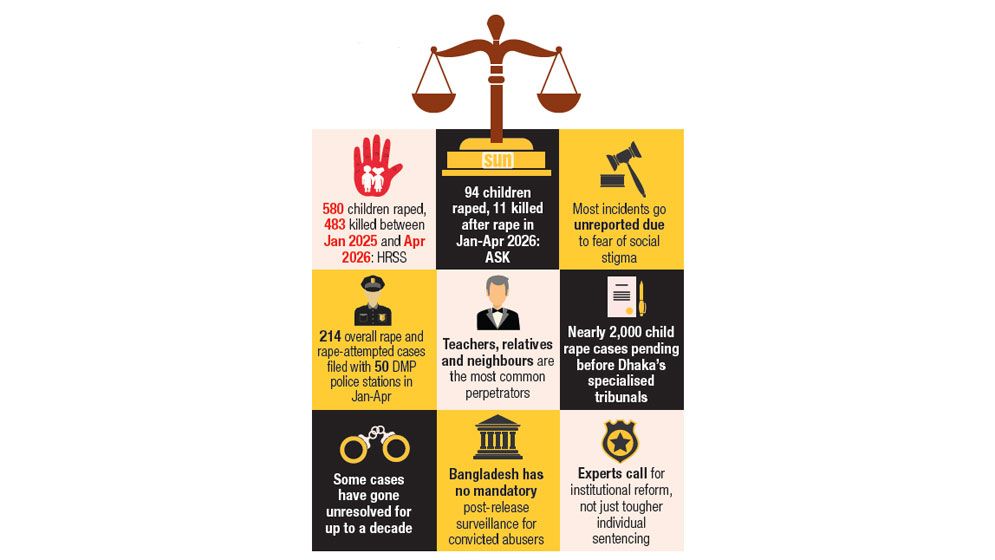
HRSS data shows 580 children were raped and 483 killed between January 2025 and April this year.
The Ain o Salish Kendra recorded 94 incidents of child rape in January-April this year, with 11 children killed afterwards – seven of them under 13.
Over the three preceding years, at least 57 children were murdered after rape.
The Manusher Jonna Foundation’s Bangladesh Child Situation 2025 report found that of nearly 1,900 negative news items concerning children, close to 63% involved rape or murder.
Dhaka Metropolitan Police, meanwhile, recorded 214 rape and attempted rape cases across its 50 police stations in the first four months of this year alone.
Courts buckling under the weight
The legal system has not kept pace – not remotely.
Around 2,000 child rape cases involving victims aged 16 or under have been transferred from Women and Children’s Repression Prevention Tribunals in Dhaka to specialised Child Violence Prevention Tribunals. Of those, roughly 1,400 have been registered and proceedings begun.
The remaining 600 still await case numbers. A further 150 general registration cases have been transferred, with formal proceedings started on only around 50. Some of the cases now sitting before the tribunals were originally filed between four and ten years ago. Shamsuddoha Sumon, public prosecutor at the Dhaka Metropolitan Court, laid out the bottlenecks without equivocation.
“If the investigation is delayed, the police report is also submitted late,” he said, adding, “It often becomes difficult to ensure the appearance of witnesses in court. The investigating officer is often changed or transferred, which also requires time to coordinate their presence. Altogether, these factors contribute to delays in the trial process.”
A system built to fail
Those who study these crimes say the problem runs far deeper than clogged courtrooms and tardy police reports.
Dr Sayed Md Saikh Imtiaz, professor of Women and Gender Studies at the University of Dhaka, pointed to compounding structural failures.
“The perpetrators of such heinous crimes are often repeat offenders. Bangladesh lacks a legal framework to keep convicted abusers under mandatory surveillance or counselling,” he said.
He also flagged the absence of state oversight in madrasahs and the lack of age-appropriate sexual education.
“The absence of gender and sexual education, coupled with easy access to explicit content, is creating a generation of young offenders.”
He was emphatic that these perpetrators must not be labelled mentally ill. They are criminals, he insisted, and must face punishment followed by rigorous post-release monitoring.
Ejajul Islam, executive director of the HRSS, was blunter still.
“It is the constitutional and legal responsibility of the state to prevent violence such as child murder, rape and torture. But one after another, incidents of child rape, murder and torture prove that the existing system for child protection is not effective enough. The culture of impunity, lengthy judicial processes and weak law enforcement are showing the increase in brutal violence,” he said.
Mufti Shamsud Doha Ashrafi, principal of Jamia Islamia Rawjatul Ulum Madrasah, argued that crimes committed in any educational institution – school, madrasah, college or university – must be treated uniformly as criminal offences, with punishment meted out in line with Shariah law.
Read More