



 For all latest news, follow the Daily Sun's Google News channel.


The sweet scent of ripening mangoes is once again drifting across northern Bangladesh as orchards in Rajshahi, Naogaon, and Rangpur prepare for what could be a record-breaking season.
Industry insiders predict the trade could generate upwards of Tk1,500 crore this summer, driven by ideal flowering conditions, a strong fruit set, and surging domestic and export demand.
Yet, underneath the optimism, farmers remain anxious over volatile transport costs, inadequate cold storage, and the ever-present threat of seasonal storms.
Rajshahi sets the timetable
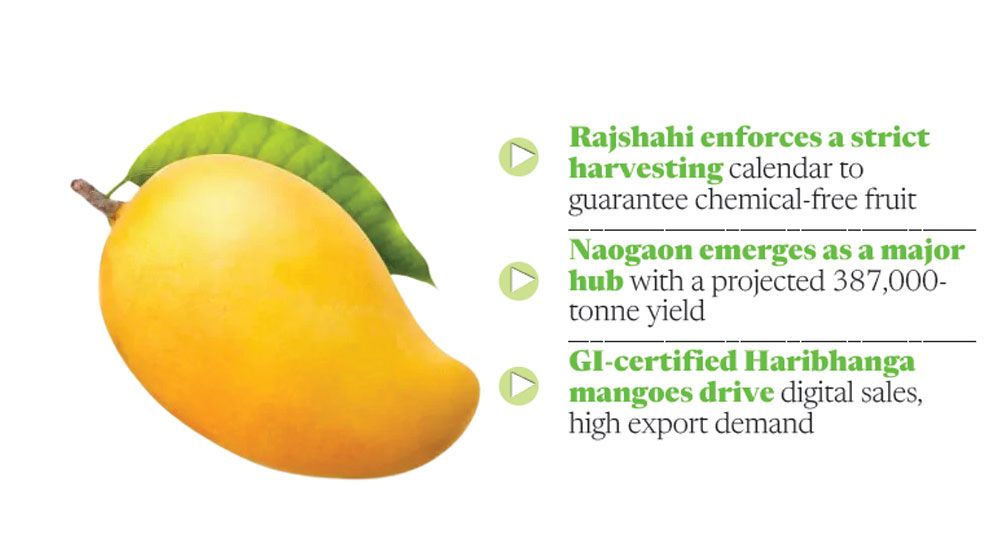
In Rajshahi, the traditional heartland of the trade, plucking has already begun for early varieties. To preserve the region’s reputation for chemical-free fruit, local authorities have reinstated a strict harvesting calendar.
Under the schedule, Gopalbhog mangoes can be picked from 22 May, followed by Laxmanbhog and Rani Prasad on 25 May, Himsagar on 30 May, and Langra on 10 June.
The Department of Agricultural Extension (DAE) in Rajshahi forecasts a yield of nearly 244,000 metric tonnes, valued at approximately Tk780 crore. While April's weather was highly favourable, growers worry about price stability once the market becomes saturated.
"The trees are heavy with fruit this year, and the weather has mostly been on our side," said Rafiqul Islam, a farmer from Bagha, adding, "If market prices remain fair, we will finally be able to recover from the losses of previous seasons."
Kazi Shahidul Islam, deputy commissioner of Rajshahi, emphasised that the timetable is critical for maintaining standards. "The harvesting schedule is not only about timing; it is about protecting consumers and preserving Rajshahi’s reputation for naturally ripened, chemical-free mangoes," he said.
Naogaon eyes historic output
Meanwhile, Naogaon is rapidly emerging as a heavyweight in northern mango production, targeting a historic harvest. Cultivation has expanded to around 30,000 hectares across Sapahar, Porsha, and Patnitala as growers find the fruit far more lucrative than traditional crops.
Habibur Rahman, a grower from Atrai, noted that while a single bigha requires an initial investment of Tk5,000 to Tk30,000, a successful season can yield profits between Tk100,000 and Tk125,000.
"This is why so many are shifting to mangoes," he added. The DAE expects Naogaon’s output to reach 387,000 metric tonnes, bringing in close to Tk400 crore.
Infrastructure gaps hit Rangpur
Further north in Rangpur, the spotlight is on the signature Haribhanga variety, which secured Geographical Indication (GI) status last year. The variety is expected to generate over Tk300 crore, aided by farmers leveraging digital platforms for direct-to-consumer sales.
However, Rangpur’s orchards have been hit hard by recent squalls."We lost nearly 10 maunds of mangoes from a single acre after a recent storm," said Salah Uddin, a farmer from Badarganj, expressing fears of further damage during the peak weeks.
The short shelf-life of the Haribhanga variety has also intensified calls for better post-harvest infrastructure. w Farmers complain that refrigerated transport and local storage facilities are severely lacking. Md Bakul, a grower from Padganj, pointed out that whilst international interest has soared since the GI recognition, infrastructure has failed to keep pace.
Another grower, Ajgar Ali, added that repeated appeals for transport and storage support have yielded little progress.