



 For all latest news, follow the Daily Sun's Google News channel.


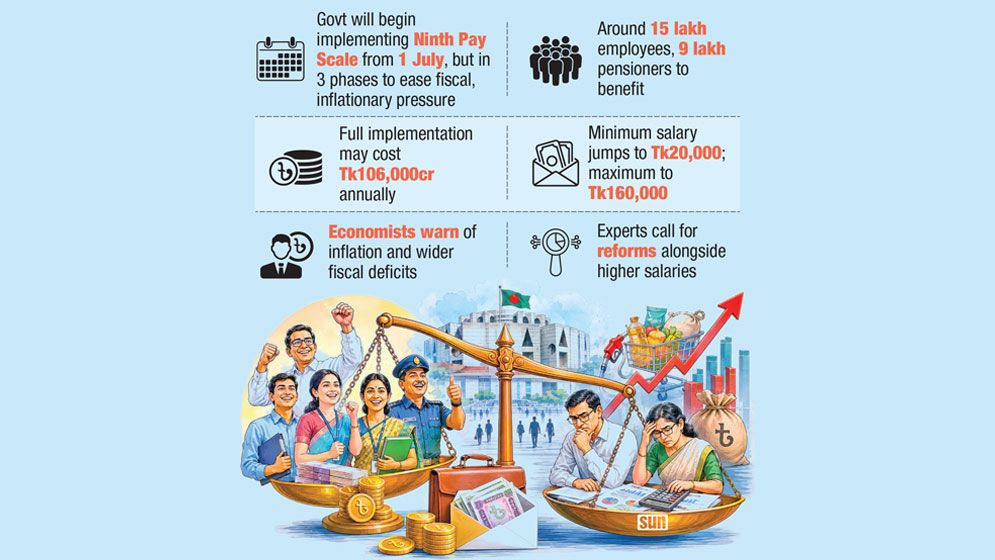
The government’s decision to begin implementing the Ninth National Pay Scale from 1 July has sparked renewed debate over how Bangladesh will finance one of the largest salary adjustments in its history amid persistent inflation, weak revenue growth and mounting fiscal pressure.
While the proposed increase has brought relief to nearly 1.5 million public employees and around 900,000 pensioners struggling with rising living costs, economists and former officials have cautioned that the move could deepen economic strain unless accompanied by credible financing measures and structural reforms.
According to finance ministry and Cabinet Division sources, the government has decided to implement the revised pay structure in phases over three fiscal years to reduce immediate pressure on the budget and inflation.
The phased implementation proposal, prepared by a committee led by Cabinet Secretary Nasimul Ghani, received policy-level approval from Prime Minister Tarique Rahman during recent budget meetings at the Secretariat.
Under the proposal, 50% of the revised basic salary will take effect from July 2026, while the remaining increase in basic pay will be introduced in the following fiscal year. Revised allowances and other benefits are expected to be fully implemented in the third phase during FY2028-29.
Finance and Planning Minister Amir Khosru Mahmud Chowdhury confirmed that implementation would begin in the next fiscal year.
“The new salary structure will be implemented from the beginning of the next fiscal year, meaning from 1 July. Work is underway to determine the best possible way to execute it,” he said.
Government estimates show the scale of the financial burden involved. Officials believe even partial implementation during the first year could require more than Tk30,000 crore in additional expenditure.
According to the pay commission, full implementation of the revised structure may require an additional Tk106,000 crore annually for salaries and allowances, alongside another Tk25,000 crore in pension liabilities.
At present, the government spends around Tk85,000 crore annually on salaries and benefits for public employees, while total expenditure for employees and pensioners combined exceeds Tk131,000 crore.
The proposed structure recommends increasing the minimum basic salary from Tk8,250 to Tk20,000 and the highest salary from Tk78,000 to Tk160,000. Overall salary increases would range between 100% and 140%.
The recommendations were prepared by a 23-member pay commission headed by former finance secretary Zakir Ahmed Khan, which submitted its report earlier this year.
The announcement comes at a delicate moment for the economy, with Bangladesh continuing to grapple with high inflation, pressure on foreign exchange reserves, sluggish private investment, rising debt servicing costs and slower revenue collection. Zahid Hossain, former lead economist of the World Bank, said the salary increase was understandable given the sharp rise in living costs, but warned that financing the package sustainably would be the government’s biggest challenge.
He said phased implementation appeared more realistic under current fiscal conditions, though failure to identify clear funding sources could widen the budget deficit and intensify inflationary pressure.
He also questioned whether such a large expansion in public expenditure aligned with the government’s broader fiscal adjustment efforts, including subsidy rationalisation, expenditure restraint and attempts to reduce dependence on foreign borrowing.
The concerns are particularly significant as Bangladesh’s tax-to-GDP ratio remains among the lowest in Asia, limiting the government’s ability to generate additional revenue without resorting to further borrowing.
The phased implementation strategy has also drawn mixed reactions from public employees. Some support a gradual rollout, arguing that current economic conditions do not permit full implementation in a single year. Others are demanding immediate execution through a formal gazette notification, fearing inflation could erode the real value of the salary increases before the full package comes into effect.
Critics of the phased approach have also warned that partial implementation may trigger market distortions if businesses raise prices in anticipation of increased public-sector purchasing power.
Economists say the debate surrounding the new pay scale has once again highlighted the need for broader institutional reforms alongside salary increases.
Selim Raihan, executive director of the South Asian Network on Economic Modeling, said higher salaries should be matched by stronger accountability, transparency and improvements in public service delivery to justify the added fiscal burden. At a recent pre-budget dialogue in Gulshan, the Citizen’s Platform for SDGs described the government’s pay scale plan as a “deceptive illusion”, warning that implementing such an expensive package amid high inflation and weak revenue growth could further destabilise the economy.
Debapriya Bhattacharya, distinguished fellow at the Centre for Policy Dialogue, said salary increases without structural reform and improved productivity could create long-term economic imbalances.
Speakers at the dialogue also questioned whether the government’s projected revenue target of Tk695,000 crore for FY27 would be achievable.
They warned that financing the new pay scale through borrowing, money creation or higher indirect taxes could intensify inflation and increase pressure on ordinary citizens.