



 For all latest news, follow the Daily Sun's Google News channel.


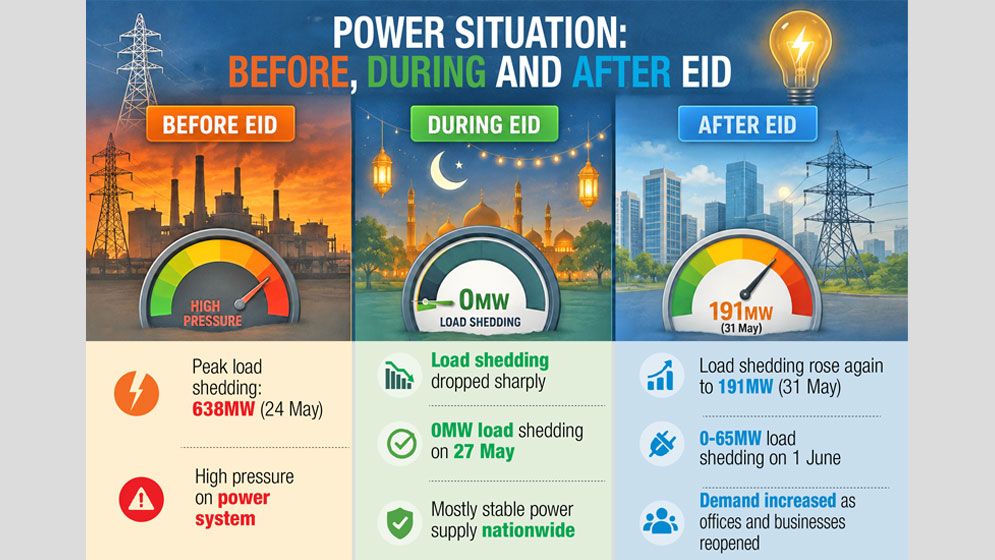
Power cuts are creeping back across the country as factories, offices and markets reopen following the
Eid-ul-Azha break – laying bare the gulf between official assurances of adequate supply and the daily reality faced by millions, especially in rural areas.
State Minister for Power, Energy and Mineral Resources Anindya Islam Amit struck a confident note while speaking to journalists in Jashore after Eid prayers, insisting the country had no electricity shortage and that planned load shedding was unnecessary.
"Any disruptions that occur are mainly due to storm-related damage to transmission and distribution lines," he said.
On paper, the holiday period bore that out – at least partially.
Power officials in Sylhet, Cumilla, Kishoreganj, Rajbari, Moulvibazar and Feni reported that demand was fully met during the break, with brief interruptions attributed to bad weather and routine maintenance. But conditions elsewhere told a different story.
In Munshiganj, residents endured repeated outages throughout the holiday. The district needs between 175 and 180 megawatts daily yet receives only 110 to 115 – a shortfall of nearly 60 megawatts.
In Bauphal, Patuakhali, residents went without electricity for four to five hours a day, with officials blaming storm damage to poles and transmission lines.
The worst situation emerged in Shyamnagar, Satkhira, where outages at the upazila headquarters stretched between five and eight hours daily, and some rural pockets went dark for up to 18 hours.
The prolonged blackouts sparked public protests during the holidays.
In Abhaynagar, Jashore, rural households reported cuts lasting 10-12 hours, with local officials conceding that supply constraints were forcing them to ration power.
Grid data from Power Grid Bangladesh PLC confirms the shifting picture. Before the holiday, load shedding peaked at 638 megawatts on 24 May. It eased sharply over the following days – dropping to 136 megawatts on 25 May, 29 megawatts on 26 May and zero on 27 May – as industrial and commercial demand fell. But pressure began building again as the break drew to a close, climbing to 67 megawatts on 30 May and surging to 191 megawatts on 31 May.
On the first working day after Eid, national electricity demand reached around 13,267 megawatts while generation stood at approximately 13,203 megawatts – a small but telling gap, according to the National Load Dispatch Centre.
Energy experts say the pattern reflects deep structural problems that generation figures alone cannot fix.
Shafiqul Alam, chief energy analyst at the Institute for Energy Economics and Financial Analysis, pointed to the need for a fundamentally different approach.
“Bangladesh has made significant investments in power generation capacity, but long-term energy security will require greater emphasis on renewable energy, particularly utility-scale solar power projects. Solar energy can help reduce dependence on imported fossil fuels, lower generation costs over time and strengthen supply reliability during peak demand periods," he said.
Shafiqul argued that Bangladesh is sitting on considerable untapped solar potential and urged faster deployment of solar parks, rooftop systems and battery storage to ease grid pressure and reduce costly fuel imports.
Transmission bottlenecks and ageing distribution infrastructure remain the immediate problem. Until those are addressed, rural consumers will continue bearing the heaviest burden every time demand rises.
Recommended Stories
Read More