


 For all latest news, follow the Daily Sun's Google News channel.


NPLs hit Tk5.89 lakh crore despite regulatory support
Classified loans surge by Tk31,487 crore in three months
Daily Sun Report, Dhaka
Published: 03 Jun 2026, 12:00 AM
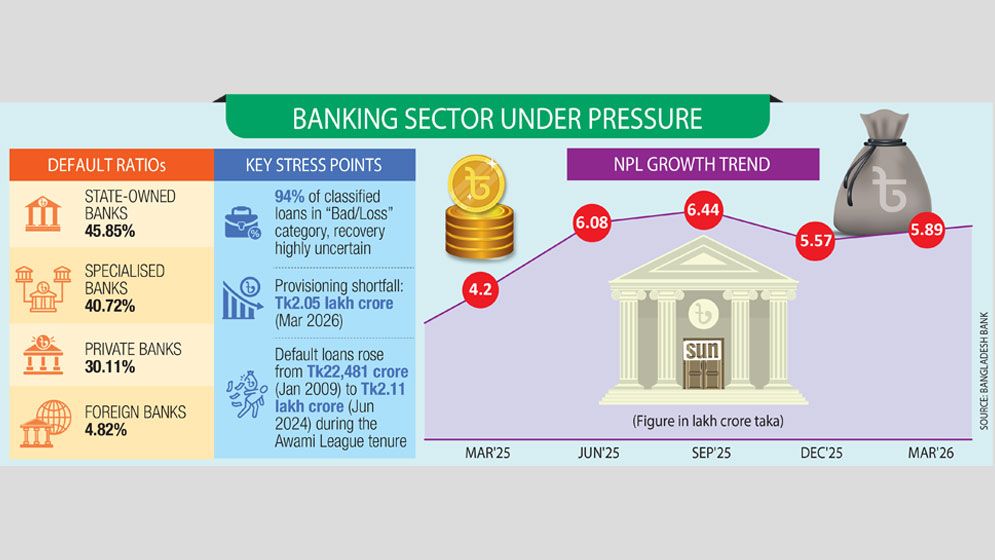
Despite repeated loan-rescheduling facilities, special waivers, and continuous regulatory support from Bangladesh Bank, non-performing loans (NPLs) in the country’s banking sector have continued to soar, reaching an unprecedented Tk5.89 lakh crore by the end of March 2026.
According to Bangladesh Bank data, classified loans increased by Tk31,487 crore in just three months, rising from Tk5.57 lakh crore in December 2025 to Tk5.89 lakh crore in March this year.
The latest figure means that 32.26% of all outstanding loans in the country’s banking sector are now classified, indicating that nearly one-third of all loans disbursed by banks have become distressed.
The total outstanding loans and advances across the country’s 61 scheduled banks stood at Tk18.25 lakh crore at the end of March.
The sharp increase came despite repeated policy interventions by the central bank, including relaxed repayment facilities, large-scale loan restructuring programmes, special rescheduling opportunities, and regulatory concessions aimed at containing the deterioration in asset quality across the banking sector.
Bangladesh Bank spokesperson Arief Hossain Khan told journalists that loan recovery had failed to meet expectations, while interest on existing classified loans continued to accumulate.
He said many borrowers who rescheduled loans under special policy support programmes are currently enjoying a two-year grace period, delaying immediate recovery efforts.
“The pace and volume of recovery will increase once the two-year period expires,” Khan said.
He also noted that many politically connected borrowers who restructured loans ahead of the 13th Parliamentary Election on 12 February made only a 2% down payment.
An alarming aspect of the report is the concentration of loans in the “Bad/Loss” category. Of the total classified loans, Tk5.51 lakh crore has been placed in this category, indicating that nearly 94% of problem loans are now considered highly difficult to recover.
Provision shortfall widens
Meanwhile, provisioning shortfalls across the banking sector widened further due to the mounting volume of bad loans.
Bangladesh Bank data showed that banks were required to maintain provisions worth Tk4.62 lakh crore against classified loans by March 2026. However, actual provisions stood at only Tk2.56 lakh crore, leaving a massive shortfall of Tk2.06 lakh crore.
The provisioning deficit increased by Tk14,224 crore within just three months, intensifying pressure on banks’ capital adequacy and financial stability.
State-owned banks post highest default rate
State-owned commercial banks remained the worst-performing segment of the banking sector, with classified loans amounting to Tk1.45 lakh crore against total loans of Tk3.27 lakh crore, resulting in a default rate of 45.85%.
Private commercial banks, however, carried the largest volume of toxic assets, with classified loans reaching Tk4.16 lakh crore out of total loans worth Tk13.83 lakh crore, representing 30.11% of their total loan portfolio.
Specialised banks recorded classified loans of Tk19,175 crore against total loans of Tk47,086 crore, resulting in a default ratio of 40.72%.
In contrast, foreign commercial banks maintained comparatively strong asset quality, with classified loans standing at Tk3,263 crore against total loans of Tk67,628 crore, keeping their NPL ratio at only 4.82%.
Weak governance, political interference blamed for soaring defaults
Bankers and economists said the deteriorating condition of the banking sector is the cumulative result of years of weak governance, political interference, poor credit assessment, financial irregularities, and large-scale loan fraud.
During the tenure of the previous Awami League government, default loans rose sharply. When the Awami League-led alliance assumed office in January 2009, default loans stood at Tk22,481 crore. Before the government left power in June 2024, the figure had climbed to Tk2.11 lakh crore.
Dr Mustafa K Mujeri, former chief economist of Bangladesh Bank, told the Daily Sun that serious discrepancies had existed in earlier calculations.
“Following the political transition and the formation of the interim government, the actual condition of the banking sector began to emerge more clearly. At the same time, many politically connected borrowers reportedly went out of public sight, further weakening recovery efforts,” he said.
He warned that the continued rise in default loans poses a serious threat to the broader economy, as banks burdened with mounting provisioning requirements and shrinking capital buffers are gradually losing their capacity to extend fresh credit to productive sectors.
He cautioned that reduced private-sector lending, higher borrowing costs, weaker bank profitability, and possible recapitalisation needs for state-owned banks could eventually place additional pressure on public finances and economic growth.