


 For all latest news, follow the Daily Sun's Google News channel.


Big borrowing plans loom
Experts flag severe policy conflict as excessive bank-reliance threatens business credit

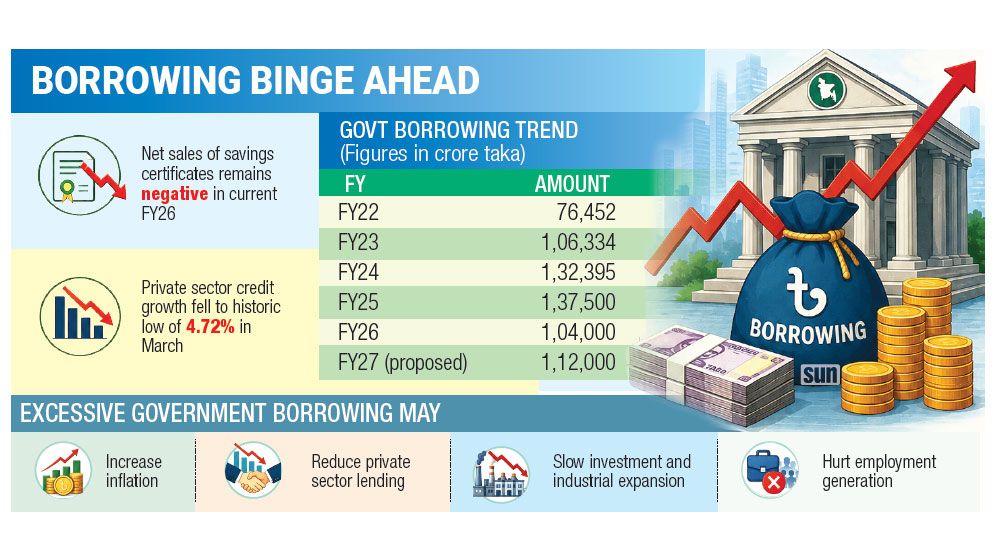
 The government is heading into the 2026-27 fiscal year (FY27) with a sharply expanded borrowing programme, raising fresh concerns among economists about inflation, private sector credit and the broader coherence of economic policy.
Draft budget documents obtained from the Finance Division indicate that the total outlay for FY27 could reach approximately Tk9.38 lakh crore – with nearly one-third of that figure expected to be financed through domestic and foreign borrowing. Total borrowing is projected at around Tk243,000 crore.
Of that sum, the government plans to raise roughly Tk116,000 crore through net foreign loans from development partners and bilateral creditors.
The remaining Tk127,000 crore would come from domestic sources – Tk112,000 crore from the banking system and Tk15,000 crore from savings certificates and other instruments.
The figures represent a notable step up from the current FY26 budget, which had originally targeted total borrowing of Tk226,000 crore, including Tk104,000 crore from banks.
However, Bangladesh Bank data show that within the first nine months of this fiscal year alone, the government had already drawn Tk108,985 crore from the banking system to meet rising expenditure – effectively exhausting the original bank-borrowing ceiling months before the year’s end.
In the revised FY26 budget, bank borrowing was subsequently adjusted upward to Tk118,000 crore.
A structural tension
Economists warn that the government’s growing reliance on bank financing carries two distinct but compounding risks.
Borrowing from commercial banks directly reduces the pool of credit available to businesses, while borrowing from the central bank – which finances a significant portion of government debt by printing money – stokes inflation. Overall inflation stood at 9.04% in April, according to the Bangladesh Bureau of Statistics.
Private sector credit growth, meanwhile, has fallen to a historic low. It dropped to just 4.72% in March, reflecting what analysts describe as weakening business confidence and mounting economic uncertainty.
Mustafa K Mujeri, former chief economist of Bangladesh Bank, said the government had little room to manoeuvre given the sluggish state of trade and commerce.
“The problem is that when the central bank prints money to finance government borrowing, inflation rises,” he said. “On the other hand, if commercial bank borrowing increases excessively, entrepreneurs fail to get loans, affecting employment.”
He called on the government to focus on reviving business activity, boosting investment and broadening the tax base.
Dr Zahid Hussain, former lead economist of World Bank’s Dhaka office, pointed to a specific market dynamic driving the shift away from private lending.
“When government securities offer 11-12% interest with almost no risk, banks become more interested in lending to the government rather than the private sector,” he said. He urged policymakers to weigh borrowing targets against their wider economic consequences.
Fahmida Khatun, executive director of the Centre for Policy Dialogue, offered perhaps the sharpest critique. Bangladesh’s combined domestic and foreign debt has already reached around 38% of GDP, she noted, and debt-servicing pressures are rising steadily.
She also flagged a deepening policy contradiction: “We are pursuing contractionary monetary policy to control high inflation, while at the same time formulating an expansionary budget. This creates a conflict between the two policies, and balancing them will be a major challenge for the government.”
Savings certificates in prolonged decline
Complicating the government’s financing picture further, net sales of national savings certificates have remained negative throughout the current fiscal year, despite a target of Tk12,500 crore in net mobilisation from that source.
The shortfall has continued a streak that now spans three consecutive fiscal years.
In FY25, the government had targeted Tk15,400 crore in net savings certificate borrowing; the year ended with negative net sales of Tk6,063 crore. The year before was worse still, with negative net investment of Tk21,124 crore against a revised target of Tk7,310 crore.
Dr Zahid Hussain attributed the persistent decline to a straightforward yield problem: interest rates on bank deposits and treasury bonds now exceed the returns offered by savings certificates, making them unattractive to investors.
He suggested raising the individual purchase ceiling from Tk50 lakh to as much as Tk1 crore and increasing profit rates as practical remedies.
_____________________________
The reporter can be reached at: [email protected]