


 For all latest news, follow the Daily Sun's Google News channel.


MAIDEN VENOM RESEARCH INITIATIVE
Lab trials show promise for Russell’s viper antivenom
►►VRC report submitted to health ministry for evaluation ►►Funding suspension continues amid stalled approval of development plan

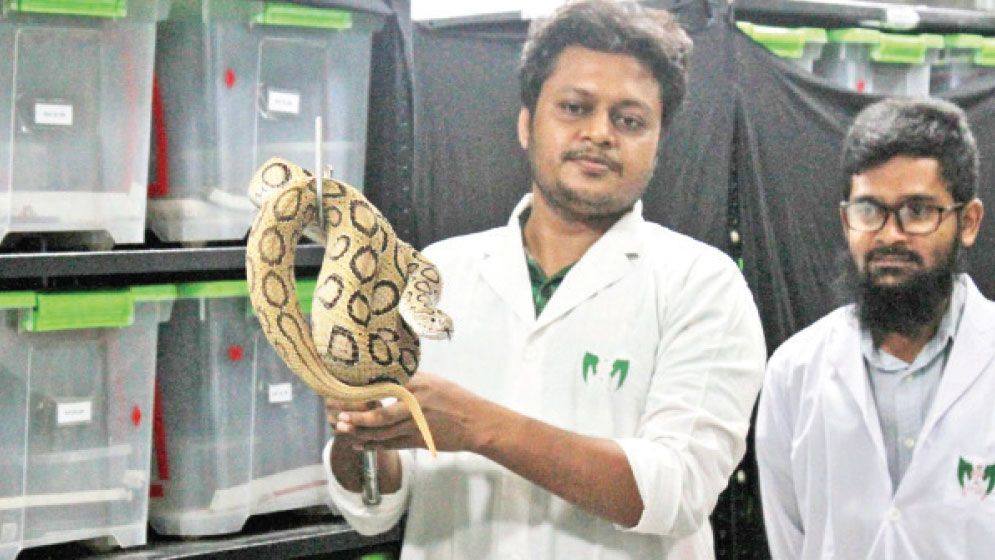
The country’s first research initiative on snake venom, aimed at developing antibodies against Russell’s viper venom, has shown promising results in laboratory trials, raising hopes for locally produced and effective antivenom for snakebite treatment.
However, researchers say several stages of evaluation are still required before the project can move to clinical trials and eventual commercial production.
Scientists at the Venom Research Centre (VRC) in Chattogram have already submitted their findings to the Ministry of Health and Family Welfare for review.
Principal investigator Professor Dr Aniruddha Ghose said the antibody developed in the laboratory showed effectiveness comparable to commercially available antivenom.
“We found that antibody development is possible in chickens, and it works as effectively as the antivenoms currently available in the market. The process we followed could serve as an effective method
for small-scale antibody production,” he said.
He added that the final report had been submitted to the ministry several months ago and is now awaiting assessment of the research methodology.
“We are yet to receive clearance regarding the research conducted under the Integrated Health Science and Research and Development Fund of the ministry,” he said.
Professor Aniruddha said funding for the VRC has remained suspended since August 2024, while a Detailed Project Proposal (DPP) is still awaiting approval from the Planning Ministry.
Although the project was initially expected to be completed by December 2024, progress has been delayed due to funding constraints following the political transition in August 2024.
The project also suffered setbacks after samples stored at the Animal Immunisation Laboratory of the Zoology Department at Chittagong University were damaged during a prolonged power outage caused by a cyclone in 2024.
A multidisciplinary research team involving Chattogram Medical College, Chittagong University, the Toxicology Society of Bangladesh and Goethe University in Germany has been working on antivenom development at the centre.
Established under the Directorate General of Health Services’ Non-Communicable Disease Control (NCDC) programme, the VRC began operations in 2018 at an unused building of Chattogram Medical College Hospital.
The centre operates under separate funding streams for routine research and antivenom development, focusing on venomous species native to Bangladesh.
Its long-term goal is to support the production of safe, effective, affordable and locally suitable antivenom on a pilot basis.
The initiative also covers research on cobra and krait venom alongside Russell’s viper.
Explaining the research process, VRC Research Associate Mizanur Rahman said venom was first injected into chickens and goats in laboratory settings at Chittagong University.
The antibodies produced were then processed and tested in further laboratory experiments involving rats.
He said the results indicate that antivenom development is now possible following proper standardisation of the antibodies.
However, he added that clinical trials, commercial production and further stages will require formal approval from the ministry.
According to the VRC, around 400,000 people are bitten by snakes and about 7,500 die from envenomation every year in Bangladesh.
Currently, the country relies on antivenom produced against the “big four” snake species of India, which is not always fully effective against local species due to regional variation in venom composition.
The World Health Organisation (WHO) has classified snakebite as a neglected tropical disease and has urged member states to take steps to reduce global deaths by 50 per cent by 2030.
Bangladesh is home to 94 species of terrestrial snakes, including 33 front-fanged venomous species, of which 12 are considered medically significant.
The VRC currently maintains more than 350 snakes, including around 60 Russell’s vipers and 20 green pit vipers.