


 For all latest news, follow the Daily Sun's Google News channel.


Despite being a major source of foreign exchange earnings, Bangladeshi expatriate workers continue to receive minimal attention in national budget allocations, raising concerns about the government’s commitment to their welfare.
While policymakers regularly cite remittances as a cornerstone of macroeconomic stability, critics argue that the people generating those earnings remain largely neglected in fiscal planning. The disparity has renewed questions about whether national policies adequately reflect the challenges and risks faced by overseas workers.
“The name of the ministry that deals with migrant workers is the Ministry of Expatriates’ Welfare, but you will find no welfare there. You  see how countries like the Philippines, India and Sri Lanka ensure the welfare of their expatriates. In Bangladesh, even the reintegration of returnee workers depends on donors or NGOs. It happens because expatriate workers live abroad and there is no one to raise their voice,” Shariful Hasan, associate director of BRAC Migration Programme and Youth Platform, told the Daily Sun.
A review of recent budgets for the Ministry of Expatriates’ Welfare and Overseas Employment shows that allocations have either been reduced from the previous fiscal year or significantly cut from the originally proposed amounts.
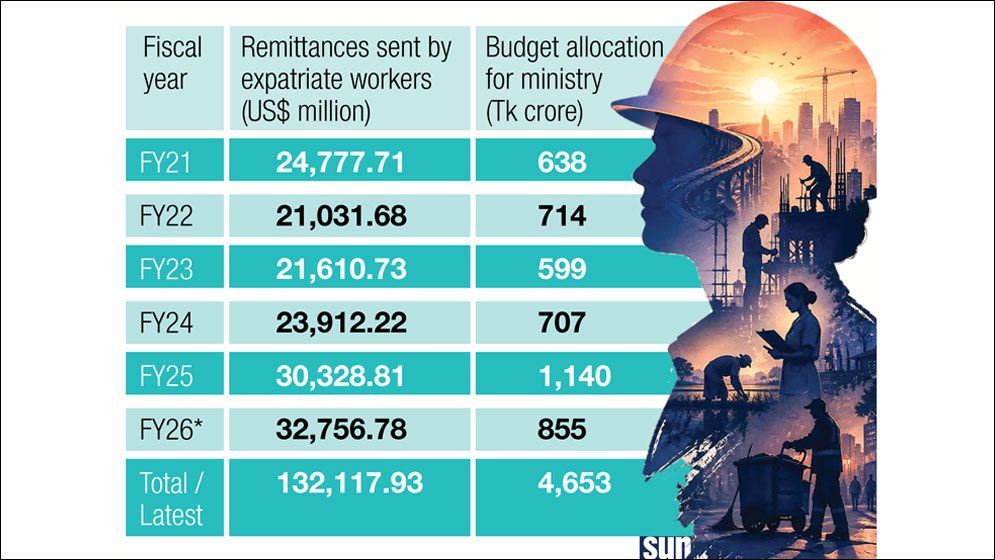
For the current fiscal year, the interim government allocated Tk855 crore to the ministry, a sharp decline from FY25, when the final allocation stood at Tk1,140 crore against a proposed Tk1,217 crore.
The previous four fiscal years saw gradual increases, largely in response to the COVID-19 pandemic.
In FY21, the final allocation was Tk638 crore against a proposed Tk662 crore. In FY22, the ministry received Tk714 crore, exceeding the proposed Tk702 crore. However, the government reduced the allocation to Tk599 crore in FY23. In FY24, although Tk1,018 crore was initially proposed, the final allocation was reduced to Tk707 crore. Similarly, in FY25, the proposed Tk1,217 crore was trimmed to Tk1,140 crore.
Critics note that even these allocations do not necessarily translate into direct welfare spending for expatriate workers, as many welfare programmes are financed through funds generated from fees paid by departing workers.
Shariful Hasan said, “Actually, remittance inflows are surging without any investment from the state. Workers’ money is spent for
workers’ welfare. Be it the money allocated for the families of deceased workers or the cars and salaries of labour wing officials, everything is spent from the workers’ welfare fund. Yet expatriate workers often say they do not get quality services from embassies. Those who give the most to the state receive nothing.”
The situation appears even more striking when viewed against the scale of expatriate workers’ contribution to the economy.
According to Bangladesh Bank data, remittance inflows reached US$24.78 billion in FY21, $21.03 billion in FY22, $21.61 billion in FY23, $23.91 billion in FY24 and $30.33 billion in FY25. During the current fiscal year, remittances had already reached a record $32.76 billion by May.
In total, Bangladeshi expatriates sent $132.12 billion in remittances over the past six fiscal years. During the same period, the government allocated approximately $382.3 million to the Ministry of Expatriates’ Welfare and Overseas Employment — equivalent to only about 0.3 per cent of the total remittances received.
Agriculture, ready-made garments (RMG) and labour migration are widely regarded as the three pillars of Bangladesh’s economy. However, while agriculture receives substantial budgetary support and RMG exporters enjoy various incentives, the Ministry of Expatriates’ Welfare and Overseas Employment consistently ranks among the lowest-funded ministries in the national budget.
Responding to questions about the ministry’s allocation, Debojit Singha, Joint Secretary (Administration and Finance Wing), said there were no funding concerns.
“We consider our budget is enough. We are not facing any problem. In case of necessity, when we ask for money, we get it,” he told the Daily Sun.
Mohammad Rashed Alam Bhuiyan, Associate Professor in the Department of Political Science at Dhaka University, believes the government should increase allocations to enable the ministry to serve expatriates more effectively.
“Expatriates feel most helpless when they face crises in destination countries. The government needs to expand the scope of work for embassies and high commissions. It has to ensure 24/7 services for them, including counselling facilities, legal assistance and healthcare support, while also increasing manpower for documentation and work order verification,” said Bhuiyan, who is also an Adjunct Research Fellow at the Refugee and Migratory Movements Research Unit (RMMRU).