



 For all latest news, follow the Daily Sun's Google News channel.


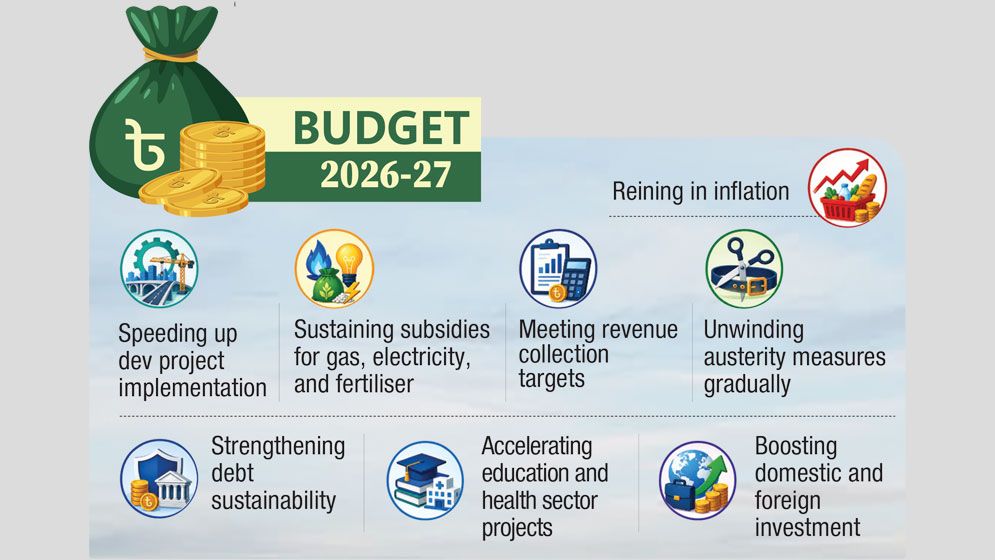
Economists have identified eight major challenges the government will need to navigate in implementing this budget.
The government is preparing to unveil the largest national budget in the country’s history, but economists warn that the numbers simply do not add up, and that ordinary people struggling with surging prices may see little relief. Recommended Stories
The BNP-led government under Prime Minister Tarique Rahman is set to present a budget of nearly Tk9.38 lakh crore for fiscal year 2026-27 (FY27) in parliament tomorrow. That represents a jump of roughly Tk1.48 lakh crore from the current year’s original allocation of Tk7.90 lakh crore.
Yet the government’s revenue target stands at only Tk6.95 lakh crore, leaving a deficit of nearly Tk2.43 lakh crore.
With revenue collection already falling well short of expectations, analysts say the government will have no choice but to lean heavily on domestic and foreign borrowing to plug the gap.
Inflation is currently running above 9%, and between 40 and 50 million low- and fixed-income Bangladeshis are feeling the strain. Prices of rice, lentils, edible oil, gas, and electricity have all climbed, leaving household budgets under severe pressure.
Dr Mustafa K Mujeri, former chief economist of Bangladesh Bank, raised the fundamental question hanging over the budget.
“The key question now is whether such large-scale spending is truly necessary under the current circumstances, because revenue collection cannot be increased overnight,” he told the Daily Sun.
He was equally blunt about the structural problem.
“Although the government is increasing the size of the budget, revenue sources are not expanding at the same pace. As a result, the economy is becoming increasingly dependent on loans. Additional pressure is also coming from higher operational expenses and increased salaries and allowances for government employees.”
Zahid Hossain, former lead economist at the World Bank’s Dhaka office, argued that the budget’s priorities need reordering entirely.
“Controlling inflation should be the principal goal of the upcoming budget to maintain macroeconomic stability. Most current government decisions are expenditure-driven. On one hand there is an energy crisis, while on the other there is uncertainty in agricultural production. Together, these factors are creating a dangerous combination of high inflation and low economic growth, pushing the economy toward stagnation and shrinking employment opportunities.”
He warned that financing must be secured before expenditure is scaled up. Without that discipline, he said, the burden of debt and interest payments could rise geometrically – raising the risk of future repayment failures.
Eight tests for a mega budget
Economists have identified eight major challenges the government will need to navigate in implementing this budget.
Taming inflation tops the list. It stood at 9.42% in May, and while the government is targeting 7.5% for the coming fiscal year, analysts consider that goal extremely ambitious given current market conditions.
Hitting the revenue target of Tk6.95 lakh crore is the second major hurdle. The shortfall in the first ten months of 2025-26 had already reached Tk1.04 lakh crore and is projected to touch Tk1.5 lakh crore by the financial year’s end.
A third challenge involves carefully unwinding austerity measures without unsettling economic stability – a difficult balancing act in an already fragile environment.
The fourth is managing escalating subsidy demands for gas, electricity, and fertiliser while preserving meaningful development spending under the Annual Development Programme.
Slow project implementation remains a fifth concern. Bureaucratic bottlenecks and structural weaknesses continue to inflate costs and drag down efficiency across infrastructure and social-sector schemes.
Education and health represent a sixth pressure point, with project implementation sluggish and approvals of foreign-funded schemes falling sharply.
Attracting investment is the seventh challenge. High interest rates, energy shortages, a volatile dollar, and policy uncertainty have dampened appetite among both domestic and foreign investors.
Finally, finding a coherent path through all seven of these pressures simultaneously – without allowing one fire to ignite another – may prove the most demanding test of all.
The reporter can be reached at [email protected]