


 For all latest news, follow the Daily Sun's Google News channel.


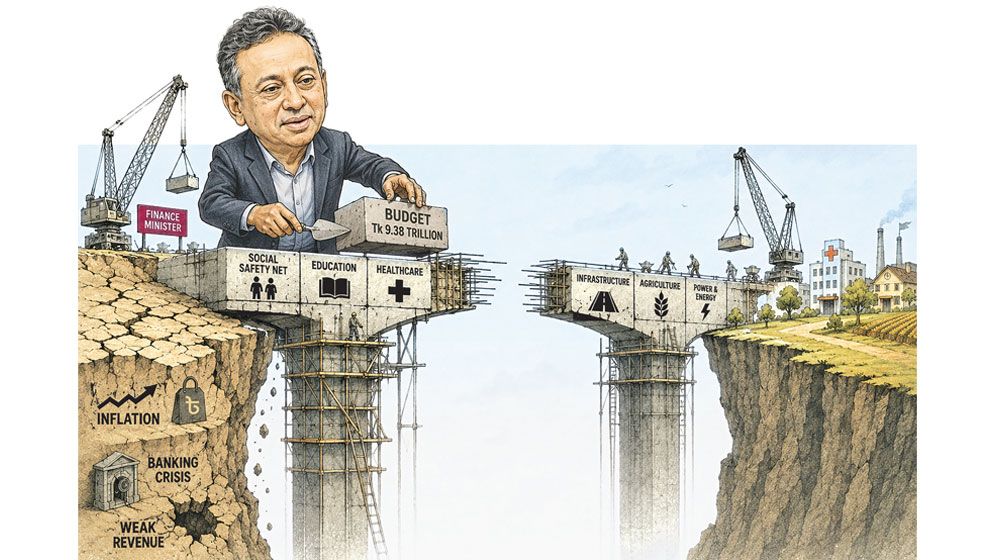
 When Finance and Planning Minister Amir Khosru Mahmud Chowdhury stands before the 13th Jatiya Sangsad today to present the fiscal year 2026-27 (FY27) national budget, the mood will be far from celebratory.
This is the first budget for the newly elected BNP-led government, which assumed office in February following a highly anticipated general election. Yet the celebratory mandate of the ballot box has collided head-on with a sobering economic reality.
Inheriting an economy frayed by years of structural distortions, a banking crisis, and external energy shocks, the new administration faces a highly delicate balancing act: fulfilling ambitious electoral pledges to expand the social safety net and revitalise public services, while implementing the fiscal discipline needed to rein in inflation and stabilise a volatile macroeconomic environment.
The resulting fiscal framework is unprecedentedly massive – a proposed budget of Tk9.38 trillion (Tk9.38 lakh crore), representing an increase of approximately Tk1.48 trillion over the previous year’s original outlay.
The administration’s underlying philosophy, as expressed by the finance minister, is that substantial investment is required to shock the economy out of its current stagnation – likening it to pouring water into a dry tube well to restore pressure.
Independent economists, however, are already raising red flags, questioning how a government operating with an exceptionally weak revenue base will finance such an expansion without worsening the country’s debt situation or stoking inflation.
Dr Zahid Hussain, former lead economist of the World Bank’s Dhaka office, told the Daily Sun that a culture has developed in Bangladesh where large budgets are announced on paper despite limited implementation capacity.
While the upcoming budget stands at Tk9.38 trillion, he said, the country is realistically in a position to implement no more than Tk7 trillion to Tk7.5 trillion given current economic realities.
The macroeconomic backdrop: A heritage of fragility
The new administration did not inherit an economy running on all cylinders. According to recent data from the Centre for Policy Dialogue (CPD) and the Bangladesh Bureau of Statistics (BBS), the country faces multiple, overlapping crises.
Foremost among these is inflation, which reached a 16-month high in May 2026. For nearly four years, ordinary citizens have seen their purchasing power systematically eroded. Nominal wages rose by an average of 8.21% in May, yet have consistently lagged behind the actual cost of living.
Basic commodities – from BR-28 rice to soybean oil – have seen double-digit price increases over the past year, turning the daily trip to the kitchen market into an exercise in financial survival for middle- and low-income households.
The financial sector is equally troubled. Non-performing loans (NPLs) in the banking system reached an alarming 32.26% at the end of March 2026, driven by currency depreciation, high interest rates, and entrenched governance failures.
Private sector credit growth has slowed to a historic low of 4.72%, starving businesses of the working capital needed to drive recovery.
The core dilemma: Ambitious outlays vs. missing revenue
The most contentious aspect of the FY27 budget is the disconnect between its targeted expenditure and its projected income.
To fund the Tk9.38 trillion fiscal blueprint, the government has set an overall revenue target of Tk6.95 trillion, with the NBR expected to collect Tk6.04 trillion.
To put this in perspective, the NBR would need to collect roughly Tk2 lakh crore more than its projected outturn for the current fiscal year – a target that senior finance officials privately admit is highly optimistic.
During the July-April period of the outgoing fiscal year, the NBR already suffered a shortfall of Tk1.04 trillion, with revenue growth of only 10.6% against a target of 34.5%.
Dr Zahid Hussain observed that instead of pursuing structural reforms in the revenue sector, there appears to be a growing tendency to place additional pressure on businesses – a course he regards as counterproductive.
To bridge the inevitable deficit, the government will rely heavily on domestic bank borrowing, projected at around Tk1.2 trillion.
Dr Zahid Hussain warned that this carries serious risk. “At a time when private-sector credit demand has already weakened, the government is offering attractive interest rates of around 11 to 12% through Treasury bills and bonds, making government securities a safe and profitable option for banks. The result is that a substantial portion of banking sector funds is absorbed by the state – the classic crowding-out effect – leaving private businesses starved of credit precisely when investment is most needed.”
He cautioned that when the government increasingly relies on bank borrowing to finance routine operational expenditure rather than boosting revenue collection, it risks falling into a long-term debt trap.
Honouring commitments: Social spending and electoral promises
Despite these revenue constraints, the political imperative to deliver on electoral pledges has driven sharp increases in social spending.
The government has prioritised its signature social assistance initiatives, expanding the Family Card programme to 4.1 million households at a fresh annual allocation of Tk127 billion.
A newly formulated Farmer Card programme has also been launched in a pilot phase, providing direct cash transfers to smallholders to offset the rising cost of agricultural inputs such as fertilisers and diesel.
Human capital has received a major boost.
Education sector expenditure is projected to rise to Tk1.36 trillion from Tk978 billion in the last fiscal cycle, while the healthcare budget is set to nearly double to Tk693 billion from Tk347 billion – moves designed to bring both sectors closer to 5% of GDP.
The challenge, however, lies not in allocating funds but in spending them effectively.
Both ministries have historically struggled with implementation, their development budgets repeatedly cut during mid-year revisions owing to structural underspending and slow procurement.
The annual development programme: A bold expansion
A key pillar of the government’s strategy against economic stagnation is a Tk3.0 trillion Annual Development Programme (ADP), approved by the National Economic Council (NEC) under the chairmanship of the prime minister – around 30% higher than the original outlay of the preceding year. Of the total, Tk1.90 trillion will come from internal state funds, with foreign loans and project grants bridging the remaining Tk1.10 trillion, focusing on transport infrastructure, communication networks, and the energy grid.
To prevent the leakages, delays, and cost overruns that have long plagued public infrastructure projects, the finance ministry has announced a comprehensive review of approximately 1,300 current projects, with plans to cancel unnecessary or corrupt initiatives.
Dr Zahid Hussain argued that substantial institutional reforms are needed to improve efficiency and reduce corruption, warning that simply announcing a larger budget will not solve the underlying economic challenges.
Navigating external shocks and the deferred LDC graduation
The domestic balancing act is further complicated by severe external pressures. Ongoing instability in the Middle East has disrupted liquefied natural gas (LNG) shipments from traditional suppliers such as Qatar and Oman, forcing Dhaka onto the volatile spot market at significantly inflated rates and driving the electricity and energy subsidy bill to an estimated US$3.5 billion.
Compounding this is the country’s critical Least Developed Country (LDC) transition.
While Bangladesh was originally scheduled to graduate in November 2026, a significant development occurred earlier this month when the UN Committee for Development Policy (CDP) backed Dhaka’s formal request for a three-year extension of the preparatory period – though the final duration remains subject to approval by the UN General Assembly through ECOSOC.
Should the extension be confirmed at 24 November 2029 as requested, it would offer the domestic economy a vital buffer.
The CDP, however, was explicit that any deferral must not be treated as a window for complacency, but rather as a strategic catalyst to accelerate long-delayed domestic reforms.
The extension grants particular breathing space to the ready-made garment (RMG) sector, which recently recorded a 3.41% decline in export earnings over an 11-month period.
The FY27 budget must lay down the fiscal foundation for this extended transition – utilising the next three years to phase out structural weaknesses, reduce advance income taxes on imported raw materials, and build a diversified industrial base capable of thriving once international support measures are eventually withdrawn.
Watchpoints for the parliament session
As the budget debate begins in the Jatiya Sangsad, policymakers and market observers will be watching several indicators closely.
The feasibility of the inflation target is a primary concern.
The government aims to bring inflation down to 7.5%, yet expanding the budget by Tk1.48 trillion naturally increases money in circulation – which can run directly counter to anti-inflationary goals.
Dr Zahid Hussain warned that if the government resorts to printing money to finance its borrowing needs, inflation could spiral further out of control, with ordinary citizens bearing the greatest burden.
Industrial production is already constrained by gas and energy shortages, he noted, preventing factories from operating at full capacity.
Additional liquidity under such conditions would not boost output but would instead drive up prices, raise interest rates, pressure the exchange rate, and create a three-pronged economic challenge that could push the economy into deeper difficulty.
A second focal point will be the investment climate.
Mostafa Azad Chowdhury Babu, former senior vice-president of the Federation of Bangladesh Chambers of Commerce and Industry (FBCCI), told the Daily Sun that attracting foreign direct investment and generating jobs requires more than tax incentives.
Investors need policy stability, lower borrowing costs, efficient services, and a predictable business environment, he argued.
Corporate tax rates and VAT should be made more competitive and aligned with neighbouring countries, particularly India; licensing procedures simplified through an effective one-stop service system; and the tax net widened rather than squeezing existing taxpayers harder.
Sustainable private investment, he said, will only materialise when businesses have confidence in long-term policies and access to affordable finance.
Outlook: Ambition meets realism
The FY27 budget represents a calculated gamble by the new administration.
By choosing an expansionary, investment-led model over an austere, contractionary framework, the government is betting it can stimulate GDP growth – targeting a rebound to 6.5% – and generate sufficient employment to offset the strains of a fragile economy. In public finance, however, execution is everything.
If revenue targets fall short and the government is forced to print money or drain liquidity from commercial banks, the strategy risks driving inflation higher and crowding out the private sector.
Whether the government has a practical plan to navigate these pressures – or whether the country faces a widening fiscal gap – will become clearer as the budget debate unfolds.
________________________________________________________
M Munir Hossain is a Deputy Editor of the Daily Sun. Email: [email protected]