



 For all latest news, follow the Daily Sun's Google News channel.


Budget for people, focused on growth
Says finance minister in post-budget press conference
Daily Sun Report, Dhaka
Published: 13 Jun 2026, 12:00 AM
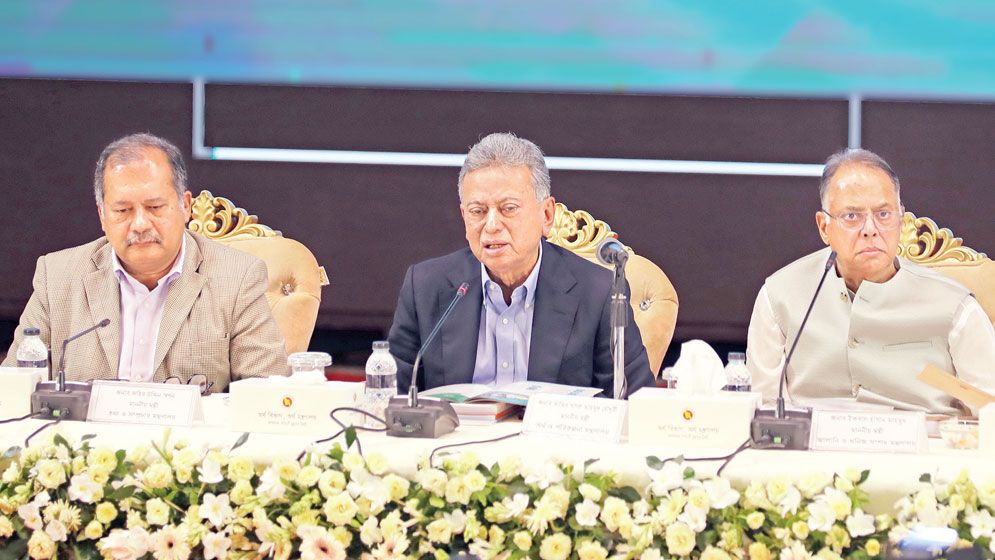
Finance Minister Amir Khosru Mahmud Chowdhury on Friday defended the proposed national budget for fiscal year 2026-27 (FY27) as a people-centred plan designed to lay the foundation for stronger, more inclusive economic growth, pledging that no segment of society has been excluded from its scope.
Speaking at a post-budget press conference at the Osmani Memorial Auditorium, Khosru said the Tk9.38 lakh crore budget reflects public aspirations after years of political and economic turbulence.
“No group, profession, religion or community has been left out,” he said.
The minister acknowledged the difficult conditions the administration had inherited – institutional weaknesses, inflationary pressure, fiscal constraints and heightened global uncertainty – but said the budget is firmly oriented towards stabilisation, recovery and long-term growth.
A central theme, he said, is “economic democratisation and deregulation”, a deliberate shift away from what he characterised as a patronage-driven system towards a more open, investment-friendly economy.
He said inflation control would rely less on administrative intervention and more on cutting the cost of doing business.
Lengthy approval processes, high borrowing costs, port delays and transport bottlenecks, he argued, are among the principal drivers of prices, and reforms are under way to address all of them.
The government plans to simplify regulations, expand digital services and improve port efficiency, with a dedicated task force to monitor deregulation and take strict action against violations.
A public grievance website will be introduced to ensure accountability, alongside a real-time project monitoring dashboard to track development spending.
On macroeconomic targets, the government has projected GDP growth of 6.5 % and inflation of 7.5% for FY27, while aiming to reduce bank borrowing gradually and expand alternative financing instruments, including Sukuk bonds.
Khosru said the budget prioritises job creation, skills development, social protection and human capital investment, with expanded allocations for health, education, entrepreneurship and welfare.
Targeted safety net schemes – including family cards, farmer cards and preventive healthcare programmes – are intended to improve living standards while building long-term resilience.
Public spending, he added, will be assessed against value for money, return on investment, job creation and environmental sustainability, ensuring every taka produces measurable outcomes.
He acknowledged persistent challenges: inflationary pressure, energy vulnerabilities, a weakened banking sector and external shocks from global conflicts and supply disruptions.
Geopolitical tensions in the Middle East, he noted, have pushed up import costs. Even so, he expressed confidence that the economy could be gradually stabilised within two years, describing the FY27 budget as the start of a broader reform process rather than a short-term fiscal fix.

Bangladesh Bank rejects interference claims over Islami Bank
At the same briefing, Bangladesh Bank Governor Md Mostaqur Rahman firmly rejected allegations that the government or the central bank had interfered in Islami Bank Bangladesh PLC, describing claims circulating on social media as “misinformation” with no factual basis.
“We have not instructed the bank regarding loan approvals, promotions, or transfers. Yet false claims of interference are being spread on social media,” he said, adding that depositors’ funds remain safe and can be withdrawn at any time.
He confirmed that Bangladesh Bank is prepared to provide emergency liquidity support if necessary to preserve depositor confidence.
Mostaqur noted that Islami Bank already had a board in place when the interim government assumed office.
One member was replaced on 16 March following allegations of irregularities, but beyond that, the central bank has not intervened in the bank’s operations.
He said a decision on returning deposits of customers of the merged Sammilito Islami Bank would be taken within one to two weeks, rejecting claims that the merged entity’s activities had been halted.
Integration of the core banking systems of the five merged Islamic banks remains a significant challenge, he added, though work is ongoing to resolve operational issues.
Mostaqur said Bangladesh’s banking sector continues to face deep structural problems, with nearly a third of funds previously siphoned off through irregularities. Five Islamic banks remain under stress, and some other banks face isolated difficulties.
He said solutions must come through structured financial mechanisms rather than direct injections from public revenue.
On asset recovery, he said a Stolen Asset Recovery Task Force has been formed, with support from around ten international organisations. Some assets have already been frozen abroad, and a joint investigation team is working continuously.
“Recovery of stolen assets is globally difficult and often takes five to ten years, but we will not stop trying,” he said.
He also announced that the Bangla QR payment system will become mandatory from next month, aiming to expand digital transactions and reduce reliance on cash.
Energy minister flags inherited power sector burden
Energy and Mineral Resources Minister Iqbal Hassan Mahmood said the government inherited a power sector burdened by capacity charge-based agreements, delayed maintenance of state-owned plants and heavy dependence on private generation – factors that have driven up financial liabilities and reduced operational flexibility.
Ongoing reforms and a gradual shift to renewable energy, he said, are expected to ease the pressure in the years ahead.