


 For all latest news, follow the Daily Sun's Google News channel.


PROPOSED BUDGET FY27
No tax relief raises doubts over new listings
Shakhawat Hossain Sumon, Dhaka
Published: 14 Jun 2026, 12:00 AM
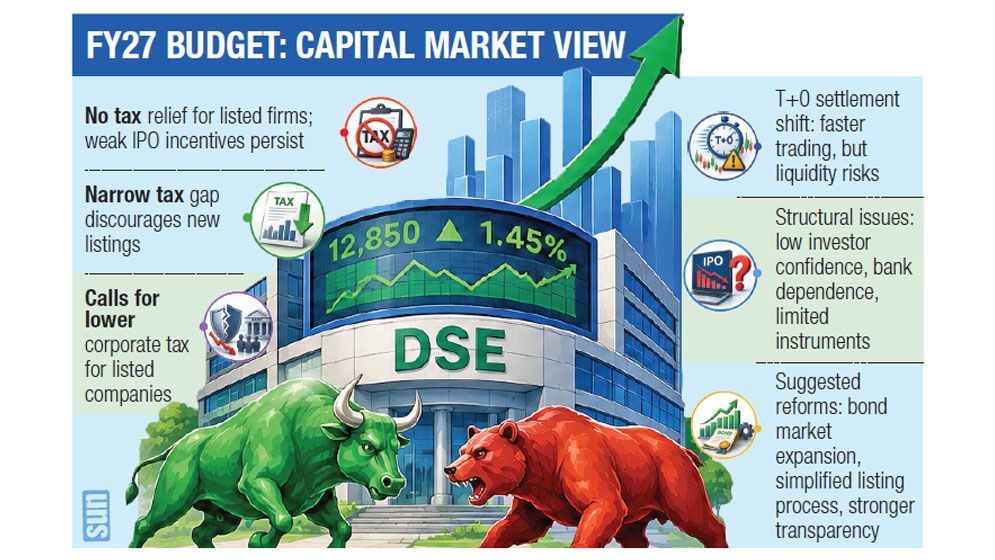
While the proposed budget for the fiscal 2026-27 prioritises governance reforms and investor confidence in the capital market, stakeholders say it lacks the tax incentives needed to attract new companies to the stock market.
According to market participants, the narrow gap between the corporate tax rates of listed and non-listed companies has discouraged new listings over the past two years.
They argue that governance reforms alone will not be sufficient to attract more companies to the market without attractive tax benefits.
Capital market analyst and Chairman of the Investment Corporation of Bangladesh (ICB), Abu Ahmed, told Daily Sun that the budget’s proposed initiatives could improve governance in the capital market if implemented properly.
However, he stressed the need for additional measures to stimulate new investment.
Among his recommendations are financial support for capital market institutions and direct tax incentives for newly listed companies through lower corporate tax rates than those applied to non-listed firms.
Commenting on the proposal to shorten the stock settlement cycle from T+2 to T+0, Abu Ahmed said the move carries both advantages and risks.
On the positive side, investors will be able to reinvest the proceeds from share sales on the same day, potentially increasing market turnover and liquidity.
Currently, investors must wait two days before they can withdraw or reinvest their funds.
However, he cautioned that investors with large amounts of capital who seek short-term gains could also withdraw funds more quickly after selling shares, creating potential liquidity pressures in the market.
He therefore emphasised the need for stronger regulatory oversight and market monitoring.
Anam Ataullah Nayeem, president of the Bangladesh Capital Market Investors’ Combined National Unity, said the proposed budget offers tax incentives for mobile operator companies if they become listed.
However, he questioned the effectiveness of the measure, noting that only a handful of such companies operate in the country.
Instead, he proposed allowing newly listed companies that offer at least 20% of their shares to the public to pay only half of the prevailing corporate tax rate. Such a policy, he argued, would encourage profitable and well-performing companies to seek listing.
Nayeem also welcomed the move toward a T+0 settlement cycle but stressed the importance of close monitoring to prevent speculative investors from entering the market, quickly realising profits and withdrawing funds in a way that could create liquidity shortages.
He further noted that the government’s initiatives to develop the bond market would contribute positively to the overall growth of the capital market.
While welcoming the proposed FY27 budget, the DSE Brokers Association of Bangladesh (DBA) highlighted several long-standing structural weaknesses in the country’s capital market.
DBA President Saiful Islam said Bangladesh’s capital market has long suffered from a lack of investor confidence, a limited range of investment products and excessive dependence on bank-based financing.
As a result, the market has been unable to play its expected role in supporting economic growth and industrialisation.
He said the budget’s plans to restore investor confidence, strengthen governance, improve transparency and enhance accountability could help rebuild trust among investors.
Measures aimed at strengthening the regulatory framework and protecting investors’ interests would also have a positive impact on market development.
Saiful Islam further noted that the country’s financial sector remains heavily dependent on banks, limiting the capital market’s role as an alternative source of financing.
He believes the budget’s policy decisions to promote equity-based financing and expand the bond market could help address this imbalance.
He also described the initiative to review and simplify the listing process for qualified and promising companies as timely.
Likewise, efforts to make disclosure and reporting requirements more transparent, practical and business-friendly would support the long-term development of the capital market.
Currently, 383 companies are listed on the country’s stock exchanges, including 103 Shariah-compliant firms.