



 For all latest news, follow the Daily Sun's Google News channel.


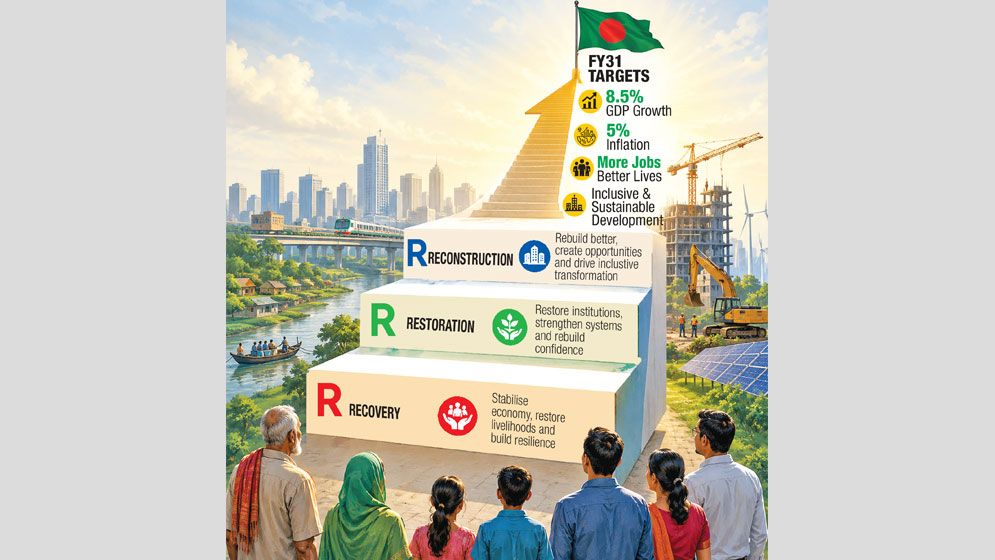
The government has unveiled a three-tier “3R” master plan – recovery and stabilisation, restoration, and reconstruction for acceleration – aimed at steering Bangladesh’s economy out of its current crisis and onto a path of sustainable, high growth, amid structural weaknesses, financial sector instability, stagnant investment and mounting global pressures.
The framework sets out short, medium and long-term measures to overcome the crisis, rebuild key sectors, and usher in accelerated growth.
Under the strategy, the government aims to lift real GDP growth to 8.5%, bring inflation down to 5%, raise foreign direct investment to 2.7% of GDP, and increase total investment to 40% of GDP by FY31.
According to the proposed FY27 budget presented by Finance Minister Amir Khosru Mahmud Chowdhury, the first phase – recovery and stabilisation – is to be implemented within a year, focusing on restoring macroeconomic stability while protecting vulnerable groups from immediate economic shocks.
Priorities include strengthening social protection, improving public service delivery, simplifying business procedures, and enhancing coordination across institutions.
The second phase, economic restoration, will run over the medium term – one to three years, under the current government’s tenure – and concentrate on strengthening the foundations of sustainable growth.
Priority actions include revenue system reforms, greater domestic resource mobilisation, reviving private investment, strengthening the banking and financial sectors, export diversification, enhancing human capital, and continued investment in agriculture, energy and infrastructure.
The third phase, reconstruction for acceleration, spans five years, transforming Bangladesh into a modern, innovative, technology-driven economy through a skilled workforce, innovation, digital transformation, stronger institutions, deeper global integration, energy security and climate-resilient, inclusive growth. In his budget speech, the finance minister said the 3R strategy placed the highest priority on improving the investment climate and restoring confidence in the private sector.
“To identify and address the key constraints facing businesses through legal, regulatory and institutional reforms, thereby reducing business uncertainty and the cost of doing business while ensuring investment security through an improved ease-of-doing-business environment,” he said.
The government is confident these measures will stimulate investment, revitalise industrial production and strengthen the foundations for sustainable medium-term growth.
Restoring discipline in the banking and financial sectors, and rebuilding public confidence in them, is a key medium-term priority for sustaining recovery and investment flows.
Measures under way include reducing non-performing loans, enhancing transparency in loan approval and rescheduling, and strengthening accountability in bank management.
A risk-based supervisory framework will be introduced to restore the soundness of weak banks, alongside recapitalisation and management reform where necessary.
Economists say the plan is ambitious but its success hinges on effective implementation of the first phase, warning that failure to address initial challenges could jeopardise later objectives. They stress this will require consistent policy implementation, stronger institutions, banking reforms, improved investment governance and sustained macroeconomic stability.
Dr Mustafa K Mujeri, former chief economist of Bangladesh Bank, told Daily Sun, “Considering the country’s current economic situation, the government’s three-tier economic recovery plan is both timely and highly positive. I believe that, if implemented properly, it can play a significant and powerful role in revitalising an economy currently facing multiple challenges.”
He added that the main challenge lay in executing the first phase successfully. “We need to closely monitor how the government addresses the immediate crises and ensures a successful transition through this stage.
The effectiveness of the subsequent phases and the future of the overall strategy will depend largely on the success of this initial phase,” he said.
Dr Mustafizur Rahman, distinguished fellow at the Centre for Policy Dialogue (CPD), said the budget contained several investment-boosting measures, citing tax and duty incentives for import-substituting and export-oriented industries, expanded bonded warehouse facilities, incentives for economic zones and industrial parks, and support for renewable energy and electric vehicles.
“Although these measures may result in some revenue concessions in the short term, they are expected to have a positive long-term impact by creating employment opportunities, accelerating industrialisation, and increasing private-sector investment,” he said.