


 For all latest news, follow the Daily Sun's Google News channel.


Mega plan to add 10,450MW solar, wind power by 2030
The draft strategy seeks to generate 20% of Bangladesh’s annual electricity demand from renewable sources by 2030

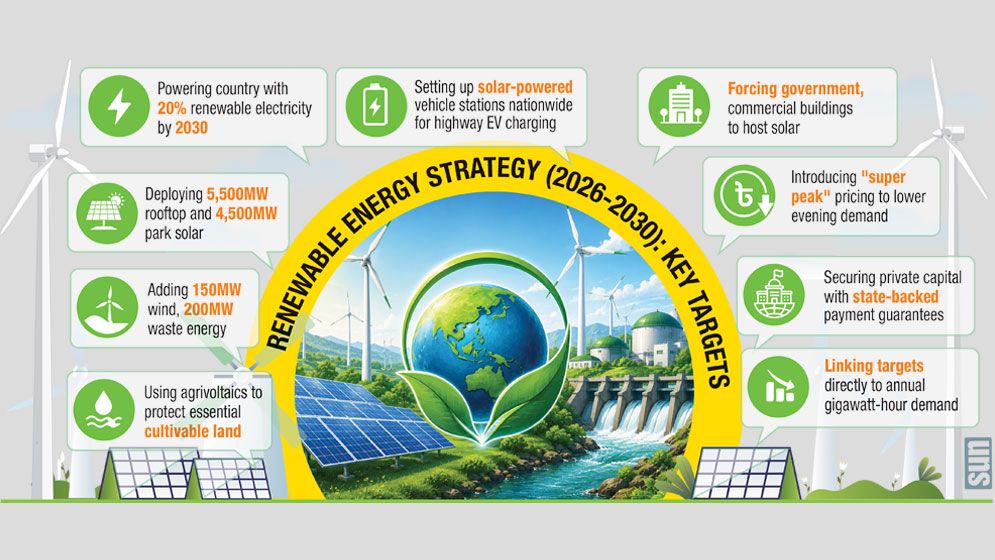
The government is poised to approve the country’s most ambitious renewable energy roadmap to date, ditching years of policy fragmentation for a comprehensive five-year strategy to transform the country’s electricity sector.
The National Renewable Energy Development Strategy (2026-2030) is scheduled to be finalised at a high-level Power Division meeting tomorrow following stakeholder consultations, according to an official notice seen by the Daily Sun.
If endorsed, the strategy will become the government’s principal policy framework for clean energy, introducing a year-by-year implementation roadmap to replace the vague capacity targets of the past.
The draft strategy seeks to generate 20% of Bangladesh’s annual electricity demand from renewable sources by 2030 – an objective officials describe as essential to lower exposure to volatile global markets, curb rising fuel import costs and meet international climate commitments.
The urgency of diversifying the energy mix is stark. According to the draft, Bangladesh’s installed generation capacity stands at around 29,000MW, while peak summer demand has already breached 18,000MW.
Clean energy accounts for roughly 2,000MW of installed capacity across grid-connected and off-grid systems, but its actual contribution to overall electricity generation remains negligible.
With national demand projected to grow at 6% annually, reaching up to 25,000MW by 2030, the government plans to aggressively add about 10,450MW of new renewable capacity over the next five years.
The proposed programme envisages 5,500MW from rooftop solar and 4,500MW from utility-scale solar parks, alongside 150MW of wind power, 200MW from waste-to-energy projects, and 100MW from other technologies.
Implementation will begin gradually across 2026 and 2027, focusing on policy reforms, land identification, competitive bidding and grid preparedness. The rollout will accelerate from 2028 through private investment, public-private partnerships, merchant power projects and rooftop Renewable Energy Service Company (RESCO) models.
To overcome Bangladesh’s acute land constraints, the strategy promotes agrivoltaics – allowing agricultural, fishery and livestock production to coexist with solar arrays to save cultivable land.
It also outlines mandatory rooftop solar installations on government buildings, stricter building regulations for commercial and residential developments to allocate roof space, and enhanced net-metering incentives.
Beyond solar, the draft introduces frameworks for onshore and offshore wind, electric vehicle (EV) charging infrastructure, and nationwide energy efficiency initiatives, including solar-powered EV stations along highways, expanded energy audits, revised office hours to maximise daylight, and “super peak” electricity pricing to flatten evening demand.
Energy analysts have welcomed the shift towards structural clarity.
Shafiqul Alam, lead energy analyst at the Institute for Energy Economics and Financial Analysis, told the Daily Sun that the strategy replaces earlier ambiguities with a realistic framework.
“Previous policies created uncertainty over whether renewable targets referred to as percentage of installed capacity or peak demand,” he said.
“The new strategy instead links the target to annual electricity demand measured in gigawatt-hours and provides a technology-wise implementation roadmap showing how different renewable sources will contribute over time.”
Shafiqul praised the integration of supply expansion with demand-side management, adding, “The implementation roadmap is much clearer than before. However, achieving the targets will ultimately depend on whether sufficient investment can be mobilised and projects are implemented on schedule.”
Alam also welcomed proposals for government payment guarantees on selected utility-scale projects, noting they address lingering investor jitters following recent project agreement revisions.
Industry leaders echoed the optimism but warned against familiar bureaucratic bottlenecks.
Mostafa Al Mahmud, president of the Bangladesh Sustainable and Renewable Energy Association, told the Daily Sun that the draft proves policymakers now grasp the urgency of the green transition.
“The government’s overall approach is highly positive and reflects many of the issues the industry has raised over the years,” Mahmud said, noting that investors will welcome commitments to facilitate public-private partnerships and green bonds.
However, he cautioned that land availability, grid connectivity and slow investment procedures remain critical hurdles.
Mahmud also flagged that recent fiscal measures on battery imports could hamper ordinary consumers from adopting rooftop solar unless addressed in the final text.
“If the implementation roadmap is executed effectively and investment flows as planned, the country could make substantial progress towards building a cleaner, more secure and more diversified energy system over the next several years,” Mahmud added.
The reporter can be reached at: [email protected]