


 For all latest news, follow the Daily Sun's Google News channel.


BB keeps export cash incentives unchanged for FY27
43 export products to continue receiving cash incentives
Daily Sun Report, Dhaka
Published: 06 Jul 2026, 12:00 AM
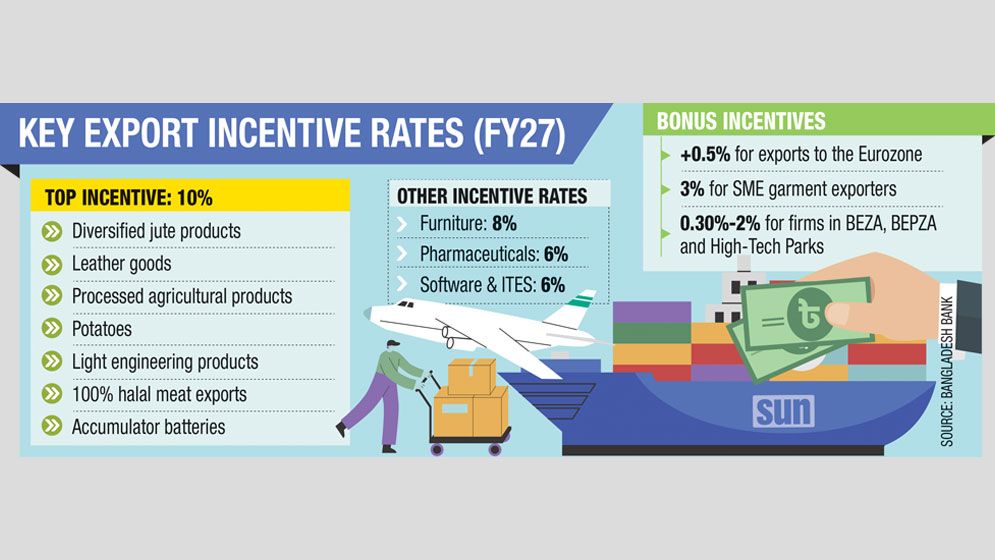
The Bangladesh Bank has kept export cash incentive rates unchanged for the 2026-27 fiscal year, extending existing support for 43 export products.
The move aims to safeguard the nation’s export competitiveness amid global demand uncertainty and rising production costs, while balancing the need for a gradual phase-out of direct subsidies ahead of Bangladesh’s graduation from Least Developed Country (LDC) status.
According to a central bank circular issued on Sunday, the export cash incentive programme will remain in effect from 1 July 2026, to 30 June 2027.
Item-wise incentive rates, ranging from 0.30% to 10%, have been retained at the same level as in FY26, signalling policy continuity amid global demand uncertainty and rising production costs.
The incentives will be available against export proceeds realised within the prescribed timeframe, subject to compliance with existing foreign exchange regulations and documentation requirements.
Bangladesh Bank said all existing conditions, eligibility criteria and operational procedures for disbursing export incentives would remain unchanged. Authorised Dealer (AD) banks have been instructed to examine applications, verify supporting documents and process payments in accordance with the prevailing guidelines.
The continuation of the existing incentive structure is expected to provide greater predictability for exporters, support export diversification and sustain momentum in non-traditional sectors without imposing additional fiscal pressure.
The highest incentive rate of 10% will continue for diversified jute products, leather goods, processed agricultural products, potatoes, light engineering products, 100% halal meat and accumulator batteries under HS Codes 8507.10 and 8507.20.
Exports of software and IT-enabled services (ITES) will remain eligible for a 6% cash incentive, while individual freelancers in these sectors will continue to receive 2.5%.
The local textile industry will continue to receive 1.5% alternative cash assistance in lieu of duty drawback or bonded warehouse facilities.
Exporters shipping products to the Eurozone will receive an additional 0.5% incentive, while small and medium-sized enterprises (SMEs) in the ready-made garment (RMG) sector will continue to receive 3%.
Pharmaceutical products, motorcycles, photovoltaic modules and ceramic products will receive 6% cash assistance.
Bicycle and cement exports will continue to receive 3%, while tea exports will remain eligible for 2% support.
The policy also covers enterprises operating in the Bangladesh Economic Zones Authority (BEZA), Bangladesh Export Processing Zones Authority (BEPZA) and High-Tech Park Authority. Depending on the category of goods and industry, these enterprises will receive incentives ranging from 0.30% to 2%.
In the leather sector, exporters of leather goods will continue to receive 10% cash assistance, while handicrafts – including products made from hogla, straw and coconut fibre – will remain eligible for 6%.
Several other emerging and traditional export sectors will also continue to benefit from the existing incentive structure.
Furniture exports will receive 8%, galvanised sheets and coils (zinc-coated, aluminium-zinc coated and colour-coated) 6%, and light engineering products 10%.
Incentives ranging from 1.5% to 8% will also remain available for frozen shrimp, electronics, plastic products, ship exports and various animal by-products.
The government reduced export cash incentives twice in 2024 as part of efforts to align the country’s subsidy regime with World Trade Organisation (WTO) requirements.
Under WTO rules, countries graduating from LDC to developing-country status are required to gradually phase out direct export subsidies.
Bangladesh, which is preparing for LDC graduation, is expected to progressively reduce such incentives over the coming years.
By maintaining the existing incentive rates for another fiscal year, Bangladesh Bank has opted for policy stability while giving exporters additional time to adjust before the country’s post-LDC trade support framework comes into effect.