


 For all latest news, follow the Daily Sun's Google News channel.


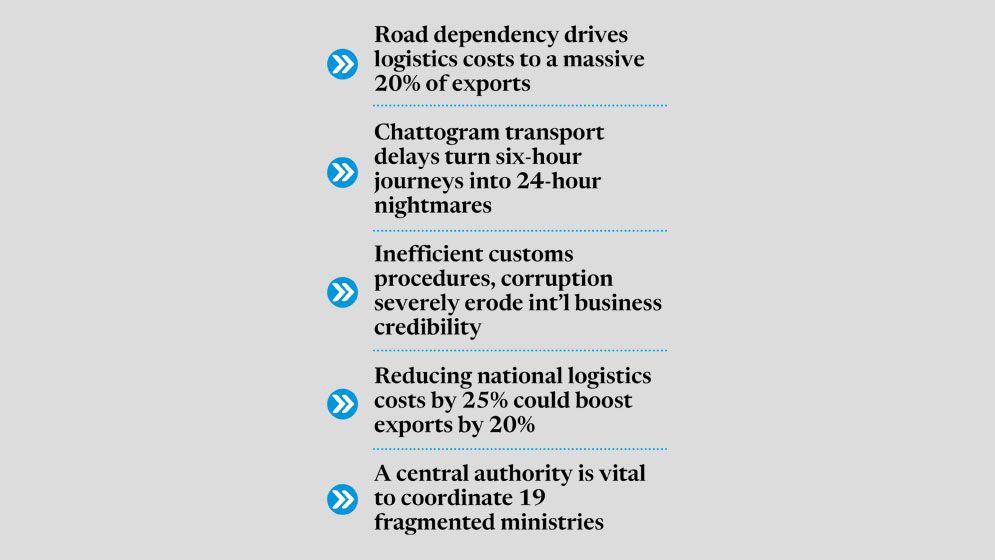
A standard shipment of export goods travelling from Dhaka to Chattogram port – a journey of roughly 265 kilometres – should, by any reasonable metric, take five to six hours. In reality, that journey frequently stretches into a gruelling 12 to 24-hour ordeal.
This chronic inefficiency is far from a minor inconvenience; it is a systemic failure that is driving up transport and demurrage costs, eroding profit margins, and severely undermining Bangladesh’s export competitiveness on the global stage.
Logistics experts and business leaders warn that Bangladesh currently grapples with some of the highest logistics costs globally.
A cocktail of persistent traffic congestion, port inefficiencies, labyrinthine customs procedures, corruption, and inadequate infrastructure has created a supply chain that leaves local manufacturers struggling to compete with regional rivals like India and Vietnam.
As the nation prepares for its eventual graduation from Least Developed Country (LDC) status, the pressure to modernise is mounting. Economists suggest the stakes are existential: reducing logistics costs by 25% could potentially boost exports by 20%, while even a 1% reduction in freight transport costs could yield a 7.4% rise in export volumes.
The human and economic cost
For exporters, these inefficiencies are not just abstract statistics; they are a direct hit to the bottom line.
Shehab Udduza Chowdhury, managing director of Amity Design Ltd and Vice President of the Bangladesh Garment Manufacturers and Exporters Association (BGMEA), points to the Dhaka–Chattogram corridor as the primary pain point.
“A truck that should complete the journey in five hours often takes 12 to 24 hours,” Shehab explains, “Persistent traffic bottlenecks at various points force truck rental costs up from Tk20,000 to as much as Tk40,000.”
The problems do not end at the port gates.
“Even when trucks arrive on time, they often face long queues,” he says, noting that mismanagement by port authorities, customs, and the roads department, compounded by extortion, has left the sector in a state of instability.
“Because international product prices are often fixed in advance, businesses must absorb these extra costs. This erodes margins, pushes up bank liabilities, and increases non-performing loans – it has a corrosive effect on the entire economy.”
Shehab also notes a stark contrast in customs efficiency, “It takes five to seven days for goods to arrive in Bangladesh from China, yet it often takes the same amount of time just to clear them from our ports. Imported raw materials under bonded warehouse facilities are frequently stuck for days due to unnecessary HS code verification, where businesses face delays and, too often, demands for unofficial payments.”
Lagging behind regional peers
Data from the World Bank paints a bleak picture of the country’s standing. In the 2023 Logistics Performance Index (LPI), Bangladesh ranked 88th out of 139 countries, trailing significantly behind India (38th) and Vietnam (43rd).
The Container Port Performance Index (CPPI) 2023 further highlights this, placing Chattogram Port at 334, while India’s Mundra port sits at 27th and Vietnam’s Haiphong at 70th.
Nurul Amin, former vice president of the Bangladesh Freight Forwarders Association (BAFFA), points out that the nation’s infrastructure allows for average truck speeds of less than 20 kilometres per hour.
“Nearly all exports are conducted on an FOB basis,” Amin notes. “Local exporters must personally absorb the high costs of transport and port congestion, which directly diminishes their global standing.”
The road-dependency trap
A fundamental issue is the over-reliance on road transport, which handles over 80% of freight despite being the most expensive and least efficient mode. Rail accounts for a mere 4%, pushing logistics costs to nearly 20% of total export expenses – one of the highest rates in Asia.
Dr M Masrur Reaz, chairman of Policy Exchange of Bangladesh, argues that the lack of integration is a critical oversight. “If we could raise the average speed of freight to 40km an hour, we could lift exports by 3.7%,” he suggests. “If congestion were eliminated, the costs borne by truck operators would be 35.5% lower, and in-transit inventory carrying costs would fall by 84%.”
Experts urge structural reform
Experts are unanimous: the path forward requires a shift from fragmented, road-centric planning to an integrated, multimodal transport system.
“Infrastructure development has largely focused on passenger transport, while freight – which is far more complex and vital to the economy – has been neglected,” says Md Shamsul Hoque, a professor of Civil Engineering at BUET.
Abul Kashem Khan, chairperson of Business Initiative Leading Development (BUILD), advocates for a massive expansion of the Dhaka-Chattogram highway to eight or ten lanes, complemented by a dedicated rail freight corridor.
He also notes that while the National Logistics Policy (NLP) 2025 has been approved, the real challenge is implementation. Currently, the sector is scattered across 19 different ministries, leading to a paralysis of coordination.
“We need a central National Logistics Authority to oversee planning, implementation, and monitoring from a single platform,” Khan says. He estimates that to modernise infrastructure, the country requires an annual investment of $18–$20 billion, representing a significant opportunity for both domestic private capital and foreign direct investment.
Looking Ahead
The government appears to be acknowledging the urgency of the situation.
Finance Minister Amir Khosru Mahmud Chowdhury recently unveiled plans to transform Chattogram into a national and regional logistics hub.
The roadmap includes constructing new seaports, establishing a free trade zone on the banks of the Karnaphuli River, and expanding the Shah Amanat International Airport.
However, as Dr Mohammad Abdur Razzaque, chairman of the Research and Policy Integration for Development (RAPID), warns that time is of the essence.
“In today’s market, ‘time to market’ is everything. If our logistics system remains inefficient, our credibility will suffer. Buyers will simply perceive the supply chain risk as too high and take their business elsewhere.”
(This report is the first instalment of a three-part series on the logistics sector in Bangladesh.)