


 For all latest news, follow the Daily Sun's Google News channel.


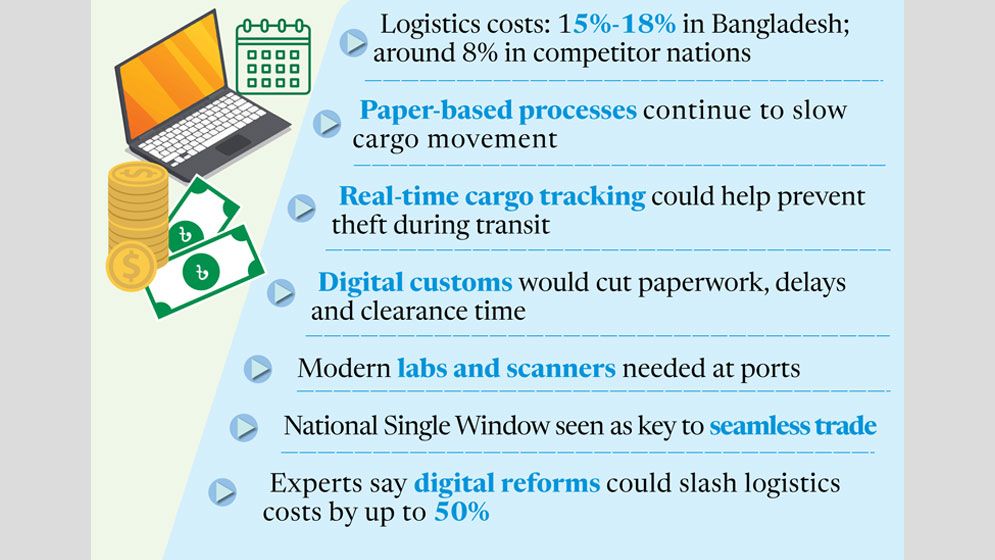
Bangladesh could slash logistics costs, accelerate exports and strengthen its global trade competitiveness by fast-tracking digitalisation across its supply chain, business leaders and trade experts say, warning that outdated systems, weak infrastructure and fragmented operations are leaving the country at a disadvantage ahead of its graduation from the least developed country (LDC) category.
Despite steady growth in exports and imports, the country’s logistics network remains heavily dependent on paper-based procedures, fragmented digital platforms and limited real-time cargo tracking. Experts say these shortcomings increase costs, delay shipments and undermine Bangladesh’s position in global markets.
They estimate logistics costs account for 15%-18% of business expenses in Bangladesh – almost double the roughly 8% incurred by many competing countries – making exports less competitive.
Industry leaders argue that integrating ports, customs, transport operators, warehouses, banks, freight forwarders and exporters into a unified digital logistics ecosystem could significantly reduce costs, shorten delivery times and improve supply chain transparency.
Mohiuddin Rubel, additional managing director of Denim Expert Ltd and former director of the Bangladesh Garment Manufacturers and Exporters Association (BGMEA), said inadequate digital monitoring has created major security risks during cargo transportation.
“We commonly face persistent cargo theft during transit between factories and shipment hubs,” he said, adding, “The lack of digital tracking enables criminals to steal goods from trucks, creating an open secret that damages the industry’s reputation. We feel a big risk during transit.”
He maintained that overseas buyers often contact manufacturers to check the whereabouts of consignments whenever truck drivers become unreachable, highlighting the urgent need for end-to-end digital tracking.
“Compared to competitors like Vietnam, we are far behind in digitalisation. We need to digitalise the entire supply chain,” Rubel said, adding that greater transparency and improved infrastructure are essential to sustaining future growth.
BGMEA Vice-President and Managing Director of Amity Design Ltd Shehab Udduza Chowdhury said outdated port facilities also add to delays and costs.
He noted that a routine laboratory test for Glauber Salt – a widely used textile chemical – takes three to four days despite requiring only about an hour because ports lack modern testing facilities.
Shehab called for replacing corrupt customs officials with skilled personnel, accelerating digitalisation, installing modern laboratories and scanners, and integrating rail transport into an efficient national logistics network.
“With comprehensive reforms, logistics costs could be reduced by as much as 50%,” he said.
Ahamedul Karim Chowdhury, adjunct faculty member at Bangladesh Maritime University and former head of the inland container depots at Kamalapur and Pangaon under the Chittagong Port Authority, said digitalisation would simplify documentation while saving both time and money.
“If you need customs documents from 10 years ago, they often cannot be produced. A digital system would make retrieval easy and significantly accelerate trade activities,” he said.
He said the National Logistics Policy 2025 has already identified key challenges, but effective implementation is now essential.
According to him, the biggest obstacles are mindset and political commitment.
“The government should prioritise digitalisation, raise public awareness and provide incentives for greater use of technology across the supply chain,” he said.
Abul Kashem Khan, chairperson of Business Initiative Leading Development (BUILD), warned that Bangladesh’s post-LDC business environment would become increasingly competitive.
“We must ensure digitalisation across the entire supply chain to reduce trade costs and strengthen global competitiveness,” he said.
Nurul Amin, former vice-president of the Bangladesh Freight Forwarders Association (BAFFA), described digitalisation as one of the most effective ways to eliminate unnecessary delays, paperwork, errors and operational inefficiencies.
“Digitalisation is not just a technological upgrade; it is a strategic transformation that can enhance the efficiency, transparency and global competitiveness of Bangladesh’s logistics sector,” he said.
According to Nurul, an integrated digital logistics system would reduce costs, shorten cargo transit times and strengthen Bangladesh’s standing in international markets.
Dr M Masrur Reaz, chairman of Policy Exchange Bangladesh, stressed the need for paperless trade, automation of land ports, improved cargo handling at Dhaka airport, and the introduction of the National Single Window and a dedicated Single Window for transport and logistics.
He said Bangladesh trails regional competitor Vietnam in almost every trade facilitation indicator except advance rulings, underscoring the urgency of comprehensive reforms.
Dr Masrur called for technology-driven logistics management, simplified regulations, full automation of customs procedures, expanded deep-sea port capacity, stronger digital trade facilitation, modern warehousing and better distribution networks.
“Latest technology-based digital logistics management will gradually reduce delays and costs while creating a seamless and efficient logistics ecosystem,” he said.
Businesses also pointed to infrastructure bottlenecks beyond digitalisation.
Bangladesh Steel Manufacturers Association (BSMA) Secretary General Dr Sumon Chowdhury said inadequate port capacity and a shortage of trailers frequently push freight charges sharply higher during peak periods.
He said transport costs for a single trip can rise from Tk30,000-32,000 to Tk48,000-50,000 when container volumes surge, increasing overall logistics costs by 20-25%, and in some cases by as much as 45-50%.
He also alleged the existence of a transport cartel, claiming some trailer operators coordinate minimum freight rates during busy periods, leaving importers with little choice but to pay inflated prices to avoid costly port demurrage charges.
To address the problem, he called for expanded port capacity, larger container yards, modern cargo-handling systems, an adequate supply of trailers and stronger government oversight to curb unjustified freight rate increases.
Former American Chamber of Commerce in Bangladesh (AmCham) President Syed Ershad Ahmed said Bangladesh’s logistics sector has progressed but continues to lag behind regional competitors.
He noted that artificial intelligence, automation, decarbonisation and shifting global supply chains are rapidly transforming international logistics, making it imperative for Bangladesh to strengthen both knowledge and institutional capacity.
Weak cold-chain infrastructure remains another major concern. Industry sources estimate that around 30% of Bangladesh’s agricultural produce is lost annually because of inadequate processing and storage facilities.
According to the Bangladesh Cold Storage Association, the country has 492 cold storage facilities, 36 of which remain closed, leaving an operational capacity of around 3.06 million tonnes for potatoes, fruits, vegetables, fish and spices. Industry leaders say this capacity is both insufficient and poorly distributed.
Bangladesh Agro-Processors Association General Secretary Md Iqtadul Hoque said modern supply chains could substantially reduce business costs and improve competitiveness.
“Otherwise, Bangladesh will continue to lag behind in the global market,” he warned.
CPD Research Director Dr Khondaker Golam Moazzem also called for greater investment in research and development, particularly in food technology and modern cold-chain logistics, saying inefficient supply chains continue to reduce profitability for both farmers and processors.
Meanwhile, Chittagong Port Authority Chairman Rear Admiral SM Moniruzzaman said the country’s busiest seaport is undergoing extensive digital transformation to improve efficiency, transparency and sustainability.
He said paperless administrative processes are being expanded while the authority continues to work with international partners to modernise Bangladesh’s maritime logistics system.
(This is the second instalment of a three-part series on the logistics sector in Bangladesh.)
Read More