


 For all latest news, follow the Daily Sun's Google News channel.


BB clears path for PayPal, Payoneer entry into country
Daily Sun Report, Dhaka
Published: 30 Jul 2026, 12:00 AM
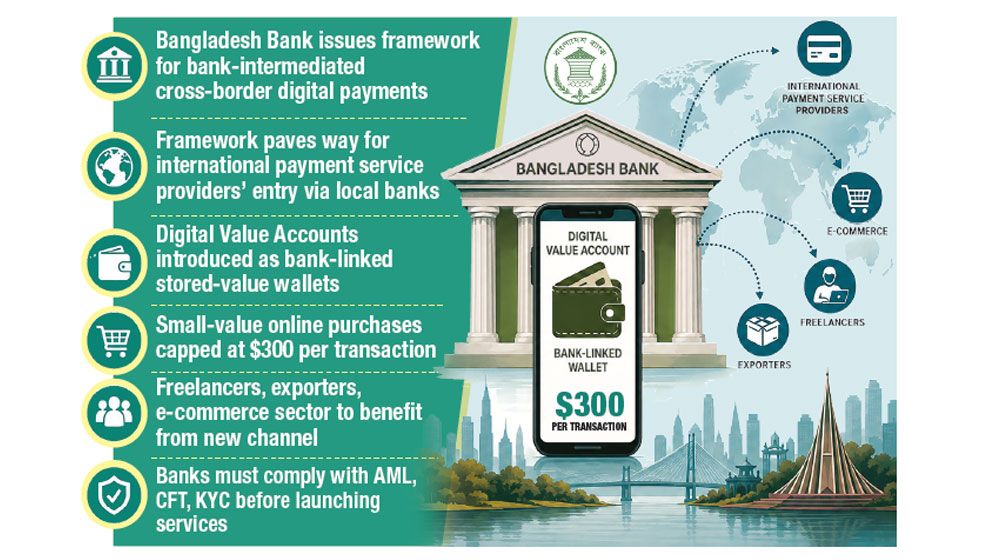
Bangladesh Bank has rolled out a comprehensive regulatory framework for bank-intermediated cross-border digital payments, opening the door for international payment service providers such as PayPal and Payoneer to enter the country's regulated financial system through partnerships with local banks.
The move is designed to modernise Bangladesh's payment ecosystem, ease international trade in services, widen digital financial inclusion, and support the country's expanding freelancing, e-commerce and cross-border digital economy.
In a circular issued on Wednesday, the Foreign Exchange Policy Department of Bangladesh Bank set out the framework, allowing Authorised Dealer (AD) banks to work with foreign payment platforms, digital service providers, online payment gateway operators and other legitimate transaction solution providers – collectively termed Cross-Border Digital Payment Service Providers (CBDPSPs).
Under the new arrangement, banks will be able to offer international digital payment services by teaming up with global payment providers, a step market observers believe could encourage the likes of PayPal, Payoneer and Stripe to expand their footprint in Bangladesh.
Digital value accounts introduced
A central feature of the framework is the introduction of Digital Value Accounts (DVAs) – digital wallets or stored-value accounts that banks may offer in the names of individual customers and businesses.
These accounts will not, however, operate independently. Each DVA must be linked to a Master DVA or settlement account held by the partner bank, ensuring regulatory oversight and secure settlement of transactions.
Bangladesh Bank has directed banks to keep real-time monitoring of all transactions and maintain a parallel ledger for transparency and reconciliation. Any unused balance must remain under the bank's direct control and be refunded or adjusted in line with regulatory requirements.
Wide range of permitted transactions
The framework allows individuals, businesses and freelancers to carry out eligible foreign currency transactions through the digital wallets.
Individuals may use the facility under approved foreign exchange travel quotas for private, medical and official travel.
The wallets can also cover legitimate payments such as membership fees, IT-related expenses, visa processing charges and online hotel bookings, along with small-value cross-border online purchases capped at $300 per transaction.
Benefits for exporters, freelancers and e-commerce
The new facility will be available against balances held in Export Retention Quota (ERQ) and Resident Foreign Currency Deposit (RFCD) accounts.
For companies maintaining ERQ accounts, up to three senior officials will be permitted to use DVA accounts to meet business-related expenses abroad.
The framework is also expected to significantly benefit Bangladesh's growing freelancing and e-commerce sectors, offering a more convenient, regulated channel for receiving and repatriating foreign earnings.
Industry stakeholders say the initiative could cut reliance on the complex intermediary payment arrangements many freelancers and digital entrepreneurs currently depend on.
Foreign tourists to benefit
The framework further allows foreign nationals and tourists visiting Bangladesh to use the settlement system for payments at local merchant outlets, adding convenience for international visitors and supporting digital commerce.
Strict regulatory oversight
Bangladesh Bank said no bank will be allowed to launch the service without prior acknowledgement from its Foreign Exchange Policy Department. Banks must submit detailed information on their partnerships with foreign payment providers, system integration arrangements, technical infrastructure and cybersecurity measures before approval is granted.
They will also be required to fully comply with anti-money laundering (AML), combating the financing of terrorism (CFT), know-your-customer (KYC) and customer due diligence (CDD) requirements, and to submit regular transaction reports to the central bank to ensure ongoing compliance.
Major shift in payment landscape
The framework marks a significant shift in Bangladesh's cross-border payment landscape. Previously, banks were largely confined to using Online Payment Gateway Service Providers (OPGSPs) for inward remittance and limited international payment services.
The new guidelines create a broader, bank-supervised ecosystem covering both inward and outward digital payment transactions through globally recognised platforms.
Bankers and market analysts said the move brings Bangladesh's payment infrastructure closer to international practice and is expected to strengthen the digital economy, improve the ease of doing business, and facilitate international trade in services – while making the country a more attractive market for global payment companies.