




 For all latest news, follow the Daily Sun's Google News channel.


INTERNATIONAL DAY OF THE WORLD’S INDIGENOUS PEOPLES TODAY
When a mother tongue falls silent

Every morning, millions of children in Bangladesh open books written in Bangla or English and begin another day of learning. But in some indigenous households, a different struggle is unfolding quietly: children can speak the language of their grandparents but cannot read or write it. Some understand only fragments, while others are growing up without learning it at all.
For communities whose languages carry generations of stories, songs, traditions and knowledge, the loss is far greater than the disappearance of words.
As Bangladesh observes the International Day of the World’s Indigenous Peoples today, the country faces an uncomfortable question: how can a nation that sacrificed lives for the right to speak its mother tongue protect the many other mother tongues spoken within its borders?
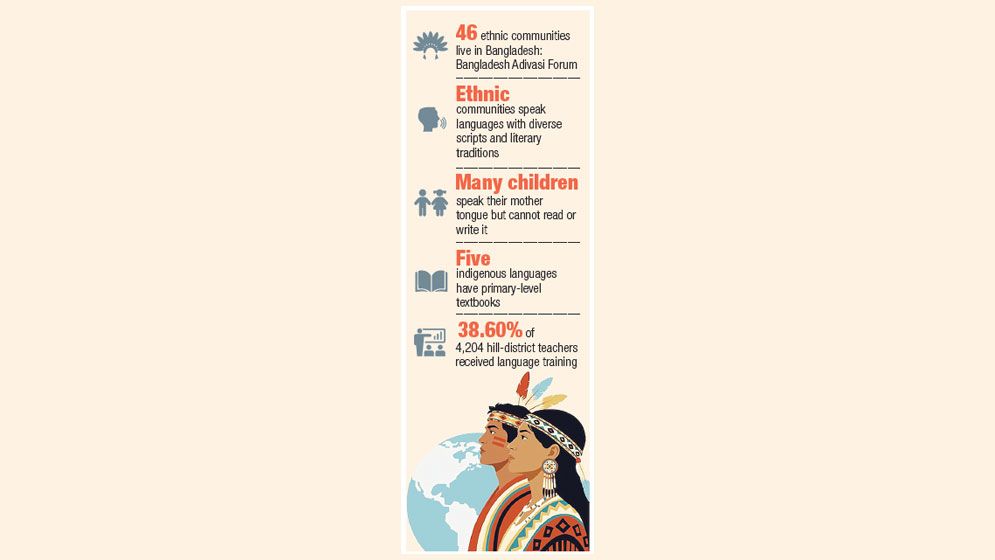
According to the Bangladesh Adivasi Forum, Bangladesh is home to 46 ethnic communities with a combined population of around three million, although government statistics put the figure at about 1.5 million. These communities are mainly concentrated in North Bengal, Mymensingh, northeastern Sylhet and southeastern Chattogram.
Most have their own languages, but their linguistic traditions vary considerably. Some have developed their own scripts and rich literary traditions, while others use Bangla or Roman alphabets.
The Chakma community, for example, speaks Changma and has a substantial written tradition, including books on medicine and literature. It also publishes newspapers such as Abangpang and Juniponro.
The Rakhine community uses Akkhara and has books written in its own script. Tripura communities use Kokborok in everyday life and have books written in their own alphabet. Among the Marmas, the language is taught at Khang, or Buddhist temples, while their literary tradition includes works in Bangla script and books on traditional medicine.
The Garo language, Achik, is used by the Garo community, with some speakers writing it in Roman script. It also has several dialects, including Abeng, Aoay, Chisak, Dakka, Ganching, Kamrup and Matchi.
Bangladesh’s two major Manipuri communities have similarly distinct linguistic identities. Meitei-speaking Manipuris use the Meitei script, while Bishnupriya Manipuris generally write their language in Bangla script. Both communities have long literary traditions.
But for many communities, maintaining a written language has proved far more difficult.
Influenced by Christian missionaries, some Khasia, Mahali, Bawm, Khumi and Santal communities use Roman script. Many Kols, Hajongs, Santals, Mundas and Oraons use Bangla script to write their languages.
Yet the biggest threat today may not be the absence of a script but the declining use of the languages themselves.
Practical considerations are pushing many indigenous families towards Bangla and English. Some children still grow up speaking their community language at home but cannot read or write it. Others who once learned their mother tongue gradually forget it because they have little opportunity to practise.
For years, indigenous children had virtually no opportunity to learn their mother tongues through formal education. A change came with the Education Policy 2010. In 2012, the National Curriculum and Textbook Board decided to publish primary-level textbooks in five indigenous languages – Chakma, Marma, Tripura, Sadri and Garo.
The initiative began distributing textbooks in 2017.
According to the NCTB, it is going to print 185,715 books in one lot for students from ethnic minority communities for the 2027 academic year.
But putting a textbook into a child’s hands is only part of the solution.
A critical shortage of trained teachers continues to undermine the initiative.
Many teachers can speak their community languages but cannot read and write them adequately.
Of 4,204 indigenous teachers in the three hill districts, only 38.60 per cent attended a 14-day language training programme during the past three years.
Even those who attended say the training was too short to develop a strong command of their respective languages.
Outside the hill districts, the situation is even more difficult.
Language training programmes have hardly been organised for indigenous teachers in North Bengal, Mymensingh and northeastern Sylhet.
“Language is the principal tool of education and education is the only way to bring the tribal people forward,” said Bichitra Tirki, president of Jatiya Adibasi Parishad.
When indigenous children cannot learn their mother tongue at school, she said, they face an identity crisis that can eventually contribute to dropping out before completing primary education.
The warning extends far beyond classrooms.
A language is more than a means of communication; it carries a community’s history, traditions, worldview, songs, stories and accumulated knowledge. When a language disappears, much of that cultural memory can disappear with it.
Globally, a language dies roughly every two weeks, taking with it knowledge and cultural heritage accumulated over thousands of years.
For Bangladesh, where the Language Movement remains one of the defining chapters of national history, the disappearance of indigenous languages presents a profound contradiction. A nation that sacrificed lives to protect the dignity of its mother tongue should perhaps be among the strongest voices for protecting every mother tongue within its borders.