



 For all latest news, follow the Daily Sun's Google News channel.


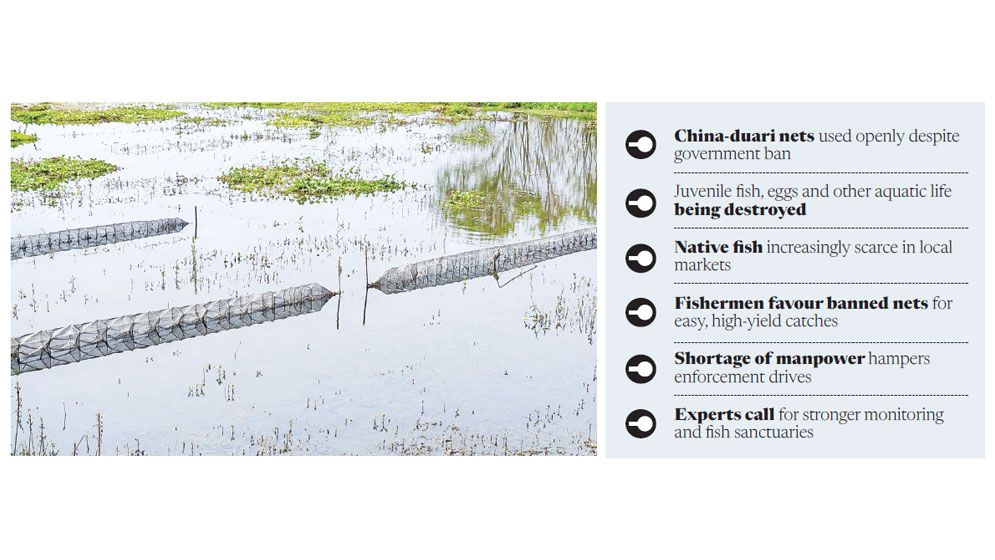
Native fish and aquatic biodiversity in Madaripur are facing a growing threat as the widespread use of banned China-duari, ring and current nets continues in rivers, canals and wetlands, destroying not only fish but also juvenile stocks, fish eggs and other aquatic life.
The monsoon is in full swing, with rivers, canals and wetlands across the district brimming with water. Despite continuous rainfall and an abundance of water since Baishakh, native fish are becoming increasingly scarce.
The indiscriminate use of banned fishing nets has emerged as a major threat to local fish stocks. The practice is particularly visible in different rivers, canals and wetlands in Shibchar upazila, while effective measures to curb the use of the illegal nets remain inadequate.
The China-duari net is banned in Bangladesh under the Fish Protection and Conservation Act, 1950. Despite the ban, the nets are reportedly being sold and used openly in different parts of the district.
The administration occasionally conducts drives and seizes the illegal nets. However, concerned officials say shortages of manpower and logistical support make it difficult to completely stop their use.
During a recent visit to different rivers, canals and wetlands in Shibchar, this correspondent found China-duari nets being set in shallow water, with parts of the nets submerged and the remaining portions left along the banks. In some places, the nets were reportedly kept in the water for days at a stretch.
Local people said the use of such nets has contributed to a sharp decline in native fish. Markets are also receiving far fewer native fish than in the past. Previously, the arrival of monsoon water would bring an abundance of native species such as shol, gachar, tengra, pabda, koi, boal, air, magur, shing, punti, baim, shrimp, baila and nani. Many of these species are now rarely found in local water bodies.
The banned nets are particularly destructive as they catch fish indiscriminately. Juvenile fish, egg-bearing female fish and even fish eggs are also trapped and destroyed.
A China-duari net is generally 30 to 80 feet long and around one to one-and-a-half feet high. It consists of an iron-ring structure covered with very fine mesh. Depending on its size and quality, a net costs between Tk 2,000 and Tk 5,000. A fisherman, requesting anonymity, said the nets were popular because they could be used for a long time with little effort.
“China-duari nets can be kept in water continuously for months, allowing fishermen to catch fish without much effort. They are also relatively cheap and readily available at different shops,” he said.
He said traditional fishing nets often become damaged if kept in water for a long time, prompting many fishermen to use China-duari nets despite the ban.
Kawsar Ahmed, a resident of Shibchar, alleged that the activities of the fisheries offices at district and upazila levels were not sufficiently visible.
“There is a lack of effective monitoring by the upazila fisheries office, which is why the use of banned nets has not stopped. There also appears to be no effective plan to increase fish production,” he said.
Shibchar Upazila Senior Fisheries Officer Satyajit Majumder said regular drives were being conducted throughout the year against China-duari and other banned fishing nets. “We are conducting regular drives against banned fishing nets to protect native fish species. At the same time, awareness programmes are being carried out to protect fish breeding and aquatic biodiversity,” he said.
Easy catch drives use of banned nets
Despite the government ban, many fishermen continue to use China-duari nets because they can catch comparatively large quantities of fish with relatively little effort.
Once placed in water, the nets can be left for long periods, allowing fish to become trapped without fishermen having to remain nearby.
A fisherman, speaking on condition of anonymity, said many fishermen were aware of the harmful effects of the nets but continued to use them for economic reasons.
“Many people know about the harmful effects of these nets. But they can catch more fish with less effort. The nets can also be easily hidden in deeper water when necessary. That is why many fishermen ignore the ban,” he said.
Suman Howlader, a fish trader in Panchhar, said fish stocks in local water bodies would decline rapidly unless the use of banned nets was stopped.
“If the use of banned nets continues, fish stocks in local water bodies will decrease rapidly. Various aquatic animals are also becoming trapped and dying in these nets. Regular monitoring by the administration needs to be strengthened,” he said.
Local resident Sirajul Islam said native fish were becoming increasingly difficult to find in local markets. “We no longer find native fish in the markets as we did in the past. If the situation is not brought under control now, many native fish species could disappear in the future,” he said.
He added that the impact would extend beyond fisheries resources, threatening food security and aquatic biodiversity.
Coordinated action needed
Environmentalists say raids alone will not be enough to ensure the long-term protection of native fish and aquatic ecosystems. They called for stricter controls on the production and sale of banned fishing nets, alternative income opportunities for fishermen and increased surveillance during fish breeding seasons.
Raju Ahmed, a lecturer in the Department of Geography and Environment at Dr Nurul Amin Degree College in Shibchar, said the unrestricted use of China-duari, ring and current nets had emerged as a serious environmental threat to inland water bodies.
“The use of these banned nets is disrupting natural food chains and reducing aquatic biodiversity. Effective conservation measures during fish breeding seasons, expansion of fish sanctuaries and preservation of the natural environment of rivers, canals and wetlands are equally important to protect native fish and aquatic resources,” he said.
He said the local administration, fisheries department, elected representatives and residents needed to work together to protect aquatic ecosystems. “Otherwise, many native fish species will face the risk of extinction, while the natural ecosystem of rivers and other water bodies will also be pushed towards an existential crisis,” he said.
Satyajit Majumder, Shibchar upazila senior fisheries officer, said regular drives were being conducted to prevent the sale and use of banned fishing nets.
“We are also monitoring the situation to ensure that fish eggs and juveniles are not destroyed. Although 100 per cent control is not possible due to manpower and logistical limitations, initiatives have been taken to strengthen drives and monitoring,” he said.