


 For all latest news, follow the Daily Sun's Google News channel.


Bangladesh seeks durable US economic partnership
PM Tarique urges American businesses to invest in Bangladesh with confidence
Daily Sun Report, Dhaka
Published: 14 Aug 2026, 12:00 AM
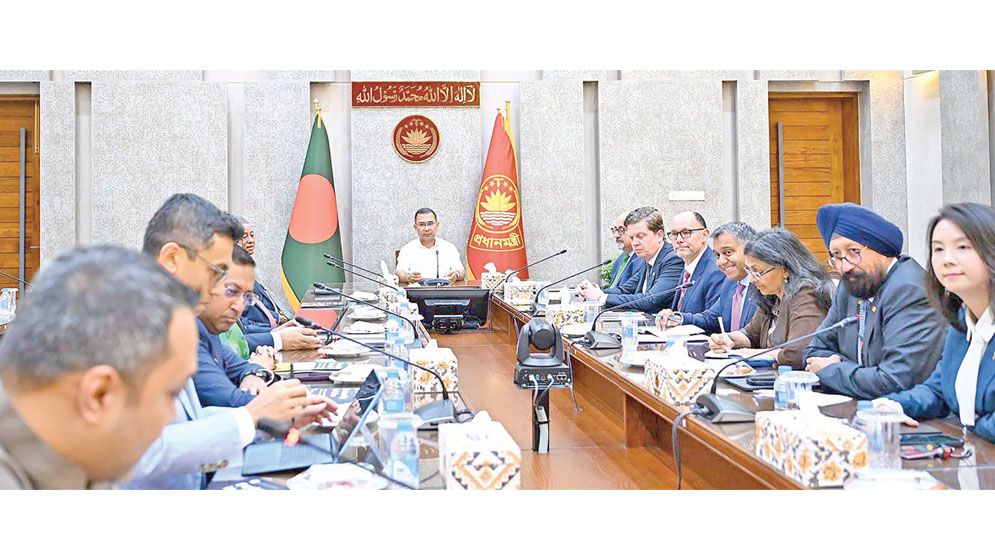
Prime Minister Tarique Rahman on Thursday urged US businesses to invest in Bangladesh with confidence and take a long-term view, saying his government wants to build a durable economic partnership with the United States based on investment, trade, technology and job creation.
“Our objective is not simply to attract foreign direct investment but to build a durable and mutually beneficial economic partnership. This will strengthen ties between Bangladesh and the United States,” said the prime minister when a delegation of the US-Bangladesh Business Council, representing 25 leading American companies, met him at the Bangladesh Secretariat.
The 50-member delegation was led by Oliver Simpson, executive vice-president and chief commercial officer of Constellation Energy, and Ambassador Atul Keshap (retd), president of the US-Bangladesh Business Council and senior vice-president for South Asia at the US Chamber of Commerce.
Tarique invited US companies to invest and expand their operations in Bangladesh, highlighting opportunities in energy, infrastructure, technology, digital services, finance, agriculture, healthcare, manufacturing and logistics.
“Our six-month-old, forward-looking government wants American companies to invest and expand in Bangladesh. We welcome your capital, technology, expertise, and global experience,” he said.
The prime minister said his government was committed to deregulation, a pro-business budget and liberal economic and fiscal policies aimed at creating a more predictable and investment-friendly environment.
“Our vision is to build a rules-based, globally connected economy that is driven by the private sector. We want American businesses to be partners in this transformation,” he said.
He said the government was working to strengthen investor protection, simplify regulations, improve tax and VAT administration, facilitate profit repatriation, reduce red tape and digitise public services. It was also improving infrastructure, ports and logistics, while seeking to strengthen energy security and encourage investment in renewable energy and modern technologies.
“Please consider our entire government as your partner. We are here to listen, respond, and facilitate,” Tarique said.
He said Bangladesh welcomed US investment through direct investment, joint ventures, public-private partnerships and consultancy, while seeking to expand two-way trade and strengthen the export-import relationship.
The United States is Bangladesh’s seventh-largest source of foreign direct investment, with cumulative investment reaching $1.09 billion between 2001 and the end of March 2025, according to Export Promotion Bureau and Bangladesh Bank data. Bilateral trade stood at $10.13 billion in FY24.
Tarique said the government had set a target of building a $1 trillion economy by 2034 and was positioning Bangladesh as a manufacturing and investment hub through targeted incentives for priority sectors and investment in skills and technology.
He linked the proposed economic partnership with the US directly to employment, trade and investment, saying greater American participation could help create jobs and strengthen bilateral ties.
“I invite you to invest with confidence and build for the long term. Let us create jobs, expand trade and investment, and ensure your companies’ thriving presence. Let us grow together and build a prosperous, competitive, and globally connected Bangladesh,” he said.
The prime minister also recalled that he had started his career as a businessman before entering politics, saying he understood the importance of having the right policies and conditions for businesses to grow.
“My message today is simple,” he said, assuring the visiting business leaders that his government was ready to provide all possible support to facilitate their business interests in Bangladesh.
Among others, the US-Bangladesh Business Council delegation included Ravi Arora, senior vice president of Global Public Policy and Indo-Pacific Policy Operations at Mastercard; Zakia Sultana, country manager of Mastercard Bangladesh; Cha Yuen Ting, director of public policy for South Asia at Meta; Ruzan Sarwar, head of public policy at Meta Bangladesh; Kevin Ropke, executive director for the Middle East, North Africa and South Asia at the US Soybean Export Council; Khabibur Rahman, country team lead for Bangladesh at the US Soybean Export Council; Anand Vijay Jha, vice president and head of government affairs for India and South Asia at Visa; and Sabbir Ahmed, country manager for Bangladesh, Nepal and Bhutan at Visa.
Speaking at the meeting were Salil Gupte, president of South Asia and India and vice president of Boeing Global; Shu Xiong, managing director and president of Chevron Bangladesh; Elena Butarova, senior vice president for Bangladesh, Malaysia, Nepal and Vietnam at MetLife; Pia Bruner, head of public policy and government relations for Asia-Pacific at Uber; and Siddhant Mehra, executive director for Bangladesh and South Asia at the US-Bangladesh Business Council.
The delegation also included Patrick Pitts, senior director for South Asia at the US Chamber of Commerce; Udaya Arun, director for South Asia at the US-Bangladesh Business Council; Debi Chatterjee, director at the US-Bangladesh Business Council; and Shemei Levy, senior security consultant at the US Chamber of Commerce.
Also present at the meeting were Finance and Planning Minister Amir Khosru Mahmud Chowdhury; Foreign Minister Dr Khalilur Rahman; Industries Minister Khandakar Abdul Muktadir; Prime Minister’s Adviser on Economic and Planning Affairs Rashed Al Mahmud Titumir; State Minister for Foreign Affairs Shama Obaed Islam; Prime Minister’s Adviser on Foreign Affairs Humayun Kabir; State Minister for Power, Energy and Mineral Resources Anindya Islam Amit; Prime Minister’s Adviser and Spokesperson at the Prime Minister’s Office Mahdi Amin; Prime Minister’s Adviser for Posts, Telecommunications and Information Technology, and Science and Technology Rehan Asif Asad; and BIDA Executive Chairman Chowdhury Ashik Mahmud Bin Harun.
‘US businesses keen to expand investment’
Prime Minister’s Adviser Mahdi Amin said the US private sector was keen to increase investment in Bangladesh and create new employment opportunities following the meeting.
He described the discussions as “highly productive and effective”, saying the two sides had held detailed talks on how US private-sector support could help increase foreign investment, create jobs and accelerate economic growth.
The meeting also explored how US companies could contribute to implementing the government’s election manifesto and policy initiatives, he said.
Mahdi said the US business leaders had expressed interest in contributing to faster economic growth through job creation and hoped the visit would further strengthen Bangladesh-US economic ties.
“We firmly believe that this successful meeting with the Prime Minister will take us one step closer to building a self-reliant and prosperous Bangladesh,” he said.
Among the companies represented were Constellation Energy, Chevron, Meta, Visa, the US Soybean Export Council, MetLife, Boeing, Uber, Salesforce, Cisco, Abbott, HSBC Bank, Standard Chartered Bank and others.
Keshap said the delegation was honoured by the warm hospitality extended by the prime minister and his government and described its meetings in Bangladesh as “extremely productive”.
He said US companies were proud to be among Bangladesh’s largest foreign investment partners and had contributed management expertise, business ethics and modern technology.
“We believe the private sector can be one of the most powerful catalysts for accelerating the wellbeing and economic prosperity of the people of Bangladesh by bringing technology, global experience and sufficient capital,” Keshap said.
He said the delegation was confident in Tarique’s vision of transforming Bangladesh into a $1 trillion economy by 2034 and viewed Bangladesh as a country with “immense potential”.