



 For all latest news, follow the Daily Sun's Google News channel.


Govt steps up investment reforms in first 180 days
BIDA merger, single-window services aim to improve business climate

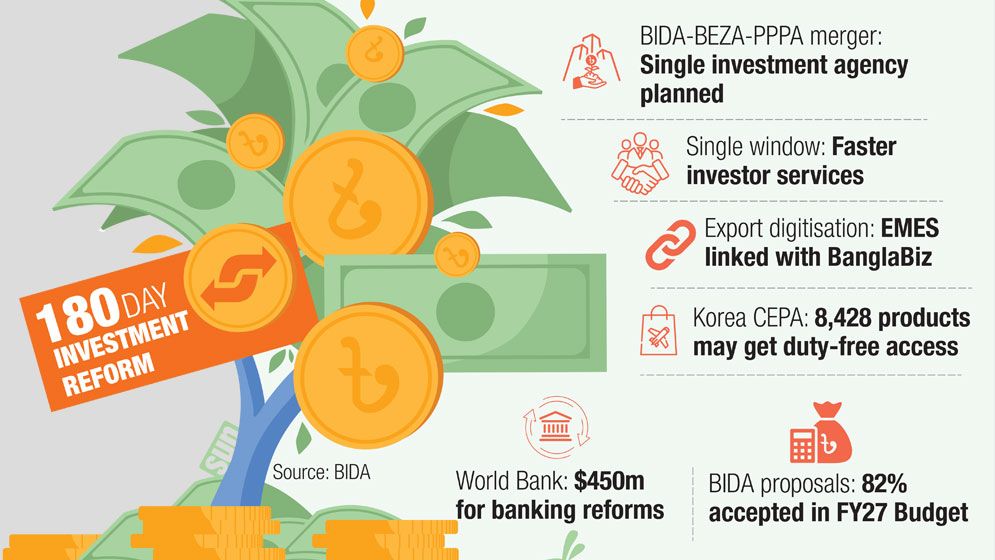
The government has rolled out a sweep of institutional and digital reforms during its first 180 days in office, aiming to simplify business procedures and spur exports, according to a review by the Bangladesh Investment Development Authority (BIDA).
Since taking office on 17 February 2026, the administration has focused on streamlining investment agencies, expanding digital services, and improving policy coordination.
Central to these efforts is a major structural overhaul merging BIDA, the Bangladesh Economic Zones Authority (BEZA), and the Public Private Partnership Authority (PPPA) into a single apex agency.
To support the merger, the government enacted the Invest Bangladesh Act, 2026.
The central authority aims to eliminate administrative overlaps, speed up approvals, and provide investors with a unified, efficient single-window service.
Single-window services expanded
BIDA has introduced a single-window service to provide businesses with multiple government services through a unified platform.
According to BIDA, investors no longer need to visit different government offices separately to obtain approvals and other services.
The system is expected to reduce the time and cost of doing business while improving efficiency and transparency.
Another major initiative has been the integration of the Export Promotion Bureau’s (EPB) EMES software with BIDA’s BanglaBiz central platform.
BIDA said the integration would provide exporters with faster and more streamlined services, marking a major step towards digitalising Bangladesh’s export trade.
CEPA talks with South Korea
As part of the 180-day programme, Bangladesh has also advanced negotiations on a Comprehensive Economic Partnership Agreement (CEPA) with South Korea.
Following a bilateral meeting on 4 August, the two countries continued discussions aimed at reaching an understanding on the proposed agreement.
According to BIDA, if implemented, the CEPA could provide duty-free market access in South Korea for around 8,428 Bangladeshi products, equivalent to nearly 97% of the country’s export items.
In return, around 1,054 South Korean products would receive similar preferential access to the Bangladeshi market.
$450m World Bank financing
The government has also secured significant international financing to support banking sector reforms.
Under the Financial Sector Support Project-II, the World Bank has approved US$450 million, of which $351 million is planned for a deposit protection fund.
The financing is expected to strengthen the financial sector and improve protection for depositors.
82% of BIDA recommendations reflected in budget
BIDA said 14 of its 17 sector-specific and policy recommendations, or 82%, have been fully or partially reflected in the FY27 national budget.
In addition, 12 of 19 recommendations, or 63%, related to deregulation and easing regulatory requirements have been accepted.
Policy continuity key to investor confidence
BIDA Public Relations Officer Md Abu Hanif told the Daily Sun that the reforms were aimed at creating a more predictable and investor-friendly business environment by reducing regulatory hurdles and improving policy coordination.
“Investors are particularly concerned about policy and political continuity. The government’s efforts to provide clear and consistent policy signals are important for building investor confidence,” he said.
He said investment would not increase overnight, but sustained reforms, regulatory simplification and long-term policy consistency could gradually encourage both domestic and foreign investors to expand their operations in Bangladesh.
Read More