


 For all latest news, follow the Daily Sun's Google News channel.


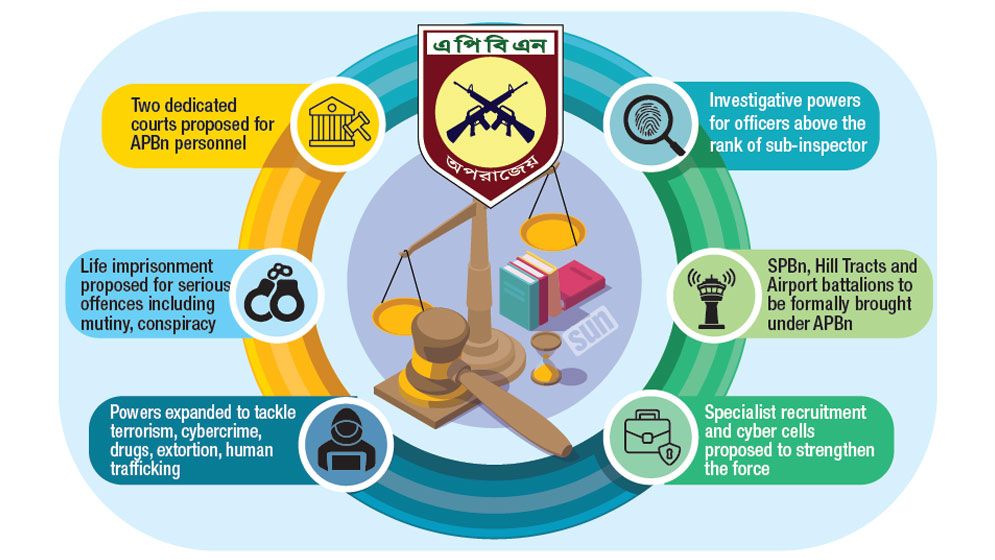
The government is moving to overhaul the Armed Police Battalion (APBn) with a new law that would expand its operational mandate, introduce two dedicated courts for its personnel and impose tougher penalties for serious offences.
The draft “Armed Police Battalion Act-2026” will replace the “Armed Police Battalions Ordinance of 1979”, which officials say needs updating as the force’s responsibilities have expanded significantly.
The Ministry of Home Affairs on Tuesday invited opinions from all sections of society on the draft at [email protected].
Under the proposed law, the APBn will remain part of Bangladesh Police, while the Special Security and Protection Battalion (SPBn), Hill Tracts Battalion and Airport Battalion will formally come under its structure. Each unit will be headed by an additional inspector general of police.
The draft also provides for setting up cyber cells where necessary and recruiting non-police specialists, including lawyers, psychologists, doctors and judges, to support administrative and legal functions.
The proposed law gives the APBn a broad range of responsibilities, including maintaining public safety, protecting the president, prime minister and other VIPs, guarding key installations and airports, countering terrorism and extortion, recovering illegal arms and explosives, and tackling drug trafficking, cybercrime, enforced disappearances and land grabbing.
It would also empower the force to act against violence against women and children and human trafficking.
APBn personnel would have the authority to enter, search, seize and arrest in accordance with the Code of Criminal Procedure. Officers above the rank of sub-inspector would be able to exercise the powers of investigating officers in criminal cases.
A major feature of the draft is the creation of two dedicated courts for trying APBn personnel – the “Summary Armed Police Battalion Court” and the “Special Armed Police Battalion Court”.
The summary court would deal with offences such as negligence of duty, destruction of weapons, being drunk while on duty and disobeying orders from superiors. Such offences could carry up to three years’ imprisonment.
The special court would try more serious offences, including mutiny, conspiracy and acts against the state, with penalties of up to life imprisonment. Any life sentence would require presidential approval before execution.
Personnel convicted by either court would have the right to appeal to separate appellate courts within a prescribed period.
The draft also sets out departmental disciplinary procedures for misconduct, corruption, bribery, misappropriation of state property and providing false information. Punishments could include dismissal, compulsory retirement, demotion and forfeiture of pay or seniority.
However, no disciplinary penalty could be imposed without giving the accused an opportunity to defend themselves.
The draft provides legal protection to APBn members for actions taken in good faith while performing their duties, shielding them from departmental proceedings or compensation claims arising from such conduct.
At the same time, personnel would be barred from joining organisations, speaking to the media or engaging in business activities without prior approval.
Once enacted, the 1979 ordinance would be repealed. However, actions taken and cases initiated under the existing ordinance would be deemed to have been taken under the new law and dealt with accordingly.
The draft is still undergoing the approval process, according to sources familiar with the matter.
Under the existing law, the APBn has 11 battalions, while the Special Security and Protection Battalion has two.