


 For all latest news, follow the Daily Sun's Google News channel.


17 banks join Tk60,000cr stimulus drive
Bangladesh Bank’s initiative targets 2.5m jobs and offers a vital lifeline to 370 distressed textile and apparel units
Daily Sun Report, Dhaka
Published: 28 Aug 2026, 12:00 AM
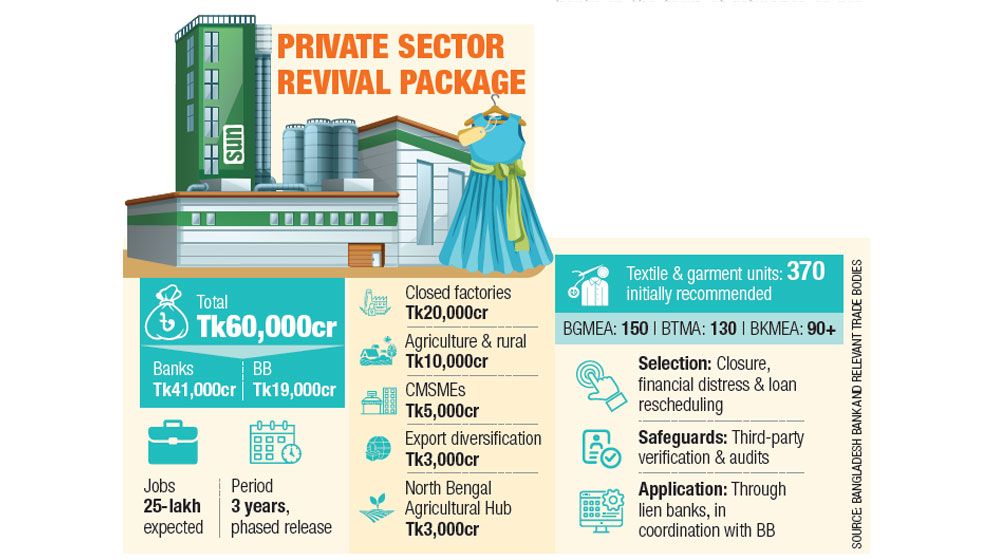
Seventeen commercial banks have signed agreements to supply Tk41,000 crore as part of Bangladesh Bank’s landmark Tk60,000 crore stimulus package.
Bangladesh Bank will contribute the remaining Tk19,000 crore of the package from its own resources with a government guarantee.
Aimed at reopening closed factories, spurring private investment, and creating an estimated 2.5 million jobs, the three-year refinancing scheme targets an economic recovery following prolonged industrial disruptions.
The central bank’s Banking Regulation and Policy Department said the participating banks include Sonali Bank, Agrani Bank, Rupali Bank, BRAC Bank, City Bank, Jamuna Bank, Dutch-Bangla Bank, Mutual Trust Bank, Uttara Bank, Prime Bank, Bank Asia, National Credit and Commerce Bank, Pubali Bank, Eastern Bank, Mercantile Bank, Trust Bank and Southeast Bank.
Bangladesh Bank announced the stimulus package on 23 May to restart closed and financially distressed factories, stimulate private investment and support an economy that has remained sluggish in recent years.
Bangladesh Bank Executive Director and Spokesperson Arief Hossain Khan told the Daily Sun that agreements had been signed with banks holding excess liquidity.
“The excess liquidity of these banks will be collected, and the funds will be provided to banks in the form of refinance or pre-finance,” he said.
He said the full amount would not be released at once but disbursed in phases over three years.
“The main objective of the stimulus package is to revive demand that has remained stagnant over the past few years, reopen closed and struggling factories and create employment,” Arief said.
The central bank estimates that the package could create around 2.5 million private-sector jobs by reviving industrial production and investment.
The largest allocation, Tk20,000 crore, has been earmarked for reopening industrial factories that have remained closed for a prolonged period.
The refinancing scheme also includes Tk10,000 crore for agriculture and rural activities, Tk5,000 crore for cottage, micro, small and medium enterprises, Tk3,000 crore for export diversification and another Tk3,000 crore for the North Bengal Agricultural Hub.
The Tk41,000 crore component will be mobilised from banks with excess liquidity through deposits with maturities of at least three years at a 10% interest rate.
The remaining Tk19,000 crore will come from Bangladesh Bank’s own resources with a government guarantee.
Private-sector businesses will receive loans under the fund at an average interest rate of 7.5%, according to officials.
Meanwhile, three major textile and apparel trade bodies have recommended 370 closed and financially distressed factories for loans under the Tk60,000 crore stimulus package.
The Bangladesh Garment Manufacturers and Exporters Association (BGMEA) has submitted a list of 150 garment factories, while the Bangladesh Textile Mills Association (BTMA) has recommended 130 textile, spinning, weaving, dyeing, finishing and printing mills.
The Bangladesh Knitwear Manufacturers and Exporters Association (BKMEA) has recommended more than 90 factories.
BKMEA President Mohammad Hatem told the Daily Sun that applications had initially been submitted to Bangladesh Bank for more than 90 factories, with more to follow after verification.
“The fund would help many small and medium-sized factories recover and repay overdue bank loans, although restoring the sector’s overall health would take time,” he said.
Together, the 370 factories account for more than half of the nearly 700 closed or financially distressed textile and garment units affected by political instability, labour unrest and operational disruptions over the past two years, according to the trade bodies.
Industry representatives said the factories were selected based on factors including prolonged shutdowns, financial deterioration and loan rescheduling during the period.
The recommendations were finalised after third-party verification to ensure that the stimulus fund reaches genuinely distressed businesses.
BGMEA President Mahmud Hasan Khan told the Daily Sun that the association had certified the factories only after third-party audits.
“We certified the factories only after a third-party audit so that the fund reaches the right recipients,” he said, adding that BGMEA had not recommended any factory that no longer exists.
Factories certified by BGMEA, BTMA and BKMEA will be able to apply for loans through their respective lien banks. The banks will process the applications in coordination with Bangladesh Bank.
However, industry leaders cautioned that strict eligibility conditions could make it difficult for some genuinely distressed factories to access the fund.
The textile and apparel industry has suffered severe disruptions since and after the student-led July Uprising in 2024, affecting factory production and export operations.
Following the fall of the Sheikh Hasina government in August 2024, labour unrest spread across major industrial belts, including Savar, Ashulia, Gazipur, Narayanganj and Bhaluka.
Shipment delays forced many exporters to offer steep discounts to international buyers, use costly air freight to meet delivery deadlines and absorb losses from cancelled orders.
Many factories have yet to fully recover from the disruptions.