


 For all latest news, follow the Daily Sun's Google News channel.


Narail’s seasonal duck farming generates Tk22cr from eggs
Daily Sun Report, Benapole
Published: 30 Aug 2026, 12:00 AM
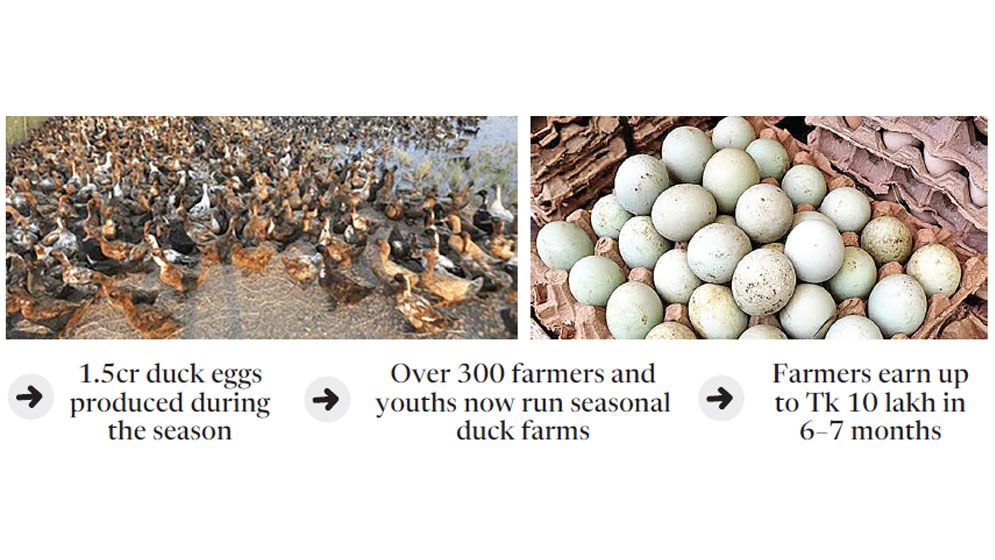
Unemployed youths and farmers in different parts of Narail are increasingly turning to seasonal duck farming in wetlands during the monsoon, earning between Tk2 lakh and Tk10 lakh from six to seven months of farming a year.
Seasonal duck farmers produce around 1.5 crore eggs each season, with the eggs currently fetching more than Tk22 crore, according to the district livestock office.
The office said around 13.5 crore chicken and duck eggs are produced in Narail every year, of which nearly 1.5 crore are duck eggs, currently worth at least Tk22 crore. Farmers sell freshly collected eggs to traders every morning at Tk15 each. Around 90% of the ducks on each farm lay eggs regularly, with production continuing for seven to eight consecutive months a year. The seasonal business is contributing significantly to the local economy while creating employment opportunities for rural people.
Narail, an agriculture-dependent district, covers 968 square kilometres and has a population of nearly eight lakh. Surrounded by wetlands and fish enclosures, agriculture and fisheries are the main sources of livelihood for its people.
Over the past several years, more than 300 farmers and young people have been setting up temporary duck farms in wetlands during the monsoon on their own initiative.
Mohammad Tuhin Sheikh, a farmer from Sarshuna village in Lohagara upazila, started his duck farm five years ago with 150 ducks and made a profit of more than Tk1 lakh in his first year. His farm has expanded every year and now has more than 400 ducks. He expects to earn at least Tk3 lakh in profit this year.
Alim Molla, another farmer from the area, said he previously supported his family through crop farming but earned little from it.
On a neighbour’s advice, he started a seasonal duck farm three years ago with 200 ducks. Encouraged by the profits, he gradually increased the number of ducks.
His farm now has around 350 ducks and produces about 300 eggs a day. He expects to make at least Tk3 lakh in profit this season.
Hundreds of farmers and young people living around 15 to 16 wetlands, including Ichamati, Sholpur, Kolora, Kumri, Pateshwari and Sarshuna in Lohagara, Kalia and Sadar upazilas, are now raising ducks in similar temporary farms.
Farmers said they release the ducks into the wetlands every morning, where the birds roam in groups, feed on naturally available food and swim in the water before returning to their farms together in the evening. Aslam Sheikh, a farmer from the Chanchuri Beel area of Kalia upazila, said almost every household in the area raises ducks, mainly for egg production. “About 90% of the ducks on a farm lay eggs every day. They continue laying eggs for seven to eight months a year,” he said.
Mohammad Jihad of Sholpur village said he started his farm five years ago with 200 ducks after seeing his neighbours make good profits. “I made a good profit in the very first year and increased the number of ducks every year. I now have 1,200 ducks and hope to make Tk6 lakh to Tk7 lakh in profit this year,” he said. Hasan Ali, another farmer from the village, said raising ducks in wetlands significantly reduces feeding costs. “There is almost no cost for feed. As a result, production costs are low and profits are high,” he said.
Rezaul Islam said each farm in the wetland areas keeps between 200 and 2,000 Campbell ducks. Besides the temporary farms, almost every household in the wetland areas raises ducks during the season. Dr Rashedul Islam, district livestock officer, said duck farming was a profitable business and had significant potential in the district.
“We provide farmers with training, technical assistance, vaccines and other support to increase duck meat and egg production,” he said.
There are currently 351,037 ducks in Narail, he said, adding that the number of duck farms in the district is increasing every year.