


 For all latest news, follow the Daily Sun's Google News channel.


BNP at 48, carrying Zia’s vision of self-reliant state
Tarique pledges an accountable, welfare-oriented Bangladesh

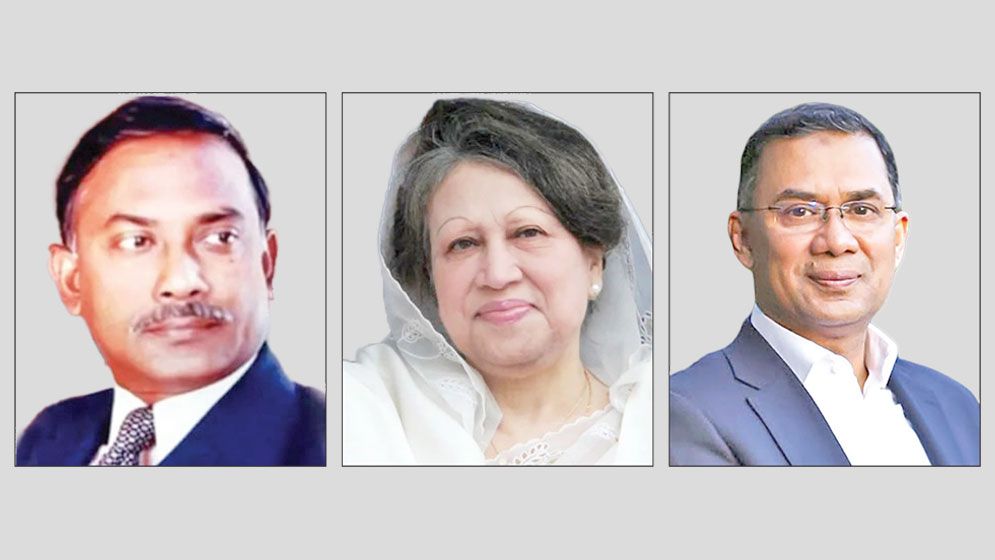
The Bangladesh Nationalist Party (BNP) turns 48 today, carrying forward the political and economic vision of its founder, Shaheed President Ziaur Rahman, whose 19-point programme sought to build a self-reliant, democratic and economically just Bangladesh.
Founded on 1 September 1978, the BNP has since remained a major force in the country’s politics, leading governments at different times and playing a key role as an opposition party.
Ziaur Rahman, the party’s founding chairman, remained at its helm until his assassination by a group of disgruntled military personnel in Chattogram on 30 May 1981.
The BNP is now in power after nearly five decades of political struggles and has announced a five-day nationwide programme to mark its founding anniversary.
Zia formally announced the formation of the BNP at Ramna Maidan in Dhaka on 1 September 1978. Its stated objectives included economic development, democratisation, national unity based on Bangladeshi nationalism and self-reliance.
The party’s political foundation was built around four principles: full faith and trust in Allah, Bangladeshi nationalism, multi-party democracy, and socialism defined as economic and social justice.
The 19-point programme was designed to reduce poverty and population growth, encourage private enterprise, strengthen agriculture and build national unity irrespective of religion, caste, creed or ethnicity.
Zia had earlier patronised the formation of the Jatiyatabadi Ganatantrik Dal (Nationalist Democratic Party) in early 1978 to bring together diverse anti-BAKSAL elements, including right-wing, nationalist and centrist groups and secular freedom fighters.
After assuming the presidency in April 1977, Zia moved to restore multi-party politics, ending the one-party BAKSAL system introduced through the Fourth Amendment to the Constitution in January 1975.
The second parliamentary election, held in February 1979, gave the BNP a landslide victory, with the party winning 207 of the 300 seats.
Focus on agriculture, private sector
Zia’s economic policies placed strong emphasis on agriculture and the private sector.
His government formed expert teams to support economic growth, introduced measures including subsidies for farmers and improved agricultural marketing, and promoted exports of both conventional and non-conventional goods.
Food production rose sharply during his tenure, with Bangladesh moving towards the prospect of becoming a rice-surplus country.
Under his 19-point programme, more than 1,500 canals were excavated or re-excavated within 18 months to improve irrigation. The country subsequently recorded its highest food-grain production for two consecutive years under the development scheme.
Zia also sought to strengthen law and order, improve police training and professionalism, and enhance discipline and organisational capacity in the armed forces.
Foreign policy and regional cooperation
In foreign affairs, Zia pursued a broad, independent and non-aligned policy, seeking friendly relations with countries across the world.
Bangladesh strengthened ties with neighbouring countries, China, the United States, the Muslim world and Southeast Asia during his tenure.
His government promoted multilateral diplomacy, helping Bangladesh secure a non-permanent seat on the UN Security Council in 1978.
Zia also championed greater regional cooperation in South Asia, laying the groundwork for the South Asian Association for Regional Cooperation (SAARC), which was launched in Dhaka in 1985.
His diplomatic engagement with Saudi Arabia and the Organisation of Islamic Cooperation (OIC) also strengthened Bangladesh’s position in the Muslim world.
Zia’s constitutional changes included inserting Bismillahir Rahmanir Rahim in the Preamble and adding “absolute trust and faith in the Almighty Allah” to Article 8(1) and 8(1A). Article 8(1) defined socialism as “economic and social justice”, while Article 25(2) called for stronger fraternal relations among Muslim countries based on Islamic solidarity.
Zia did not live to see all his political and economic goals fulfilled. His assassination in 1981, however, did not end the political legacy built around his vision.
After his death, Begum Khaleda Zia led the BNP until her death in 2025. During her imprisonment, her son Tarique Rahman served as acting chairman and later took charge of the state.
Five-day programme
The BNP has planned a series of programmes to mark its 48th anniversary.
Party flags were hoisted at 6:00am at the BNP’s Nayapaltan central office and party offices across the country.
Prime Minister and BNP Chairman Tarique Rahman will pay tribute to Ziaur Rahman and former prime minister Begum Khaleda Zia by placing wreaths at their graves at Zia Udyan in the capital.
The party will also organise a fish fry releasing programme under the leadership of Joint Secretary General Habibun Nabi Khan Sohel and a tree plantation campaign led by Joint Secretary General and Water Resources Minister Shahiduddin Chowdhury Anne.
Tarique pledges accountable state
In a message marking the anniversary, Prime Minister Tarique Rahman greeted BNP leaders, activists, supporters and well-wishers, as well as the country’s people.
“The establishment of BNP was a landmark event in the history of restoring democracy in Bangladesh,” he said.
He recalled Ziaur Rahman’s role in restoring democracy and reinstating the rights of banned political parties to conduct political activities, paving the way for the revival of pluralistic democracy.
Tarique described Zia as the Great Proclaimer of Independence, a successful statesman and architect of modern Bangladesh.
He also paid tribute to Khaleda Zia, saying her charismatic leadership brought the BNP closer to people across the country.
“Whenever independence, sovereignty and democracy have come under threat, BNP leaders, activists, supporters and well-wishers have sacrificed their lives alongside the pro-democracy people,” he said.
Tarique said the BNP had been given the opportunity to run the state whenever people could exercise their voting rights through free and fair elections.
He said the party wanted to repay the people’s trust by establishing an accountable state and building Bangladesh as a welfare-oriented country.
“The people who believe in democracy are the source of all political power of BNP,” he said, adding that the BNP’s other name was the struggle to build a welfare-oriented, democratic and self-reliant Bangladesh.
Read More