


 For all latest news, follow the Daily Sun's Google News channel.


Panchagarh-Banglabandha highway turns into dust-laden death trap
Daily Sun Report, Panchagarh
Published: 05 Sep 2026, 12:00 AM
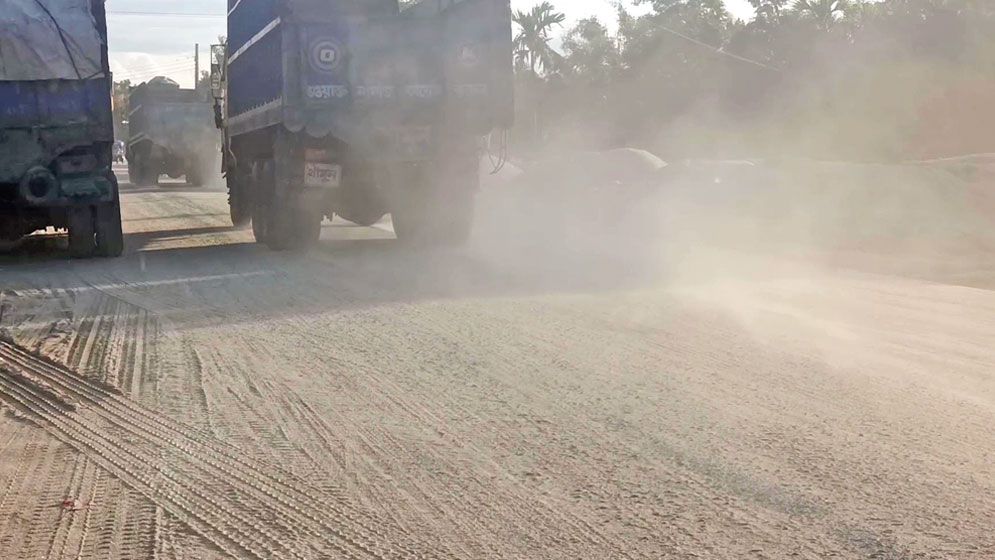
The Panchagarh-Banglabandha highway, a vital route connecting the northern district with the rest of the country and the Banglabandha land port, is increasingly turning into a hazardous corridor as thick layers of sand and dust choke the road and pollute the surrounding environment.
The 56-kilometre highway, widely known as part of the Asian Highway network, has become particularly dangerous in several areas as sand and stone piled up along both sides have narrowed the carriageway, raising the risk of frequent road accidents. At the same time, clouds of dust generated by hundreds of trucks carrying sand and stones are exposing local residents, pedestrians and roadside businesses to serious health hazards.
The highway is considered a key gateway to Bangladesh's northern region. At its northern end lies the Banglabandha land port, through which trucks carrying imported and exported goods regularly pass. The road also serves thousands of tourists visiting Panchagarh, Tetulia and Banglabandha to enjoy views of Kanchenjunga, lush tea gardens and the natural beauty of the country's northernmost region.

However, the once scenic highway is now facing growing environmental and road-safety problems.
Huge piles of sand have accumulated on both sides of the road, leaving little space for vehicles in some sections. Locals allege that the indiscriminate activities of sand and stone traders are largely responsible for the situation.
More than 1,000 trucks reportedly use the highway every day to transport sand and stones. As the heavy vehicles move along the road, they generate large clouds of dust. Sand and stone are also reportedly traded directly beside the highway, further worsening the situation.
The problem is particularly severe around roadside markets, including Jagdal, Barrister Bazar, Bhajanpur Bazar and Sipahipara Bazar, where food is often sold in open spaces amid heavy dust pollution.
Residents and pedestrians say the dust is constantly entering their eyes and respiratory systems, exposing them to various health complications.
Cardiology and medicine specialist Dr SM Mahbub-ul-Alam of Panchagarh Modern Sadar Hospital said the level of dust pollution along the highway had created a serious environmental crisis.
“The amount of dust flying on the Panchagarh-Banglabandha highway has caused an environmental disaster. Apart from visible dust, the concentration of fine particles that cannot be seen with the naked eye needs to be scientifically assessed,” he said.
The physician said polluted air was contributing to various respiratory problems and could pose risks of serious diseases.
“People are increasingly suffering from different lung diseases. Heart disease, cancer and kidney-related illnesses are also increasing. Although no case of silicosis has yet been identified here, there is a possibility of an outbreak in the future,” he said.
Environmental activist Mostak Ahmed of Bhajanpur said the dust pollution had reached an alarming level in the area.
“It has become almost impossible to stand beside the road because of the dust. While educated and conscious people understand the dangers, many working-class people are not fully aware of the long-term health risks,” he said.
He blamed sand and stone traders for much of the pollution and said the government earns substantial revenue from the extraction and transportation of sand and stones.
“Millions of taka in revenue are collected by the government in the name of sand and stone leases and transportation. There are also several associations of traders and workers that earn substantial amounts of money. If even a portion of that money were spent on maintaining the road and controlling dust, the problem could be reduced,” he said.
According to Ahmed, the Roads and Highways Department is responsible for road management, while the Department of Environment should also play a role in controlling pollution.
He said some administrative authorities, voluntary organisations and political leaders had taken initiatives to clean the highway during the caretaker government period after August 5, but such efforts were no longer visible.
“The Roads and Highways Department manages the road, but we do not see sufficient initiatives from them. The Department of Environment also appears to remain silent. This is surprising,” he said.
The original width of the 56-kilometre highway ranges from 5.50 metres to 7.30 metres. But in some sections, accumulated sand has reduced the usable roadway to just two to three metres, according to locals.
As a result, vehicles are often forced to pass through extremely narrow sections, increasing the risk of head-on collisions and other serious accidents.
Locals fear that if immediate measures are not taken, the highway will continue to pose a dual threat—causing long-term health problems through air pollution while also claiming more lives through road accidents.
Panchagarh Roads and Highways Department Executive Engineer Partha Sarker acknowledged that some sections of the highway had become narrower because of accumulated dust and sand.
“Some areas have become narrow because of accumulated dust and sand. However, the entire highway is not covered with dust,” he said.
He also admitted that excessive dust was contributing to environmental pollution.
“With the cooperation of the administration, initiatives are being taken to improve highway management. But this cannot be done by the administration alone. People from all sections of society also need to come forward,” he said.