


 For all latest news, follow the Daily Sun's Google News channel.


THE BAD LOAN BOMB
How ballooning defaults are choking credit, stalling investment and threatening economic stability

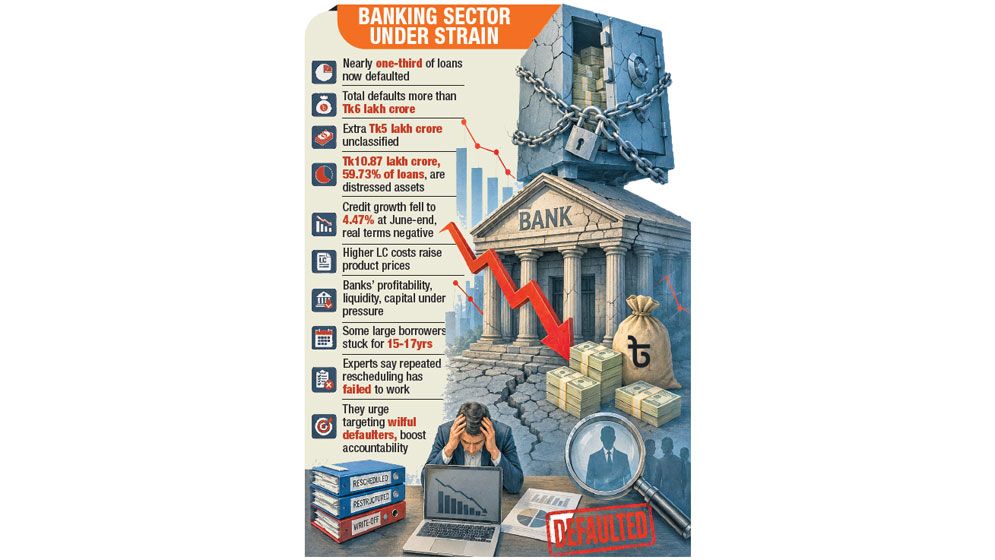
Nearly one-third of all loans in the country’s banking sector had turned defaulted by the end of June, totalling more than Tk6 lakh crore, in a crisis economists warn is now squeezing credit, discouraging investment and threatening wider economic stability.
The strain is already visible on the ground. Some banks are struggling to repay depositors on time, while others have raised lending rates.
The cost of opening letters of credit has also climbed as banking-sector weaknesses persist, a burden that ultimately feeds through to higher prices for consumers.
Bankers say overall lending has weakened sharply.
Private-sector credit growth fell to a historic low of 4.47% at the end of June, and once inflation is factored in, real credit growth is now negative.
Even financially sound businesses are showing less appetite for new loans, while some banks are no longer entertaining borrowers who seek loans through political connections.
The official default figures tell only part of the story.
Bangladesh Bank data show a further Tk5 lakh crore in loans that are effectively unpaid but not formally classified as defaulted.
Distressed loans – a category covering defaulted loans, unpaid portions of rescheduled loans, and unpaid write-offs – stood at Tk10,87,590 crore at the end of last year, equivalent to 59.73% of total lending.
The rapid growth of such loans means a large share of banks’ assets is failing to generate income, straining profitability, liquidity and capital.
Pressure spreading to businesses
The fallout is not confined to banks. When borrowers default, banks have less capital available for fresh lending.
To preserve liquidity, they may raise deposit rates, which in turn pushes up lending rates.
Higher borrowing costs add to businesses’ financing, production and import expenses, including the cost of opening letters of credit – costs that firms often pass on to consumers through higher prices.
Bankers say high interest rates, business uncertainty and weaknesses within the banking sector have dampened loan demand even among viable companies, leaving stagnant investment alongside rising defaults as a growing concern for the economy.
Dr Zahid Hussain, former lead economist of World Bank’s Dhaka office, told the Daily Sun that the impact of default loans extends well beyond a single sector.
“When borrowers take loans and fail to repay them, it disrupts banks’ cash flows and can eventually put pressure on depositors,” he said.
He added that trust underpins the banking system. “If public confidence in regulators, institutions, laws and rules declines, people may become less willing to keep their money in banks. They may instead shift their savings towards gold, land or other assets.”
Such a shift, he said, could push more money outside the formal financial system and undermine financial inclusion.
Dr Zahid noted that borrowers have repeatedly been offered special facilities to reduce defaults, but the data show no clear evidence of success, suggesting the approach needs rethinking.
Economists caution against treating all defaulters alike. Some borrowers deliberately withhold repayment, while others fall behind due to business downturns, market shifts, political instability or other genuine setbacks.
Viable entrepreneurs facing real difficulties, they argue, deserve reasonable rescheduling or restructuring options if they retain the capacity to recover – but wilful defaulters should face strict action.
Analysts warn that if special facilities become a routine alternative to timely repayment, they risk further eroding borrowers’ willingness to pay on schedule.
Bangladesh Bank spokesperson and Executive Director Arief Hossain Khan said failure to curb default loans would hit bank income and create liquidity stress, making it harder for banks to repay depositors on time.
“High levels of default loans could result in provisioning shortfalls and eventually capital shortages. This would negatively affect banks’ ratings. A lower credit rating could also increase the cost of opening LCs,” he said.
He said the central bank was providing various forms of policy support and that long-term rescheduling needed to be considered in light of economic realities.
Some large borrowers, he noted, had been unable to conduct normal business for 15 to 17 years due to adverse conditions, with some owing more than Tk1,000 crore, and various measures were being taken accordingly.
Despite years of rescheduling and restructuring facilities aimed at giving struggling businesses room to recover, default loans have continued to rise, economists say.
Former Bangladesh Bank chief economist Mustafa K Mujeri said a clear line must be drawn between wilful defaulters and those hit by genuine business problems, with loan approvals prioritising viability, cash flow and repayment capacity over political identity or influence.
Accountability, he said, must extend to loan approvers and supervisors, not only borrowers, since large defaults often reflect weaknesses in banks’ own assessment and oversight.
He called on Bangladesh Bank to tighten supervision and scrutinise how beneficiaries of special facilities have used the funds, including whether they were used for legitimate business purposes.