


 For all latest news, follow the Daily Sun's Google News channel.


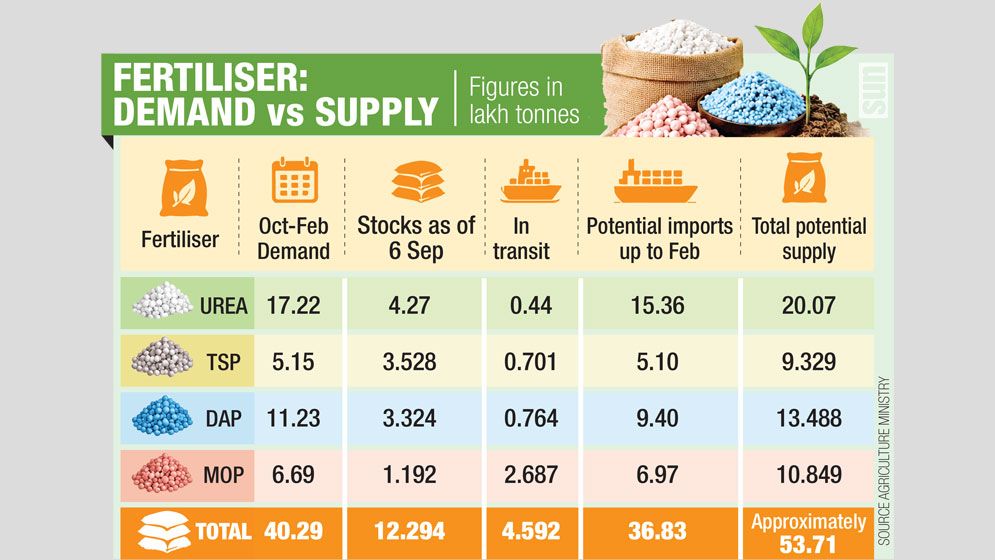
The country is projected to have a surplus of around 1.342 million tonnes of fertiliser by the end of February next, with potential supply estimated at 5.371 million tonnes against demand of 4.029 million tonnes between October and February.
However, much of the projected supply will depend on the timely arrival of imports, raising concerns over possible local shortages if shipments, port handling or distribution are disrupted.
According to fertiliser data prepared by the Ministry of Agriculture as of Sunday, demand for the four major fertilisers – urea, DAP, MOP
and TSP – is estimated at 4.029 million tonnes during the five-month period.
Urea will account for the highest demand at 1.722 million tonnes, followed by DAP at 1.123 million tonnes, MOP at 669,000 tonnes and TSP at 515,000 tonnes.
Against the urea demand, potential supply is estimated at 2.007 million tonnes, including existing stocks, shipments in transit and planned imports, leaving a projected surplus of around 285,000 tonnes.
For TSP, potential supply stands at 932,900 tonnes against demand of 515,000 tonnes, resulting in a projected surplus of about 417,900 tonnes.
DAP supply could reach 1.3488 million tonnes against demand of 1.123 million tonnes, leaving a surplus of around 226,000 tonnes.
MOP presents the tightest immediate supply situation. Against demand of 669,000 tonnes, current stock is only 119,200 tonnes. Another 268,700 tonnes is in transit, while around 697,000 tonnes of additional imports are planned up to February. Total potential supply is therefore estimated at 1.085 million tonnes, around 416,000 tonnes above demand.
The total stock of the four fertilisers stood at 1.2294 million tonnes as of Sunday, while another 459,200 tonnes was in transit.
Meanwhile, the government and private sector are projected to import 3.683 million tonnes of fertiliser from September to February. This means imports will play a crucial role in meeting demand, particularly for DAP, TSP and MOP.
The government approved the import of 365,000 tonnes of fertiliser on 24 August, comprising 80,000 tonnes of urea, 115,000 tonnes of MOP, 80,000 tonnes of DAP and 60,000 tonnes of TSP.
Earlier, on 12 August, it approved another 110,000 tonnes, including 40,000 tonnes each of urea and DAP and 30,000 tonnes of TSP.
Economist and researcher Dr Jahangir Alam Khan told the Daily Sun that although projected supply was higher than demand on paper, a substantial portion of the supply had yet to arrive in the country.
“Any disruption to import schedules, shipment, unloading at ports or distribution could create temporary local shortages and trigger a crisis,” he said.
He said the situation was particularly concerning for MOP because of its low current stock compared with demand. If MOP now in transit or awaiting import does not arrive on time, pressure could mount towards the end of the year.
Government data from 24 August also highlighted the country’s heavy dependence on imports.
At that time, stocks of urea, TSP, DAP and MOP totalled around 1.365 million tonnes, while another 865,000 tonnes was at the import stage.
Shipments in the pipeline
According to Bangladesh Agricultural Development Corporation (BADC) data as of 24 August, a substantial quantity of non-urea fertiliser is scheduled to arrive in September.
Two TSP shipments, each containing 30,000 tonnes, are expected to arrive today and on Friday. Three further 30,000-tonne lots are under import procedures based on laycan periods of 1-4 September, 9-11 September and 12-14 September. Thus, around 150,000 tonnes of TSP is scheduled to arrive this month.
Two more 30,000-tonne TSP shipments are expected on 5 and 6 October.
For DAP, at least 160,000 tonnes is scheduled to arrive this month.
A 40,000-tonne shipment from Morocco is expected today, while two Saudi Arabian lots are scheduled under laycan periods of 5-9 September and 27-30 September, bringing another 80,000 tonnes. Another 40,000-tonne shipment from Morocco is also scheduled for 27-30 September.
Loading is also under way for two more Moroccan DAP lots, although their arrival dates have not been specified.
For MOP, at least 185,000 tonnes is scheduled to arrive this month from Russia and Canada. Russia is expected to supply three 35,000-tonne lots in three phases by 20 September.
Canada is scheduled to supply two 40,000-tonne lots in two phases by 13 September. Bids have also been received for two additional 40,000-tonne Canadian lots under a 1-15 September laycan period. Including these, MOP imports currently in the pipeline total 375,000 tonnes.
The Central Procurement Technical Committee (CPTC) has also received proposals for further purchases: 60,000 tonnes of TSP from Morocco; 120,000 tonnes of DAP, including 80,000 tonnes from Morocco and 40,000 tonnes from Saudi Arabia; and 115,000 tonnes of MOP, comprising 35,000 tonnes from Russia and 80,000 tonnes from Canada.
Despite having around 812,000 tonnes of TSP, DAP and MOP in stock in the third week of August, around 495,000 tonnes of non-urea fertiliser is scheduled to arrive in September to maintain supply continuity. Of this, MOP accounts for 185,000 tonnes, DAP 160,000 tonnes and TSP 150,000 tonnes.
Read More