




 For all latest news, follow the Daily Sun's Google News channel.


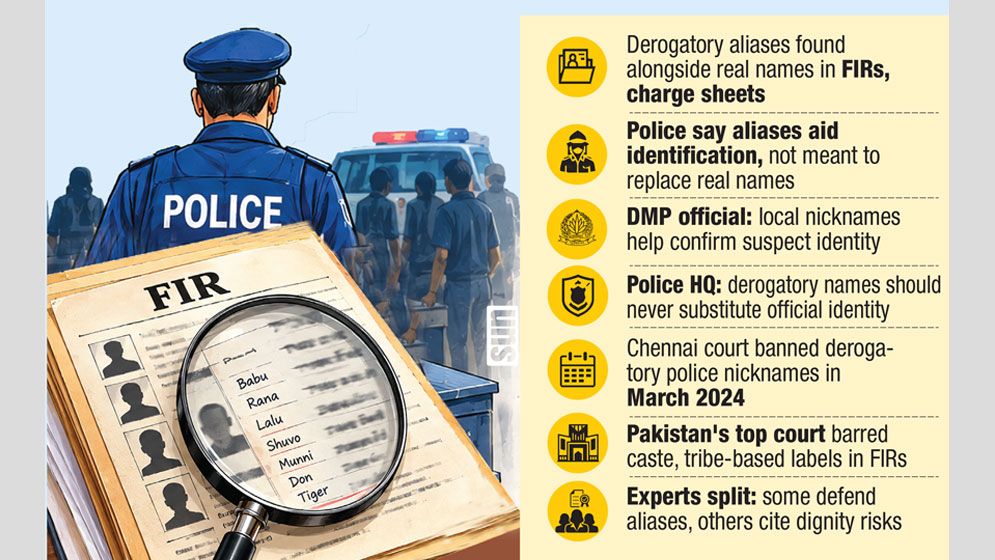
Accused persons in the country are increasingly being identified in official case records by derogatory nicknames – ranging from animal names to references to physical traits and disabilities – a practice, police officials say, is meant only to aid identification but should never substitute an accused’s real identity.
Names such as “Kalia Riaz”, “Kutta Faruk”, “Hatkata Kashem”, “Chua Selim”, “Langra Rubel”, “Blade Babu” and “Kutta Rabbi” have appeared alongside real names in recent case records, a review of FIRs, remand pleas and charge sheets has found.
While such labels can help identify a person widely known locally by a particular name, concerns arise where the name is insulting, demeaning, or based on a person’s physical characteristics or disabilities.
Recent cases
Riazul Islam Riaz, arrested last week with his associates in a murder case and later remanded, was identified in case records as “Kalia Riaz”.
In July, seven men arrested and jailed in an arms case – after allegedly being caught preparing to commit a robbery – included Omar Faruk, recorded as “Kutta Faruk”.
In August, Abul Kashem Patwary was remanded in an attempted murder case under the name “Hatkata Kashem” in the remand plea, despite not having lost a hand.
That same month, Md Selim Ashrafi, described as a reported top drug dealer, was arrested and remanded in an arms case, appearing in records as “Chua Selim”.
An accused named Rubel, arrested under the Arms Act, was recorded as “Langra Rubel”.
And in the murder case of Monjurul Islam Babu – himself referred to in records as “Blade Babu” – the accused Rabbi was identified as “Kutta Rabbi”.
Police defend limited use
Dhaka Metropolitan Police Deputy Commissioner (Media and Public Relations) Md Akter Hossain said alternative names are used only where necessary for identification.
“If a person’s real name is known, a commonly used or locally recognised name may be mentioned alongside it. The main purpose is to help identify the person locally,” he said, adding that aliases are also used when a suspect’s real name cannot be confirmed during investigation.
Police Headquarters spokesperson AHM Shahadat Hossain said an accused’s real name and identity take priority in official and legal records, with nicknames included only as supporting information for investigative purposes.
“It is not appropriate to use a derogatory or demeaning nickname as a substitute for the accused’s identity in an FIR, charge sheet or other case records,” he said.
Courts abroad have intervened
The practice has drawn judicial scrutiny elsewhere in the region. In March 2024, a Chennai city sessions court, while acquitting an accused, directed police and other law enforcement agencies to stop assigning derogatory nicknames to accused persons, ruling that every individual deserves to be treated with dignity and respect.
The case involved the prefix “Kurangu” (monkey) used before the accused’s name in the FIR; the judge said such labels could prejudice public perception and compromise the impartiality of proceedings.
Pakistan’s Supreme Court has directed police across the provinces and Islamabad to stop referencing caste, tribe, biradari, conversion status or other derogatory classifications alongside the names of complainants, accused persons, victims or witnesses in FIRs and other records.
A three-judge bench ruled that such identification may be used only where strictly necessary for bona fide investigative reasons directly connected with the offence, and only when the justification is recorded in writing.
The court held that human dignity is an inalienable right rather than a privilege that can be granted.
Legal opinion divided
Supreme Court lawyer Manzill Murshid defended the practice as sometimes necessary for accurate identification.
“Some individuals become known by different names in their local areas, although these are not names given by their parents, and they gradually become a tool for identification,” he said, adding that many of those concerned take pride in such names rather than objecting to them.
He said no accused person has been known to object to the practice, though courts can intervene if an accused or their lawyer raises a complaint. Where a complainant mentions a commonly used name in the FIR, he added, police have little scope to exclude it – though the accused’s official name, as it appears on identity documents, is also retained.
Dr Tawhidul Haque, crime analyst and associate professor at the University of Dhaka, said the dignity of an accused person should be constitutionally protected, and that neither the state nor any other party should portray anyone in a degrading manner – a principle he said is not always reflected in practice.
He warned that the use of obscene names could expose institutional and procedural shortcomings when the criminal justice system is studied by outside observers.
“When obscene terms or names of animals are used, the matter should be viewed differently,” he said, adding, “We want a criminal to leave the world of crime and return to normal life. But it is difficult to reform or rehabilitate someone by humiliating them.”
Read More