



 For all latest news, follow the Daily Sun's Google News channel.


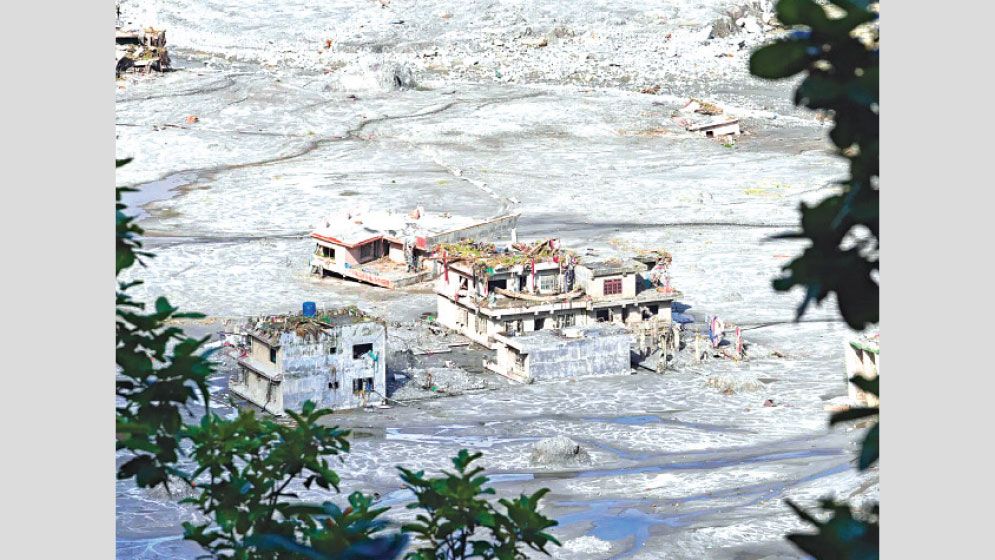
When devastating flash floods swept through the Bhote Koshi River basin along the Nepal-China border, unleashing walls of water, mud, and ice that affected over 1.6 million people, left thousands missing, and pushed the death toll past 1,200, they brought with them a reality that abstract climate metrics can rarely capture.
For ordinary citizens on the ground, the crisis is experienced through heartbreaking fragments of everyday life: local businessmen receiving frantic morning phone calls that their entire houses and liquor stores have been washed away; teachers watching helplessly as nine heavy trucks and human lives alike are swallowed by raging torrents; and head teachers like Rajendra Dawadi of Tribhuvan Trishuli Secondary School, who managed to evacuate over 1,600 children from an approaching wall of water, only to mourn a young teacher swept away in his rented room while cooking breakfast.
At temporary identification camps in cities like Bharatpur, 18-year-olds look through endless loops of televised slideshows of bloated, severely decomposed, and identical bodies just to find their missing fathers and brothers. These horrors lay bare a profound non-economic loss and damage (NELD) crisis, destroying cultural landscapes, ancestral lands, and community cohesion. Compounding this physical and emotional trauma is a staggering macroeconomic toll: as Nepal’s Finance Minister Swarnim Wagle noted in an interview with CNN's Richard Quest, the flooding is estimated to cost around $5 billion, roughly 10 per cent of Nepal's entire economic output.
This immense burden falls on a nation that contributes a mere 0.1 per cent of global greenhouse gas emissions. Despite causing virtually none of the crisis, lower-income nations like Nepal are left absorbing its most lethal consequences. This glaring inequality forms the core agenda for Nepalese Prime Minister Balendra Shah as he leads a delegation to the United Nations General Assembly on 24 September, where his upcoming address must forcefully reframe climate compensation not as discretionary charity or foreign aid, but as an overdue obligation of reparative justice owed by major industrial nations whose historic emissions locked these devastating risks into the planet's systems.
For decades, vulnerable developing nations have fought through the Warsaw International Mechanism and the Paris Agreement to address these residual impacts. Yet global financial architectures remain deeply broken, heavily biased toward mitigation while offering little to nothing for active destruction. Existing tools like parametric insurance rely on voluntary contributions, fail to handle slow-onset events or non-economic losses, and too often trap disaster-stricken countries in loan-based debt that transfers wealth straight back to the Global North. Furthermore, the newly operationalised global Loss and Damage Fund is fundamentally unequipped for mega disasters of this scale, holding only a fraction of a per cent of the hundreds of billions needed annually while major donors pull back.
Prime Minister Shah’s mission to the UN must press for an emergency financial mechanism that rejects debt-inducing loans in favour of direct public grants, while aggressively implementing a multi-pronged recovery and mitigation roadmap. This roadmap must encompass ex-ante risk reduction by legally restricting human settlements directly along volatile riverbanks, securing immediate short-term humanitarian relief from multilateral entities and global partners, hosting an international donor conference for long-term reconstruction (which has been suggested by Dr Swarnim Wagle), utilising concessional loans for infrastructure, and leveraging insurance payouts to restore critical assets like hydropower facilities, which account for over 15 per cent of national capacity alongside stabilising agriculture, tourism, and trade.
Other lower-economy and climate-vulnerable nations across the Global South such as Bangladesh must unite behind Nepal's appeal, because establishing a real-time disbursement precedent for sudden-onset catastrophes creates an invaluable operational roadmap that protects fragile domestic budgets and strengthens collective bargaining power against wealthy donor nations. Prime Minister Shah’s address is a vital test of whether global climate architecture can survive a real-time crisis, sending an unequivocal message that those who drove the climate emergency must help shoulder the cost of human survival.
________________________________________________
Pratik Poudel is a PhD Candidate and Mokbul Morshed Ahmad is a Professor, Faculty of Public Policy and Sustainable Development, Asian Institute of Technology in Pathumthani, Thailand