



 For all latest news, follow the Daily Sun's Google News channel.


Bangladesh’s manpower export sector is sliding into severe distress as key traditional destinations across the Gulf and Southeast Asia clamp down on recruitment, leaving hundreds of thousands of low-skilled jobseekers in limbo and threatening national remittance inflows.
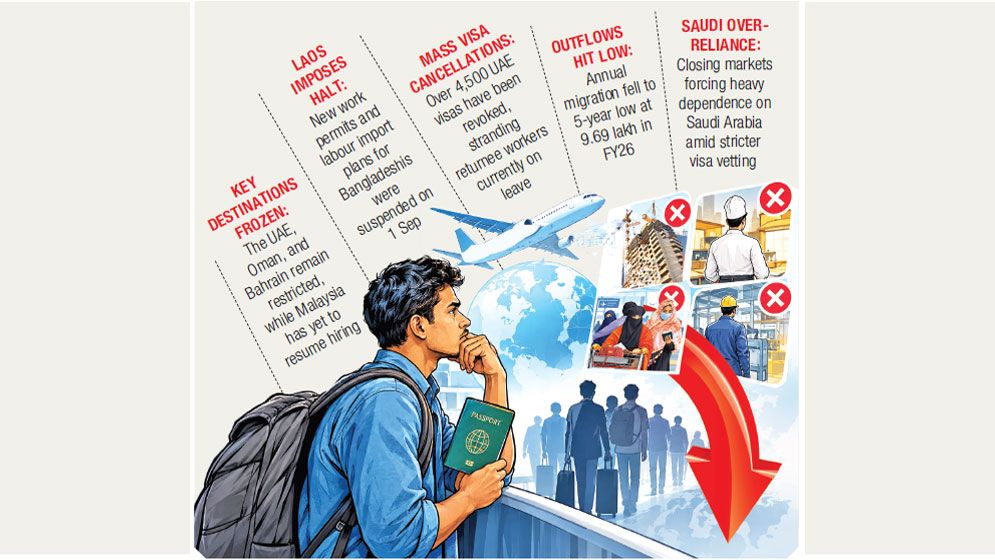
The sharp contraction has pushed overall overseas migration to 9.69 lakh in the 2025-26 fiscal year – a five-year low that marks an approximate 5% year-on-year drop, according to official data from the Bureau of Manpower, Employment and Training (BMET).
Monthly job clearances, which averaged around 100,000 during the post-pandemic recovery phase, have plummeted to between 44,000 and 65,000 in recent months, exposing the depth of the ongoing crisis.
Crucial labor destinations in the Gulf – primarily the United Arab Emirates (UAE), Oman, and Bahrain – remain virtually off-limits to fresh Bangladeshi recruits.
The situation deteriorated further after Laos suspended the approval of new work permits, labor import plans, and infrastructure project clearances for Bangladeshi nationals nationwide on 1 September.
Simultaneously, the UAE revoked the visas of over 4,500 Bangladeshis, leaving a vast number of migrants who had returned home on temporary leave unable to travel back to resume their employment.
Diplomatic maneuvers by successive administrations, including a high-level visit to Kuala Lumpur by Prime Minister Tarique Rahman in June, have so far failed to restore full market access.
Although Malaysia formally announced plans last month to resume recruitment after halting the process in June 2024, concrete implementation remains stalled pending final operational frameworks.
Oman continues to restrict entry following a major policy shift in 2024, while Bahrain has maintained a virtual freeze on new work visas for Bangladeshi workers since 2018.
“Closure of crucial international labour markets will inevitably hit Bangladesh’s remittance earnings and destabilise the broader economic situation,” warned Shakirul Islam, chairperson of the Ovibashi Karmi Unnayan Program (OKUP).
“Around two to 2.2 million youths enter the job market every year. If these markets remain shut, low- and semi-skilled youths will be left frustrated, observing a deeply gloomy future ahead.”
The narrowing array of overseas options has forced Bangladesh into heavy over-reliance on Saudi Arabia, which has emerged as the sole major intake outlet.
However, authorities in Riyadh have also tightened scrutiny over employment visas following the discovery of fraudulent job demands and recruitment irregularities.
This administrative crackdown has resulted in thousands of visa applications being rejected outright, whilst stricter documentation requirements have further slowed worker outflows.
The stakes for the national economy are immense, as earnings from these blocked markets have historically formed the backbone of foreign exchange reserves.
Ministry data presented in Parliament show that over 21.92 lakh Bangladeshis migrated to the UAE between 2004 and April 2026, making it the second-largest destination in the Middle East. Bangladesh Bank figures highlight that the UAE yielded $4.60 billion in remittances in FY24 and $4.17 billion in FY25.
Yet, fresh migration to the Emirates has cratered from nearly 98,000 in 2023 to just under 20,000 as of mid-September 2026.
A similar trajectory is evident in Oman and Bahrain.
Parliamentary records reveal that 16.52 lakh workers went to Oman and 3.09 lakh to Bahrain between 2004 and April 2026. Oman generated $1.63 billion in remittances in FY25, while Bahrain contributed $639 million in FY24.
However, manpower flow to Oman has effectively ground to a halt following the 2024 restrictions, down from over 125,000 departures in 2023.
Meanwhile, traditional labor markets in Iraq, Libya, Sudan, Egypt, and Brunei remain shut, while recruitment drives in South Korea, Romania, Jordan, and Japan have visibly lost momentum.
Industry stakeholders have urged the government to adopt a more aggressive diplomatic posture.
“We sent a record 11.32 lakh workers abroad last year, but we risk losing that momentum entirely amid the closure of crucial labour markets,” cautioned Fakhrul Islam, former joint secretary general of the Bangladesh Association of International Recruiting Agencies (BAIRA).
“The outflow to several other countries has also slowed down, and the government must concentrate its efforts here,” he added.
Mokhtar Ahmed, secretary at the Ministry of Expatriates’ Welfare and Overseas Employment, insisted that state authorities are actively tackling the bottleneck.
"Migration is a complex, bilateral issue that does not depend on a single country," he explained, adding that despite the complications, we are working to resolve these friction points, reopen closed markets, and actively explore new destinations for our workforce.
Recommended Stories