


 For all latest news, follow the Daily Sun's Google News channel.


US President Donald Trump on Saturday said he has rejected an Iranian proposal to reopen the Strait of Hormuz within a week and resume nuclear talks in return for the lifting of the US naval blockade of Iranian ports.
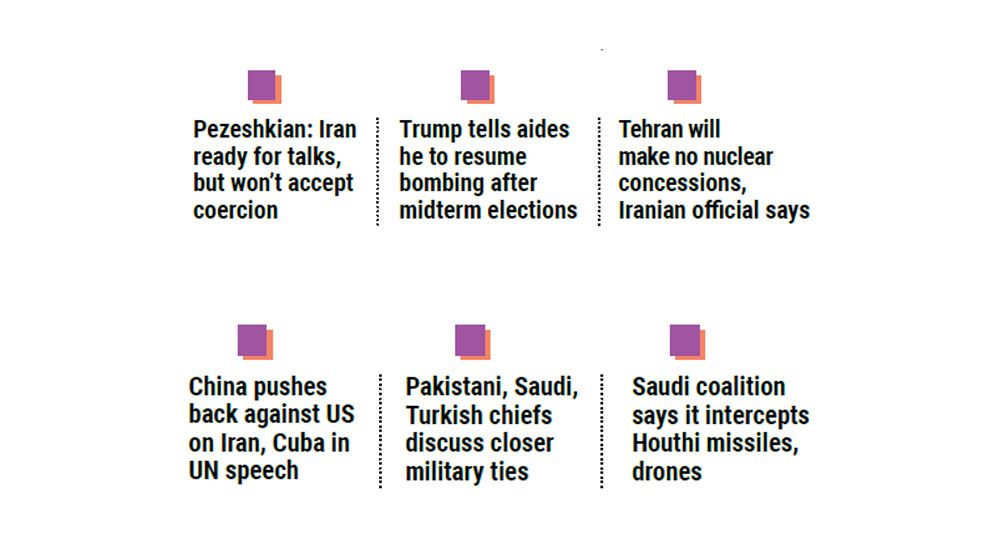
“They made a proposal but I reject it,” he told reporters at the White House. The US president was earlier said to be privately sceptical Iran would meet his demands to dismantle its nuclear programme, according to unnamed US officials cited by the Wall Street Journal. Trump has told aides he expects to resume bombing Iran after the November midterms in the US, the newspaper reported.
On Friday evening, he published a post on his Truth Social platform with a graphic showing a map with the strait of Hormuz renamed as the “Trump Strait”.
During a three-hour meeting at the UN general assembly in New York earlier this week, Iran had proposed reopening the strait, which would have relieved pressure on global energy markets, and restarting talks on its nuclear programme within seven days.
Iranian President Masoud Pezeshkian, in an interview with the CBS show Face the Nation, said Tehran was ready for talks on its nuclear programme and other issues, but would not accept “bullying or coercion”.
“Iran is not seeking war, but will defend itself against pressure, threats and attacks,” Pezeshkian said, adding that it had already agreed that “we’re not supposed to develop nuclear weapons”.
Iran will show no flexibility over its nuclear program even if the United States accepts its proposal to reopen the Strait of Hormuz, which calls for steps including the lifting of a US naval blockade on Iranian ports, a senior Iranian official told Reuters on Friday.
The official, speaking on condition of anonymity, said the waterway would remain closed until “all of Iran’s conditions are met” by the United States.
China pushed back against the United States in its speech at the UN General Assembly on Saturday, saying sovereignty of countries in the Gulf should be respected and urging the "relevant country" to stop threatening Cuba and lift its blockade on it.
Vice President Han Zheng did not mention the US by name in his remarks. The US has launched a pressure campaign on Cuba that has largely blocked oil from reaching the island. The US war on Iran started with US-Israeli strikes in February.
Meanwhile, the military chiefs of Pakistan, Saudi Arabia and Turkey discussed enhancing intelligence sharing, military coordination and capability integration at a meeting in Riyadh on Friday, according to statements from Saudi Arabia's Defence Ministry and Pakistan's military.
The chiefs of defence forces and chiefs of general staff reviewed the security situation and threats facing Saudi Arabia and condemned attacks by Yemen's Iran-backed Houthis targeting the holy city of Makkah as well as the kingdom's civilian and economic infrastructure, the statements said.
"The chiefs also discussed ways to further advance cooperation among the armed forces of the three countries," the Pakistan military added.
Saudi Arabia, Pakistan and Turkey signed the Makkah Joint Defence Agreement last month, saying an armed attack on any one of the three countries would be regarded as an attack on all, in a pact the signatories said was aimed at strengthening collective deterrence and military cooperation.
On the other hand, Yemen's Saudi-led coalition said early on Saturday it had intercepted two ballistic missiles and two drones launched by the Iran-backed Houthis towards the kingdom.
The coalition said in posts on X that the missiles were headed towards Khamis Mushait and the drones towards the capital, Riyadh, adding that it was monitoring the missile threat and drones launched at the kingdom, without providing further details. The Saudi civil defence had sent alerts overnight for Khamis Mushait and Abha but not for Riyadh.