


 For all latest news, follow the Daily Sun's Google News channel.


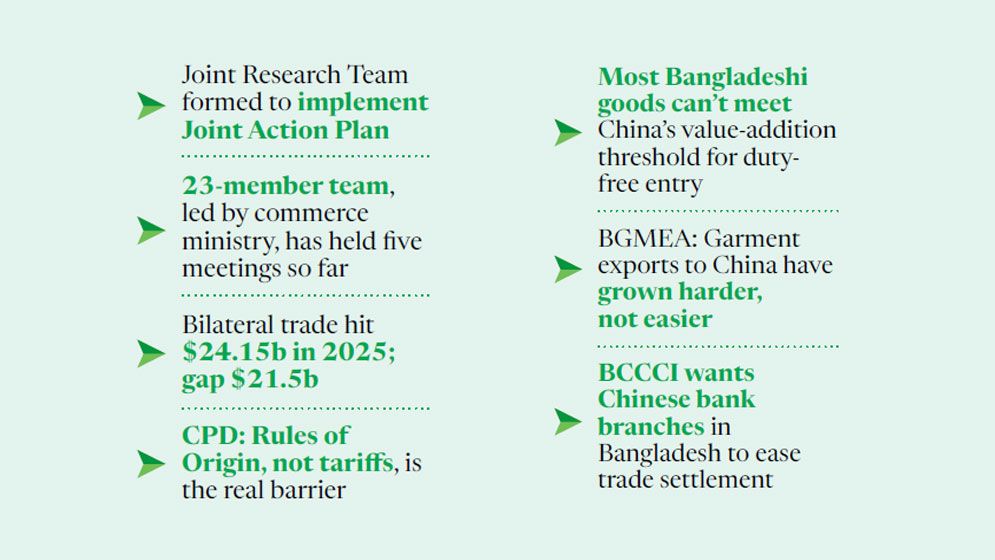
Bangladesh and China have set up a Joint Research Team to implement a Joint Action Plan (JAP) aimed at enhancing Bangladesh’s export capacity, attracting Chinese investment, and narrowing a bilateral trade gap that reached $21.48 billion in 2025.
The plan, launched through a Ministry of Commerce-to-Ministry of Commerce MoU signed during Prime Minister Tarique Rahman’s 25 June visit to Beijing, is now moving into implementation.
A 23-member Bangladesh Joint Research Team, led by Md Firoj Uddin Ahmed, Joint Secretary (FTA-1) at the Commerce Ministry, has held five meetings with its Chinese counterpart – three in person, two virtually – and decided at a 24 September session in Dhaka to form sub-committees ahead of a final report.
“The JAP is mainly focusing on increasing export products made in Bangladesh to reduce the trade gap between Bangladesh and China for the sake of sustainable relationships,” a JRT committee member said, speaking on condition of anonymity.
Bangladesh's ambitions sit on a large canvas. The government is targeting a $1 trillion economy by 2034, with garment exports alone expected to nearly triple to $100 billion by 2030 from around $48 billion currently – a scale of growth that economists say cannot come from existing markets and products alone.
BCCCI’s blueprint for the JRT
The Bangladesh China Chamber of Commerce & Industry has welcomed the Commerce Ministry’s move to form the JRT, offering the committee a set of specific recommendations rather than general support.
“BCCCI views this initiative as an important opportunity to deepen Bangladesh-China economic cooperation and promote more balanced, diversified and sustainable trade and investment relations,” said BCCCI president Mohd Khorshed Alam.
The JRT, he argued, should stay narrowly practical.
“The focus should be on identifying commercially viable products, addressing market-access barriers, connecting capable Bangladeshi exporters with genuine Chinese buyers, and converting business opportunities into sustainable export orders,” he said.
The chamber’s sector list goes beyond the products usually named in this conversation, prioritising pharmaceuticals, agro-processing, fresh food, ceramics, seafood, home textiles, leather and handicrafts.
On pharmaceuticals specifically, BCCCI has recommended Bangladesh pursue regulatory and market-access arrangements for two categories with concentrated commercial potential in China: oncology drugs and weight-management products.
Khorshed Alam also flagged a logistical constraint particular to perishable exports: high air-freight costs currently make it difficult for fresh agricultural goods to compete on price once they reach China, and the chamber wants targeted freight support or comparable measures to close that gap.
On the institutional side, BCCCI is pushing for a more transparent, capability-based process for selecting which Bangladeshi companies represent the country at Chinese trade fairs, alongside a stronger accountability framework for the freight forwarders and logistics contractors handling exhibition shipments – an unglamorous fix, but one the chamber argues has repeatedly undercut Bangladesh’s presence at past expos.
A further recommendation aims at the currency and settlement side of the relationship: Khorshed Alam proposed encouraging Chinese banks to open branches in Bangladesh, arguing this would streamline trade settlements, lower transaction costs, and strengthen financial connectivity between the two markets – a structural fix sitting underneath the product-level barriers the JRT has been tasked with resolving.
One recommendation is already becoming reality.
EPB Vice Chairman Muhammad Hasan Arif said the Chinese government has agreed to provide, free of charge, a roughly 2,000-square-foot exhibition space and an adjacent 2,000-square-foot warehouse at a shopping complex in Kunming, dedicated to displaying and selling Bangladeshi products alongside similar permanent spaces already used by other countries to ship goods into Chinese cities.
"We are now going to sign an agreement with a Chinese company to operate the exhibition centre," Arif said. "The company has already sent us a draft agreement. We hope to launch the exhibition centre within this year."
The real obstacle: Rules of Origin
The technical barrier most responsible for Bangladesh’s stalled exports has less to do with Chinese demand than with a customs rule Bangladesh struggles to satisfy, according to Dr Khondaker Golam Moazzem, research director at the Centre for Policy Dialogue.
To qualify for China’s duty-free access, Bangladeshi products must meet a specific, high threshold of domestic value addition under “Rules of Origin” – and most cannot demonstrate it.
“Even though China offers duty-free access to thousands of products from Bangladesh, exports to the country have not increased significantly,” Moazzem said, calling the JAP a well-planned initiative that has opened new sector-wide opportunities.
His prescription goes further than the current plan: relax the Rules of Origin threshold, and pursue a deeper trade agreement altogether.
“If a FTA or EPA can be established – and the Rules of Origin conditions relaxed within it – opportunities will arise to expand Bangladesh’s exports to China,” he said.
Bangladesh has so far avoided FTA talks because its Least Developed Country status already grants duty-free access, Moazzem noted, but that calculus may not hold as the country approaches graduation. Any future agreement, he argued, should reach beyond conventional goods trade into investment, energy, IT and artificial intelligence.
He separately pointed to a specific corridor worth exploring: a direct connectivity link involving Bangladesh, China and Myanmar, which he said could open opportunities for trade, investment, employment and energy cooperation – provided Dhaka manages the proposal carefully, maintaining political balance and consulting all three countries rather than favouring one relationship over another.
BGMEA Director Mohammed Sohel backed the idea, saying both countries would benefit “if Bangladesh can negotiate properly” – while cautioning that Bangladesh’s own product mix compounds the Rules of Origin problem.
“We export mostly basic garments like T-shirts and trousers,” he said. “China once offered a good opportunity among its mid- and lower-income communities, but the market has since narrowed. Now it is very tough to expand garment exports in China due to competitiveness.”
The value-addition threshold at the heart of Rules of Origin is also, separately, a target BGMEA has set for itself.
BGMEA President Mahmud Hasan Khan said the association's $100 billion export goal by 2030 is meaningless without a corresponding rise in what Bangladesh actually adds to each garment before it ships.
"We would like to achieve $100 billion in exports by 2030," he said. "But if value addition is only $5 billion, that is not the kind of export growth we want. Our target is to ensure value addition of at least $20 billion to $30 billion, and strong support from backward linkage industries, particularly the spinning and textile sectors, is essential to achieve that goal."
A stronger backward-linkage base, in other words, would not only serve Khan's export ambitions – it is close to the same fix Moazzem prescribes for clearing China's Rules of Origin threshold in the first place.
Han Kun, president of the Chinese Enterprises Association in Bangladesh, framed an FTA as a “game changer” for Bangladesh’s export competitiveness, and predicted that as Bangladesh’s manufacturing base strengthens, “more sophisticated semi-finished and finished products” would begin flowing from Bangladesh into China – provided logistics and infrastructure connectivity improve alongside it.
Bilateral trade between the two countries reached $24.15 billion in calendar year 2025, according to EPB and Bangladesh Bank data – $22.81 billion in imports against just $1.33 billion in exports, a gap of $21.48 billion.
Fiscal-year figures show a similar trajectory: exports of $695 million against $18.19 billion in imports in FY25, little changed from $715 million against $16.64 billion the year before.
Bangladesh’s exports to China remain concentrated in apparel, fish and crustaceans, raw hides, footwear, oilseeds and fruit; its imports are dominated by textiles, machinery, chemicals, base metals and vehicles – a mismatch several sources interviewed said the JAP is specifically designed to correct.
Chinese investment tells a smaller, slower story than Chinese trade. China ranks as Bangladesh's fifth-largest source of FDI, with cumulative investment of $1.71 billion between 2000 and June 2025, according to EPB data – a quarter-century total smaller than some single-year Chinese pledges elsewhere in the region. More than half of that, $968.15 million, went into power; textiles and wearing apparel took $270.38 million, trading $78.75 million, construction $46.94 million, and leather and leather products $29.75 million, with smaller allocations to pharmaceuticals and chemicals, food products, agriculture and IT.
Moazzem sees that modest total as opportunity rather than failure. "China is also an important trade and investment partner for Bangladesh in renewable energy," he said. "Chinese investment and cooperation at government-to-government, government-to-business and business-to-business levels could play a greater role in expanding Bangladesh's renewable energy sector."
With China shifting some investment away from its own borders over policy and tariff considerations, he argued Bangladesh has genuine scope to attract Chinese capital into renewable energy, logistics, agriculture and man-made-fibre garments – sectors distinct from the low-value assembly work that has defined the relationship so far.
What China is offering in return
Ambassador Yao Wen has said Beijing wants to help Bangladesh “develop into a production-based hub in the region,” pointing to electric vehicles, processed agricultural products, renewable energy and tourism as priority sectors for Chinese investment, alongside ICT and logistics-related manufacturing.
The investment-promotion track is moving in parallel with the trade-focused JAP. Invest Bangladesh has signed a separate MoU with the China Council for the Promotion of International Trade to strengthen investment promotion, business matchmaking and investor facilitation, according to Invest Bangladesh Chairman Ashik Chowdhury.
"We stay closely engaged with investors and work through the steps needed for conversion," he said – language that echoes the JRT's own emphasis on turning access into actual outcomes, applied to investment rather than trade.
Commerce Minister Khandakar Abdul Muktadir, calling China “a long-tested and trusted friend” and one of Bangladesh’s largest development partners, said he had asked the ambassador to encourage greater Chinese investment in the years ahead, including cooperation on digital infrastructure, e-learning centres and artificial intelligence.
Recommended Stories