



 For all latest news, follow the Daily Sun's Google News channel.


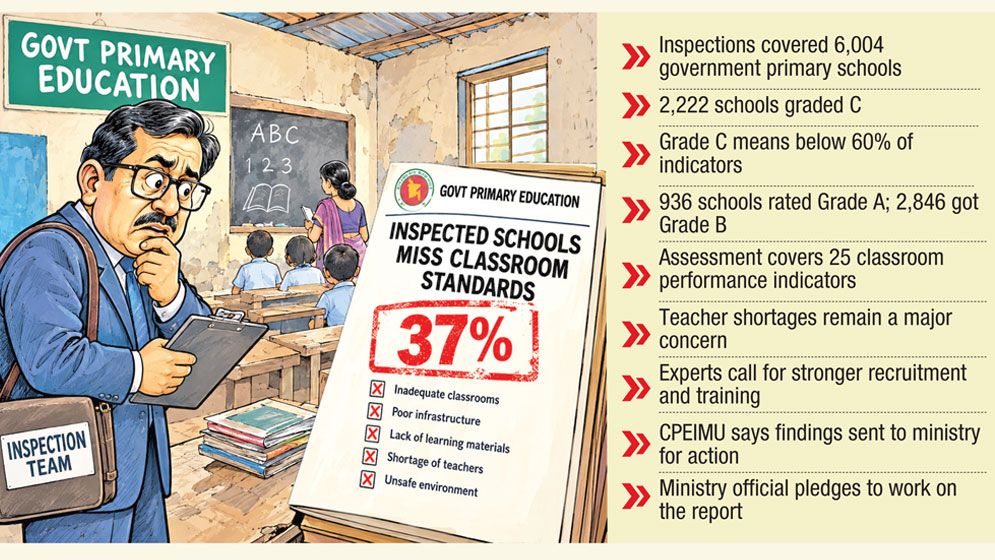
More than a third of government primary schools inspected across the country between January and August were rated below the required classroom standard, according to an inspection report obtained by the Daily Sun.
Of the 6,004 schools inspected, 2,222, or 37.22%, scored below 60% of the prescribed observational indicators and were placed in Grade C.
Another 2,846 received Grade B and 936 Grade A under the assessment system used by the Directorate of Primary Education (DPE).
The findings, compiled by the Compulsory Primary Education Implementation Monitoring Unit (CPEIMU), show wide variation across the areas covered by the inspection drive.
In January, 173 of the 352 schools inspected in Dhaka metropolitan area, Narayanganj, Mymensingh, Chandpur and Noakhali were graded C. In February, the figure was 25 of 58 schools in Dhaka district, including the city area. In March, 23 of the 28 schools inspected in Noakhali fell into the same category.
In April, 151 of 327 schools across 10 districts were graded C, followed by 396 of 816 across 15 districts in May. The drive expanded in June to 2,323 schools in 10 districts, of which 481 were graded C. In July, 368 of 782 schools in two districts received Grade C.
August recorded the highest monthly number, with 605 of the 1,315 schools inspected in Manikganj and Narsingdi placed in the category.
Md Abdul Halim Bhuiyan, director (administration and finance), who also holds additional charge of CPEIMU, said the findings had been sent to the ministry for action.
“We prepared the report, and the report is sent to the ministry, which decides on the necessary measures based on its findings,” he told the Daily Sun.
Abul Hossain, assistant evaluation officer at CPEIMU, said inspectors followed a prescribed format. “We have a prescribed format for our inspection reports. We prepare the reports accordingly and send them to the ministry,” he said.
Md Lal Hossain, additional secretary (school) at the Ministry of Primary and Mass Education, said the government was working to improve the quality of primary education.
“We are making every possible effort to improve the quality of education in primary schools. We are sincere in our efforts. We will work on the inspection report,” he said.
What the assessment measures
According to the DPE, Module 1 assesses classroom activities against 25 indicators in three broad areas: creating a safe and inclusive learning environment, lesson presentation and teaching-support strategies.
Inspectors examine whether teachers maintain a friendly classroom atmosphere, encourage pupil participation, ensure equal opportunities for boys and girls and support struggling pupils.
They also assess lesson delivery, achievement of learning outcomes, constructive feedback, use of prior knowledge and teaching aids, participatory and digital learning, questioning techniques and continuous assessment.
Schools ticked on 80% or more of the indicators are rated “Very Good”, while those scoring 60%-79% are rated “Good”. Schools below 60% are classified as “Needs Improvement” and are expected to receive mentoring and follow-up measures.
Teacher quality and recruitment
Professor Mojibur Rahman of the Institute of Education and Research (IER) at the University of Dhaka said filling teacher vacancies should be a priority.
“Many schools do not have the required number of teachers. In some schools, there are three teachers against a requirement of five, while in others, six or seven teachers are working against a requirement of 10,” he said.
He added that temporary shortages also arise when teachers attend training at Primary Teachers’ Training Institutes (PTIs).
Recruitment alone would not be enough, he said.
“We cannot expect to produce high-quality teachers by appointing people who do not have adequate qualifications and then trying to make them good teachers through training. The quality has to be ensured at the recruitment stage.”
He also called for regular refresher training as curricula and teaching methods evolve, saying teachers must keep pace with modern technologies, including artificial intelligence, and that schools need adequate laboratories and basic physical facilities.
Professor Mojibur said families, society and the state all had a role to play.
“Unless this mindset changes, it will not be possible to ensure an overall improvement in the quality of education only through teacher recruitment, training or infrastructure development,” he said.
The reporter can be reached at: [email protected]
Read More