


 For all latest news, follow the Daily Sun's Google News channel.


Smart Bangladesh Business Conference
Stimulus barely moves
Only Tk50cr disbursed to reopen closed factories in four months

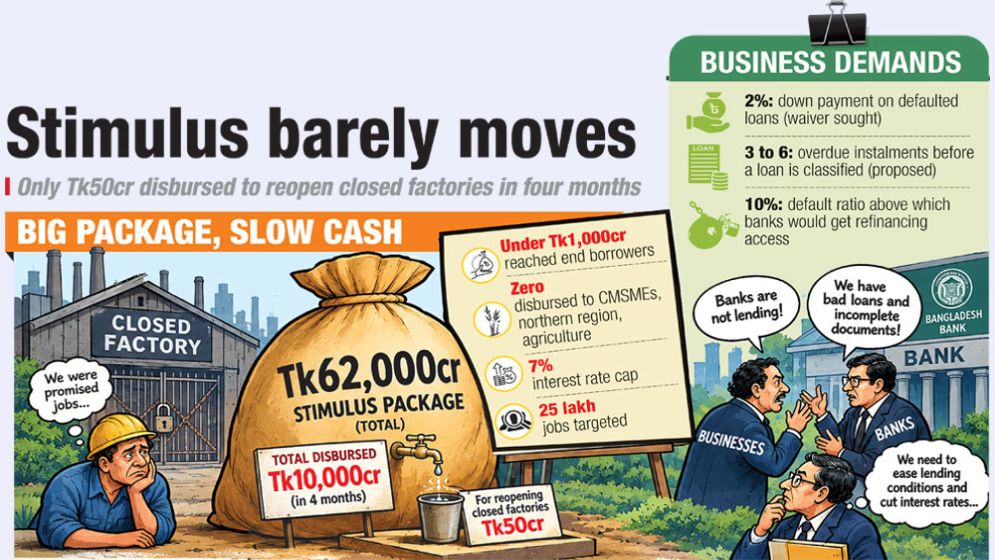
Four months into the Tk62,000 crore stimulus package, only Tk50 crore has been disbursed to reopen closed factories, against an allocation of Tk20,000 crore, with businesses and bankers blaming each other for the delay.
Overall, just Tk10,000 crore of the Tk62,000 crore package has been disbursed, and less than Tk1,000 crore has reached end borrowers. No loans have yet been released for cottage, micro, small and medium enterprises (CMSMEs), the northern region’s economy or agriculture.
Businesses blame default-loan restrictions, collateral demands and reluctant banks, while bankers cite mounting bad loans and incomplete documents for the delay in loan disbursal.
Bangladesh Bank (BB) is now exploring ways to ease lending conditions and cut interest rates to speed up disbursement.
The package, announced to revive closed factories, create jobs and reinvigorate the economy, offers loans to industrial entrepreneurs at interest rates of up to 7%. It aims to create employment for 25 lakh people.
Industries, however, continue to struggle with various challenges, including an energy crisis.
To accelerate disbursement, the central bank held a meeting with leaders of leading business organisations last Tuesday, having earlier consulted economists and former bankers. Views differed on the causes of the delay and the way out.
Sources familiar with the discussions said business leaders accused banks of being reluctant to lend and failing to cooperate, while bankers argued that entrepreneurs were unwilling to submit the documents and information required for loan approval.
A tripartite meeting of BB, bankers and business leaders is expected this month to find a way forward.
Economists, bankers urge caution
Mustafa K Mujeri, former chief economist of BB, who attended the meeting with economists, said: “The low-interest loans should be provided to eligible entrepreneurs following proper procedures. Banks have a responsibility to assess risks carefully before extending credit.”
He warned that disbursing loans merely to meet lending targets could create fresh problems for the banking sector. Instead of pressuring banks to lend more, BB could strengthenmonitoring to ensure the funds are used appropriately, he added.
Syed Mahbubur Rahman, former chairman of the Association of Bankers, Bangladesh (ABB) and managing director of Mutual Trust Bank, said banks’ primary responsibility was to lend after assessing risks.
With the sector burdened by non-performing loans, banks were scrutinising new applications carefully, he said, adding that banks must also assess whether closed enterprises have the operational capacity to resume production.
BB spokesperson Arief Hossain Khan said, “The stimulus package was announced to restore momentum to the economy. Loan disbursement under the package is ongoing, and banks are receiving applications.”
He said banks were forwarding applications from eligible businesses to the central bank, which was reviewing and processing them quickly.
BB was also holding discussions with stakeholders to determine whether additional measures were needed to speed up disbursement, he added.
Businesses seek easier terms
Business leaders made several recommendations to accelerate lending. They called for scrapping the condition that borrowers with defaulted loans cannot apply for stimulus loans.
Entrepreneurs struggling to keep factories running often cannot afford the 2% down payment needed to regularise defaulted loans, they said, adding that those with such money would be better placed to run their factories.
They proposed financing fully or partially closed enterprises after an independent third-party assessment of revival prospects, assets, production capacity, cash flow and repayment ability. They also sought project-based financing for closed enterprises, rather than treating default as the sole disqualifying factor, and special arrangements to remove borrowers’ names from the default list.
Other proposals included ensuring that one company’s default status does not automatically deny banking facilities to other companies in the same business group, and reconsidering the requirement to withdraw or settle pending court cases before financing.
The leaders also urged waiving the 2% cash deposit for borrowers seeking to regularise defaulted loans and resume production, directing banks to approve and disburse loans quickly, and setting up a support centre under BB supervision.
They further called for bringing banks with default loan ratios above 10% under the refinancing facility, raising the number of overdue instalments required to classify term loans as defaulted from three to six, simplifying application and approval procedures, and extending the policy support period for regularising default status.
Anwar-ul Alam Chowdhury (Parvez), president of the Bangladesh Chamber of Industries (BCI), told the Daily Sun the proposals were intended to facilitate lending based on relationships between banks and customers.
“Banks are unwilling to take risks by lending to closed factories. When entrepreneurs approach banks for loans, they are asked to provide mortgages. If they had the capacity to provide such collateral, they would have opted for a one-time exit facility,” he said.
He said BB was sincere about addressing the issue. Factories still operating but on the verge of closure, and distressed businesses facing working capital shortages, should also receive support to recover, he added.
Mohammad Hatem, president of the Bangladesh Knitwear Manufacturers and Exporters Association (BKMEA), told the Daily Sun that entrepreneurs were keen to benefit from the Tk20,000 crore stimulus for closed industries but were facing a lack of cooperation from banks. Many banks were unwilling to accept applications, while others discouraged entrepreneurs with various excuses, he said.
He added that certain complexities in BB’s circular were creating obstacles. Business leaders had urged the central bank to resolve them and process applications already submitted, and BB had assured them the issues would be addressed promptly, he said.
Mahmud Hasan Khan, president of the Bangladesh Garment Manufacturers and Exporters Association (BGMEA), said reopening closed factories was essential to restoring economic momentum.
“Building a new factory takes several years. Reopening a closed factory takes comparatively less time. That is why we have demanded relaxation of some conditions to increase disbursement from the stimulus fund,” he said.
How the funds are allocated
BB announced a Tk60,000 crore stimulus package in May, later raised to Tk62,000 crore. Of the total, Tk41,000 crore comes from banks’ own funds and Tk21,000 crore from central bank refinancing, with interest rates capped at 7%.
The banks’ own funds include Tk20,000 crore for closed industrial and service-sector enterprises, Tk10,000 crore for agriculture and the rural economy, Tk5,000 crore for CMSMEs, Tk3,000 crore for export diversification and Tk3,000 crore for agricultural hubs in the northern region.
The refinancing component includes Tk7,000 crore for pre-shipment finance and packing credit, Tk5,000 crore through PKSF for cottage and micro enterprises, and Tk1,000 crore each for Probashi Kallyan Bank, Karmasangsthan Bank and Ansar-VDP Unnayan Bank. A further Tk1,000 crore is earmarked for green financing, Tk2,000 crore each for frozen seafood and for leather and footwear exporters, and Tk500 crore each for startups and the creative economy.