




 For all latest news, follow the Daily Sun's Google News channel.


The National Board of Revenue (NBR) has repeatedly failed to meet its revenue collection targets despite raising its goals to keep pace with growing government expenditure and introducing a series of measures to boost tax receipts.
Initiatives such as recovering outstanding dues, preventing tax evasion, expanding the tax base, conducting tax audits, promoting alternative dispute resolution (ADR) and holding meetings with major taxpayers have failed to deliver the expected results.
Revenue figures for the past three fiscal years show persistent gaps between collection targets and actual receipts, raising questions about the tax authority’s capacity to meet increasingly ambitious goals.
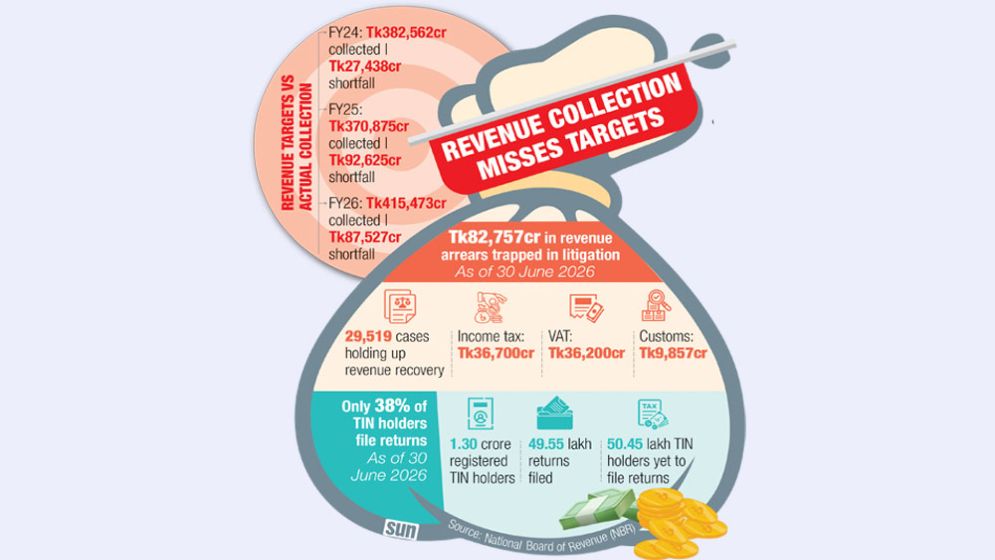
According to NBR data, revenue collection stood at Tk3.82 lakh crore in the fiscal 2023-24 against a revised target of Tk4.10 lakh crore. In FY25, collection fell to Tk3.71 lakh crore against a revised target of Tk4.63 lakh crore.
In FY26, provisional collection reached approximately Tk4.15 lakh crore against a revised target of Tk5.03 lakh crore, leaving another substantial shortfall.
Despite the repeated failures, the NBR is now pursuing an even higher revenue target for FY27.
However, although the first quarter of the current fiscal year has ended, the tax authority has yet to publish collection figures for the period.
Economists say simply raising targets or increasing administrative pressure on revenue officials will not resolve the problem.
They point to a narrow tax base, weaknesses in tax administration, sluggish economic activity, declining imports, widespread tax exemptions and slow progress in revenue management reforms as major obstacles to improving collection.
Three years of missed targets
An analysis of NBR statistics shows that the gap between revenue targets and actual collection has remained substantial over the past three fiscal years.
In FY24, the NBR initially set a collection target of Tk4.30 lakh crore, which was later reduced to Tk4.10 lakh crore. Actual receipts stood at Tk3.82 lakh crore, leaving a shortfall of Tk27,438 crore.
The tax authority had also missed its revenue target in the preceding fiscal year.
In FY25, the revised target was raised to Tk4.63 lakh crore, but collection amounted to Tk3.71 lakh crore, resulting in a shortfall of Tk92,625 crore.
The revised target increased further to Tk5.03 lakh crore in FY26. According to provisional NBR figures, collection reached approximately Tk4.15 lakh crore, leaving a gap of Tk87,527 crore.
Although revenue collection recovered in FY26 from the previous year’s level, the NBR still missed its revised target by around 17.4%.
The figures suggest that the tax authority’s collection capacity has failed to keep pace with the government’s rising revenue expectations.
On 9 June, Finance Minister Amir Khosru Mahmud Chowdhury told Parliament that political changes, sluggish economic activity, supply chain disruptions, rising production costs and inflation had contributed to the revenue shortfall.
Administrative weaknesses, economic slowdown
Economists and policymakers have long questined both the NBR’s administrative capacity and the realism of its revenue targets.
Ahsan H Mansur, executive director of the Policy Research Institute of Bangladesh (PRI), said an analysis of revenue collection pointed to weaknesses in the NBR’s administrative capacity, compounded by the economic slowdown.
He stressed the need to modernise tax administration, introduce automated systems, reduce direct interactions between taxpayers and revenue officials, and institutionally separate revenue policymaking from collection.
Towfiqul Islam Khan, additional research director at the Centre for Policy Dialogue (CPD), also questioned the feasibility of the revenue targets. He said the NBR was once again on course to miss its target, which he considered unrealistic given prevailing economic conditions and collection trends.
Narrow tax base, widespread exemptions
Bangladesh’s narrow tax base remains a major obstacle to increasing revenue collection.
Although millions of individuals and businesses engage in economic activities, a substantial portion remains outside the effective tax net, leaving existing taxpayers to shoulder much of the revenue burden.
The NBR’s revenue strategy documents have identified the limited tax base, widespread exemptions and tax evasion as major weaknesses in the country’s revenue system.
Tax concessions and exemptions across various sectors reduce potential receipts, while bringing a large portion of the informal economy under the value-added tax (VAT) system remains a challenge.
The documents also acknowledge weaknesses in the NBR’s research and analytical capacity, particularly in measuring the tax gap – the difference between potential tax revenue and actual collection.
Without reliable estimates of this gap, identifying sectors requiring reforms and assessing the potential gains from policy changes remain difficult.
Tk82,757 crore tied up in litigation
Alongside efforts to expand the tax base, the NBR faces another major challenge: recovering billions of taka in disputed revenue.
According to NBR data, Tk82,757 crore remains tied up in 29,519 cases involving income tax, VAT and customs duties.
Of the total, Tk36,700 crore is involved in 5,500 income tax cases, while Tk36,200 crore is tied up in 11,684 VAT cases. Another
Tk9,857 crore remains disputed in 12,335 customs-related cases.
Nearly Tk50,000 crore is reportedly tied up in cases involving businesses.
NBR sources said lists of the companies concerned had been sent to the Ministry of Finance, while initiatives were underway to resolve disputes and recover outstanding dues through discussions with business owners.
However, the efforts have yet to produce the expected results.
To accelerate recovery, the NBR is reportedly seeking to strengthen ADR, expedite hearings of long-pending cases, pursue book adjustments, freeze bank accounts where necessary and initiate certificate cases.
Syed Aminul Karim, a former NBR member for tax policy, said successful dispute resolution required both revenue officials and businesses to make concessions.
However, neither side had demonstrated sufficient willingness to compromise, he observed, adding that legal complexities also needed to be addressed.
TIN holders rise, but only 38% file returns
Despite growth in income tax collection and taxpayer registrations, the NBR continues to struggle to ensure regular return filing.
According to NBR data, income tax collection rose by 13.2% to approximately Tk1.46 lakh crore in FY26, compared with around Tk1.29 lakh crore in the previous fiscal year.
The figures include taxes collected from individuals, companies and other sources, rather than payments by individual taxpayers alone.
Meanwhile, the number of Taxpayer Identification Number (TIN) holders reached approximately 1.3 crore at the end of June 2026.
However, only around 49.55 lakh taxpayers, including individuals and entities, submitted returns for the 2025-26 tax year, accounting for approximately 38% of total TIN holders.
The wide gap between registered taxpayers and return filers highlights the continuing challenge of improving tax compliance.
Tax expert Snehasish Barua said stricter enforcement of existing return-filing requirements could help improve compliance.
He suggested that requiring proof of return submission for services such as trade licence renewal, bank loan applications and opening letters of credit for imports could encourage more taxpayers to comply with the law and bring additional economic activities into the formal tax system.