


 For all latest news, follow the Daily Sun's Google News channel.


At 13, Daisy was a schoolgirl who loved playing with her friends. One afternoon in 2007, she came home from the playground to learn that her marriage had already been arranged. Her childhood ended before she had the chance to choose anything else for herself.
She was in class eight when she married Shafiq, a 26-year-old man from a village in Ishwardi, Pabna. Her father worked as a hawker; her mother, Rita, earned a living cleaning other people’s homes.
After the wedding, Daisy moved in with her parents-in-law, three sisters-in-law, three brothers-in-law and another male relative of her husband’s, and took on the household’s cooking and chores.
At 14, she became a mother for the first time – the age at which most of her classmates were still sitting exams.
Daisy now has three children: sons Joy and Robbi, 18 and 12, and a daughter, Muskan, six. Her own struggle has continued far longer than her marriage. She has been receiving treatment at Pabna Mental Hospital for nearly five years.
“I was a very good student. I studied and played with my friends – those were very good times,” she said. “One day, I came back from the playground and learnt my marriage had been arranged.”
“When I become normal again, I hear what happened”
Daisy describes losing awareness of her own actions during episodes she cannot later recall. “When I become normal again, I hear from others what happened,” she said. “Sometimes I’m told I tried to harm myself.
Sometimes I’m told I tried to hurt my children.” She currently takes five separate medications a day.
Her treating physician, Dr Mohammad Ali, associate professor at Pabna Medical College and a consultant at Pabna Mental Hospital, said the connection to her marriage is more than circumstantial.
“Child marriage and pregnancy at an early age cause physical and mental harm to girls,” he told Daily Sun.
“This may be why Daisy has developed mental health problems.”
Her mother, Rita, has spent years living with the consequences of a decision made in a single afternoon.
“I do not want any mother to make the same mistake I did,” she said. “I was wrong to marry off my daughter at such an early age.” Poverty, fear for her daughter’s safety, and social pressure had all pushed her toward marriage as a solution. The family has been dealing with what followed ever since.
The numbers are moving – too slowly
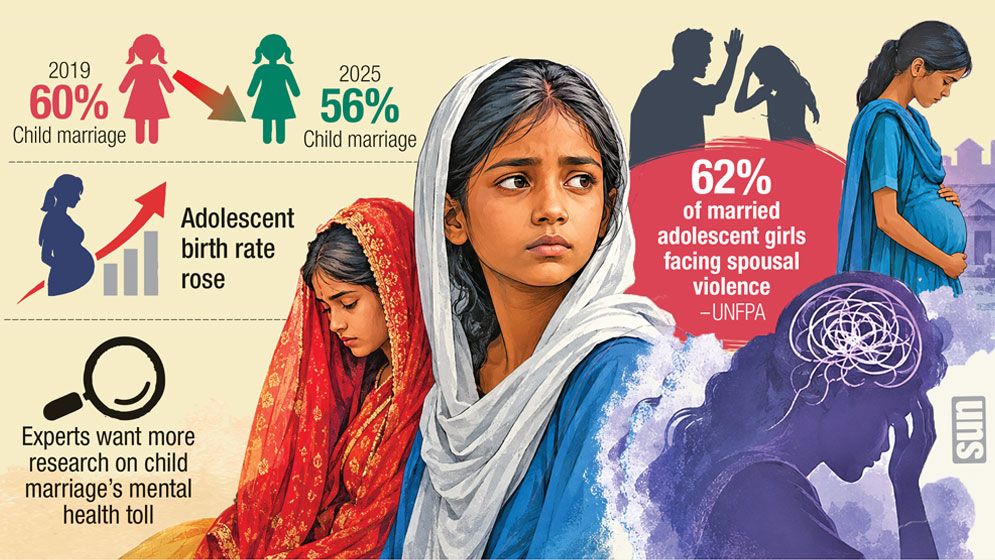
Bangladesh’s child marriage rate has fallen, but not nearly fast enough, and not evenly. According to the 2025 Multiple Indicator Cluster Survey (MICS), run by the Bangladesh Bureau of Statistics and UNICEF, the share of girls married before 18 dropped from 60% in 2019 to 56% in 2025; among women aged 20-24, the figure fell from 51% to 47%.
But the adolescent birth rate moved the other way, rising from 83-92 births per 1,000 adolescent girls over the same period – meaning fewer girls are marrying young, but a larger share of those who do are becoming mothers while still adolescents themselves.
The survey estimates that around 3.6 million girls are married as children in Bangladesh each year, at an economic cost of $7-8 billion annually in lost productivity and human potential.
At Bangladesh’s current pace, ending child marriage altogether would take more than 64 years.
The physical risk doesn’t end at the wedding
Dr Dina Layla Hossain, of the gynaecology and obstetrics department at Dhaka Medical College Hospital, said girls aged 10 to 14 are neither physically nor mentally prepared for childbirth.
Early pregnancy raises the risk of high blood pressure, anaemia, premature birth and caesarean delivery, she said, and she urged delaying childbirth until at least 21 to protect both mother and child.
The risks extend well past delivery: new responsibilities, sleep deprivation, family pressure and a lack of support can all take a toll on a teenage mother’s mental health long after the birth itself.
What the mental health data can – and cannot – say
Professor Dr Saifun Nahar, director of the National Institute of Mental Health, said starting a family and taking on household responsibility causes real strain even for adult women – strain that is harder still for girls forced into it early.
But she cautioned against drawing a direct causal line from child marriage to mental illness without further research, calling for more reliable data on the specific conditions affected girls experience and their access to long-term treatment.
The wider picture offers context, though not proof of cause.
The World Health Organization estimates that one in seven adolescents aged 10-19 worldwide lives with a mental health condition, and says such conditions are now among the leading causes of illness and disability in that age group.
In Bangladesh, the National Mental Health Survey 2018-19, conducted with WHO support and the National Institute of Mental Health, found that 13.6% of children aged 7-17 had a mental health problem, with a large share receiving no treatment or support.
Catherine Breen Kamkong, UNFPA’s representative in Bangladesh, said child marriage and early pregnancy place real physical and psychological pressure on adolescent girls, raising the risk of anxiety, depression, trauma and social isolation – compounded by limited decision-making power, interrupted education, sudden adult responsibility, and domestic violence.
A 2024 violence survey cited by UNFPA found that 62% of married adolescent girls in Bangladesh had experienced violence from their husbands in the preceding 12 months.
UNFPA also points to research, including the Bangladesh Adolescent Health and Wellbeing Survey, linking child marriage, interrupted education, gender-based violence and early pregnancy to depression, anxiety and behavioural problems – with evidence suggesting the anxiety and depression a young mother experiences during and after pregnancy can affect her child’s own emotional and behavioural development. The damage, in other words, does not necessarily stop with the generation it begins in.
Rana Flowers, a former UNICEF representative in Bangladesh, speaking to Daily Sun at the 16 November launch of the 2025 MICS report, said preventing child marriage and ensuring adolescents have accurate information and access to contraception remain central to reducing these risks.
Why families still choose marriage
Poverty is not the whole explanation.
Abdullah Al Mamun, sector lead for child protection and child rights governance at Save the Children, said many families still place more weight on finding a daughter a suitable husband than on helping her build a career or financial independence of her own – leaving girls who marry young with little say over major decisions in their own households, including when to have children.
“Girls should have the opportunity to pursue education, develop their careers and become self-reliant,” he said. “Marriage should not be presented as the only goal in life.”
Daisy’s own story is the social pattern made specific. Her mother believed marriage would protect her daughter against poverty, danger and judgement. Instead, it closed off the education, the interests and the future Daisy might otherwise have had the chance to choose for herself.
Support, not just prevention
Preventing child marriage matters, but so does supporting the girls who have already married. UNFPA has called for accessible reproductive health services, mental health counselling, and specialist treatment where needed, alongside the right for married girls to stay in or return to school, confidential access to contraception and health advice, and community-level awareness work involving families directly.
The organisation has also flagged weak enforcement of the Child Marriage Restraint Act and inadequate funding for the national action plan to end child marriage as unresolved gaps.
What’s still missing, even now, is basic data: how many affected girls actually receive regular mental health care, how many drop out of treatment, and whether Bangladesh has anywhere near enough specialists to meet the need.
The prevalence rate alone cannot capture the scale of the problem – what happens to a girl’s education, her health, and her ability to make decisions about her own life after the wedding matters just as much.
Speaking at an event on Sunday, Women and Children Affairs and Social Welfare Minister Prof Dr AZM Zahid Hossain called Bangladesh’s 51% child marriage rate “unthinkable in a civilised society.”
“Child marriage is not just a social problem – it is a major threat to children’s physical and mental well-being, education and future,” he said. “Alongside enforcing the law, it is essential to raise social awareness, involve families, and ensure mental health services.”
Read More