



 For all latest news, follow the Daily Sun's Google News channel.


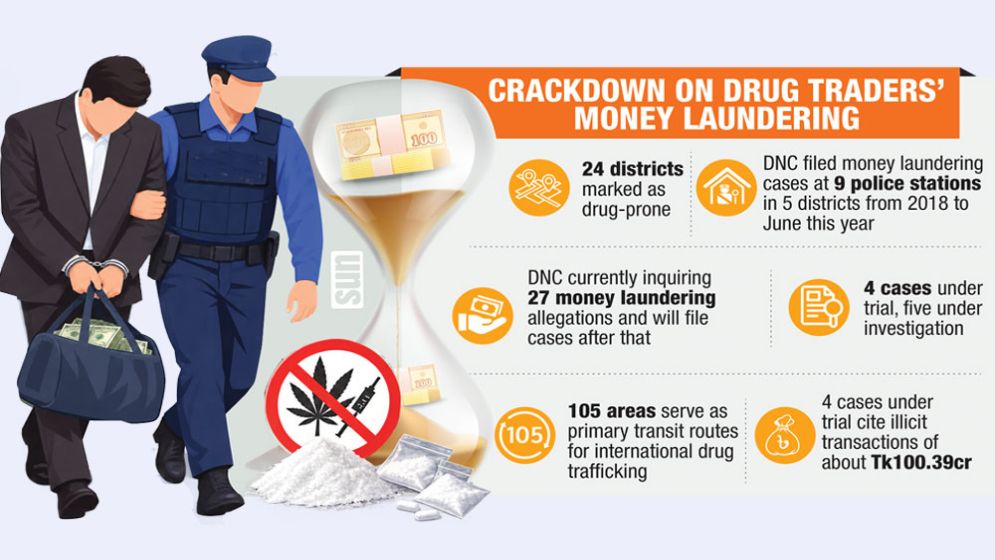
The Department of Narcotics Control (DNC) has identified 24 districts as serious drug-prone zones, where illegal drug trade is connected with money laundering, and decided to scale up legal actions against drug traders’ illegal financial operations there.
The DNC has filed money laundering cases against a number of top drug traders at nine police stations in five districts from 2018 to June this year, according to the department.
At a recent meeting attended by officials ranging from assistant directors to the director general, according to the minutes, the DNC took the initiative to file more cases and conduct investigations against drug traders in drug-prone districts where money laundering cases are yet to be lodged.
In the districts that are drug-prone but have no money laundering case despite having sufficient information and data to investigate and file a money laundering case, effective investigative activities must be undertaken with a view to filing such cases against drug traders, according to the meeting minutes.
The officers have even been told to start investigating, or file, at least two to three money laundering cases in each division, and to report progress at the next meeting, as per the meeting.
Besides, it was decided during the meeting that all activities in each money laundering-related case must be supervised and any obstacles must be reported to higher authorities. Additional directors will monitor cases within their jurisdictions.
Speaking on condition of anonymity, a senior officer of the DNC told the Daily Sun that drug dealers often get bail from courts in drug cases. “If specific evidence of money laundering can be collected and money laundering cases can be filed, the drug menace can be controlled.”
So, the department has decided to file money laundering cases against launderers, but only after collecting sufficient and proper evidence, the officer said.
Cases so far
Sources at the DNC said that the department is currently investigating 27 money laundering matters; after the inquiry ends, cases will be filed and investigated. Four money laundering cases are on trial and five are under investigation. This development followed the government’s authorisation of the DNC to deal with money laundering cases in 2012.
Charge sheets in the four trial cases cite illicit financial transactions worth about Tk100.39 crore. They were filed at police stations in Halishahar on 11 June 2018, Paharatali on 1 May 2019, Wari on 9 February 2022 and Tajhat on 9 March 2023, according to the sources.
The sources added that the five cases under investigation had been filed at police stations in Gulshan on 9 March 2025, Godagari on 26 January and 8 February in 2026, Dhamoirhat
on 15 March 2026 and Chapainawabganj Sadar Model Police Station on 16 June 2026.
Drug-prone districts
According to the DNC sources, the 24 most drug-prone districts in the country are: Dhaka, Narayanganj, Narsingdi, Gazipur, Mymensingh, Chattogram, Cumilla, Sylhet, Moulvibazar, Brahmanbaria, Cox’s Bazar, Rajshahi, Pabna, Bogura, Chapainawabganj, Joypurhat, Kurigram, Lalmonirhat, Rangpur, Dinajpur, Khulna, Satkhira, Jashore and Chuadanga.
In 18 of these districts, it has mapped 105 areas that serve as primary transit routes for international drug trafficking.
Main routes
In the west and south-west, key routes include Kolaroa, Debhata, Bhomra, Kakdanga and Palashpur in Satkhira; Benapole, Putkhali, Chougacha, Narayanpur and Shasha in Jashore; Karpasdanga, Darshana and Jibannagar in Chuadanga; and Dariapur and Buripota in Meherpur. In the north and north-west, routes run through Rajshahi, including Monigram, Charghat, Sardah, Godagari and Bagha. In neighbouring Chapainawabganj, activity is high around Volahat, Shahbajpur, Binodpur, Sonamosjid Land Port and Kansat. Panchbibi in Joypurhat is noted as a main transit point, while Dinajpur has a dense network of routes, including Ghoraghat, Fulbari, Birampur and Hili. In the east and north-east, areas of concern include Jakiganj in Sylhet, and Karimpur, Kasba and Akhaura in Brahmanbaria. In Cumilla, they include Chouddagram, Burichang and Bibirbazar, and in Feni, Chhagalnaiya, Fulgazi and Parshuram.
Further north, Kurigram is exposed through areas such as Bhurungamari, Roumari and Nageshwari, and Lalmonirhat through Aditmari, Patgram and Burimari. Border areas of Sherpur, Mymensingh and Netrokona, including Jhenaigati, Nalitabari and Haluaghat, are also affected.
In the south-east, Cox’s Bazar has an extensive network that includes St Martin’s Island, Shah Porir Dwip in Teknaf, Ukhiya, Balukhali and Nayapara.