



 For all latest news, follow the Daily Sun's Google News channel.


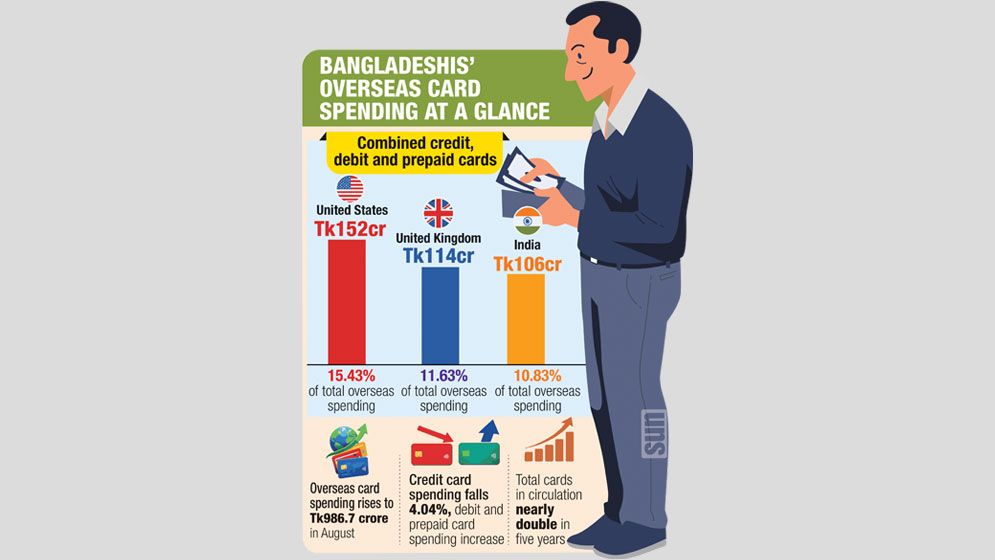
The United States accounted for the largest share of overseas spending by Bangladeshi cardholders in August, although the preferred destinations varied significantly across credit, debit and prepaid cards, according to Bangladesh Bank data.
Bangladeshis spent Tk152 crore in the US through the three types of cards, representing 15.43% of their total overseas card spending.
The United Kingdom ranked second with Tk114 crore, or 11.63%, followed by India with Tk106 crore, or 10.83%.
Together, the three countries accounted for nearly 38% of all overseas card spending by Bangladeshis during the month.
The figures were revealed in the latest report, titled An Overview of Card Usage Patterns Within and Outside Bangladesh, published by the Big Data Analytics and Data Science Unit of Bangladesh Bank’s Statistics Department.
According to the report, Bangladeshi cardholders made transactions worth Tk986.7 crore abroad in August, marginally higher than the previous month.
Meanwhile, foreign-issued cards were used for transactions worth Tk248 crore within Bangladesh, with US nationals accounting for the largest share.
Thailand, Ireland, Singapore, Saudi Arabia, China and Malaysia were among the other major destinations for overseas card spending.
Industry stakeholders said spending in the US may be driven by education, medical treatment, business travel and family visits, alongside international online purchases.
Relatively high costs of airfare, accommodation and other services could also contribute to the volume of transactions.
However, they noted that higher card spending in a particular country does not necessarily indicate a greater number of Bangladeshi visitors, as international online payments may also be included.
US dominates credit card spending
The United States topped the list of overseas credit card spending destinations, accounting for Tk86.6 crore through 216,000 transactions in August. This represented 17.16% of total overseas credit card spending.
Thailand ranked second with Tk54.8 crore through 51,714 transactions, accounting for 10.86% of the total.
The United Kingdom followed with Tk49.2 crore through 50,351 transactions, or 9.75%.
India recorded Tk46 crore through 48,498 transactions, while Singapore accounted for Tk40.3 crore through 64,080 transactions.
Malaysia followed with Tk28.9 crore, Canada Tk23.2 crore, the Netherlands Tk21.9 crore, Saudi Arabia Tk19.2 crore and China Tk18.6 crore.
UK leads debit card spending
Unlike credit cards, debit card spending was highest in the United Kingdom, where Bangladeshi cardholders spent Tk59.9 crore in August, representing 14.19% of the total.
The United States ranked second with Tk56.7 crore, or 13.43%, followed by India with Tk49.6 crore, or 11.76%.
Ireland recorded 149,000 debit card transactions worth Tk\38.6 crore, while China accounted for 101,000 transactions worth Tk31.5 crore.
India tops prepaid card transactions
India emerged as the leading destination for overseas prepaid card spending, accounting for Tk11.2 crore, or 18.71% of the total, in August.
The United States ranked second with Tk9 crore, representing 14.94%, followed by Saudi Arabia with Tk6.1 crore, or 10.21%.
Prepaid card spending in India also increased sharply from Tk8.6 crore in July to Tk11.2 crore in August.
The number of transactions rose from 11,424 to 15,328 during the period.
Overseas spending rises marginally
Overall overseas card spending increased just 0.20% month-on-month to Tk986.7 crore in August from Tk984.7 crore in July, despite a 4.14% rise in the number of transactions.
The total number of transactions climbed to 1.82 million from 1.74 million a month earlier.
Credit cards accounted for the largest share of overseas spending, with 823,000 transactions worth Tk504.6 crore. However, spending declined 4.04% from Tk525.9 crore in July.
Debit card spending, meanwhile, increased 5.24% to Tk422.1 crore from Tk401.1 crore. The number of transactions rose to 857,000 from 790,000.
Prepaid card spending also grew, rising 3.95% to Tk60.1 crore from Tk57.8 crore, while transactions increased to 136,000 from 124,000.
The figures indicate that modest growth in debit and prepaid card spending offset a decline in credit card transactions by value, leaving overall overseas spending almost unchanged.
Card numbers nearly double in five years
Bangladesh’s card market has expanded substantially over the past five years, with the combined number of debit, credit and prepaid cards rising 96% between September 2021 and August 2026.
The number of cards increased from 27 million to 53 million during the period.
Of the total cards in circulation in August, debit cards accounted for 41 million, prepaid cards 9.27 million and credit cards 2.81 million.
Prepaid cards recorded the fastest growth, increasing 174% between December 2022 and August 2026. Debit card numbers rose 37% and credit cards 33% during the same period.
The value of transactions through the three types of cards also more than doubled over five years, rising 103% from Tk24,560 crore in September 2021 to Tk49,769 crore in August 2026.
Despite the expansion, Bangladesh Bank identified several obstacles to the country’s transition towards a cashless economy.
These include inadequate digital infrastructure in rural areas, low financial literacy, cybersecurity risks, limited trust in digital platforms, high transaction costs and restricted smartphone access.
The report also cited the country’s cash-dependent culture and large informal economy as major barriers to wider adoption of digital payments.
Bangladesh Bank began promoting card-based payments in 2012 as part of efforts to develop a technology-driven, cashless banking system.
The Payment and Settlement Systems Act, which came into effect on 4 November 2024, subsequently established a legal framework for the country’s payment and settlement systems.