


 For all latest news, follow the Daily Sun's Google News channel.


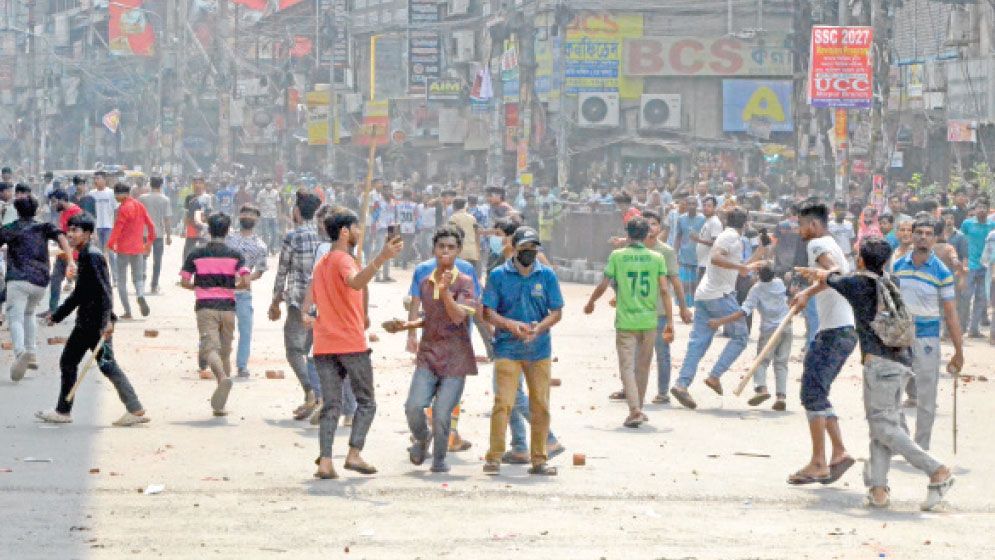
Garment workers’ protests continued for a fourth day on Tuesday, with clashes in Dhaka, Narayanganj and Gazipur, despite the government’s formation of a six-member Minimum Wage Board and repeated appeals to return to work.
 Officials allege that political elements are exploiting the unrest to destabilise the sector, while exporters warn of lost orders and deepening uncertainty for an industry that accounts for 81% of Bangladesh’s $48 billion in exports.
Workers staged demonstrations, attempted road blockades and clashed with police in Mirpur, Narayanganj, Ashulia and Gazipur, even though the board was gazetted on 1 November to review pay in the readymade garment (RMG) sector.
Unions say unresolved grievances over wages, dismissals and blacklisting are driving the unrest, while the sector, which directly employs around 4 million people, also faces an energy crisis, rising production costs and doubts over market access after graduation from least developed country (LDC) status.
According to the Bangladesh Garment Manufacturers and Exporters Association (BGMEA), more than 306 factories in Mirpur, Gazipur, Mymensingh, and Savar’s Ashulia and Zirani areas declared holidays on 3 November, affecting nearly 695,000 workers. The association said 1,828 of the country’s 2,134 factories were in operation until Tuesday.
Workers’ demands
The demonstrators are demanding a minimum monthly wage of Tk30,000, up from the present Tk12,500. The current wage structure was announced in November 2023 and took effect that December. Workers say their earnings no longer cover food, rent, transport, healthcare and education amid persistently high inflation.
They are also seeking the reinstatement of dismissed workers, the withdrawal of cases against labour activists, the release of detained workers and an end to alleged employment blacklisting.
Workers say their pay trails that of competitors. H&M Group data published in March put Bangladesh’s minimum monthly garment wage at $102, against $124 in India, $294 in China, $208 in Cambodia, $172 in Indonesia, $163 in Vietnam and $135 in Pakistan.
Allegations of political involvement
Additional IGP Gazi Jashim Uddin, chief of the Industrial Police, told the Daily Sun that some labour leaders with Awami League affiliations were instigating workers.
“Actually, we see that there are some labour leaders who have affiliations with the Awami League. They are instigating it,” he said. He added that activists of the Awami League, Jubo League and Chhatra League were also infiltrating protests in areas such as Gazipur, Ashulia and Savar.
“We cannot identify anyone separately; IDs cannot be checked for everyone on the street,” he said.
Leaders accused of making provocative social media statements had been placed under surveillance, he said. However, they could not be acted against at present because they could use their status as labour leaders to speak against the government on global platforms, which “would not be good for the garment sector”.
Home Minister Salahuddin Ahmed said those engaging in unlawful activities “under the guise of labor movements will be tackled with an iron hand”. He attributed the highway blockades and arson to external political interference and said factions backed by “a fallen autocratic regime” had been using workers to create instability.
“The government is sincerely working to improve the living standards of garment workers,” he said, adding that with the wage board’s work under way, “there is no scope for creating fresh unrest”.
Unions cite blacklisting and weak industrial relations
Ahsan Habib Bulbul, president of the Garments Sramik Front, said the core problem was the absence of industrial relations. He alleged that owners deliberately prevent active unions at factory level, leaving federation leaders with little contact with grassroots workers.
He cited an International Labour Organization (ILO) study that found only 157 collective bargaining agreements across all industries in Bangladesh, and said many of the 291 RMG washing and dye factories have no worker representation.
He also alleged that workers who try to form unions or protest are flagged in a government database and rejected by other factories through fingerprint verification. “Though hard to prove officially, thousands remain jobless, and accumulated injustice eventually erupts,” he said.
Mr Bulbul said the government’s acceptance of the wage demand was a primary victory, but that workers unfamiliar with the wage board process remained volatile amid a “protest and get it” culture. Allegations of political instigation, he said, overlook genuine grievances. “The root injustices must be addressed.”
AAM Foyez Hossain, joint coordinator of Sramik Karmachari Oikya Parishad (SKOP), a platform of 15 federations, said workers should return to work now that their demands had been accepted and a board formed. He added that it could not be said with certainty that blacklisted individuals or anyone else was instigating the unrest.
Appeals to return to work
The IndustriALL Bangladesh Council (IBC) urged workers in Gazipur, Mirpur, Ashulia and surrounding areas to return to their factories immediately. General Secretary Salauddin Shapon said the council was seriously concerned that street unrest had continued after the board’s formation.
The IBC warned that third-party vested interests were trying to exploit workers’ demands. “Genuine workers can never be involved in destroying the industry,” it said, cautioning that damage to factories would cost jobs and market share to rival countries.
Babul Akhter, the workers’ representative on the board, also urged workers to return and refrain from sudden protests. He said he wanted the new wage to reach workers from January 2027, three years after the last increase in December 2023.
He said the board should meet continuously, with intervals of no more than one or two days, and hold all-night sessions if necessary. He criticised proposals for fortnightly meetings or delays over the absence of a member abroad, and noted that the board was formed much later than the law requires.
Mr Akhter also alleged that union leaders and workers were being indiscriminately arrested and implicated in harassment cases, and called for the release of detainees and the withdrawal of what he described as false cases.
Exporters fear lost orders
Exporters said international buyers might cut orders if the unrest is not contained soon. BGMEA vice-president Shehab Udduza Chowdhury said they feared Bangladesh would lose orders if the situation did not improve quickly.
Mohammad Hatem of the Bangladesh Knitwear Manufacturers and Exporters Association (BKMEA) said the unrest hampered the industry and the economy, and that the movement was intended to put the government in a difficult position.
Federation of Bangladesh Chambers of Commerce and Industry (FBCCI) Administrator Md Fazlul Hoque said wage increases should be settled through a formal process, and urged all parties to wait patiently for the board’s decision.