



 For all latest news, follow the Daily Sun's Google News channel.


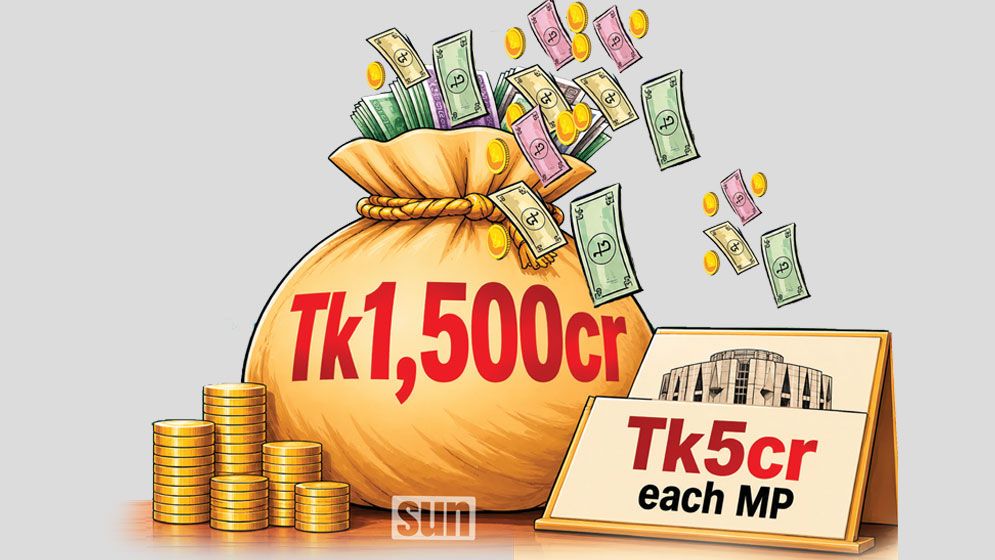
The government is considering a Tk1,500 crore special allocation for 300 members of parliament (MPs), with each lawmaker set to receive Tk5 crore for development and welfare activities in their constituencies, despite mounting fiscal pressure and austerity measures aimed at curbing public expenditure.
The Local Government Division has proposed financing the allocation from the annual development funds of upazila parishads and city corporations, rather than creating a separate fund.
The proposal has raised questions about public spending priorities, the financial autonomy of local government institutions and accountability in the use of public money.
On 10 November, Local Government Division Senior Secretary Md Shahidul Hasan sent two separate letters to Finance Division Secretary Dr Md  Khairuzzaman Mazumder, seeking the proposed allocation. Its implementation will depend on approval from the Finance Division and subsequent administrative procedures.
The funds could be used to renovate educational and religious institutions, support poor and meritorious students, assist disadvantaged people, and promote sports and cultural activities.
The proposal comes as the government is enforcing austerity measures in the 2026-27 fiscal year, restricting the purchase of new vehicles, overseas training and seminars using public funds, and the construction of new buildings. Ministries and divisions have also been instructed to keep expenditure within their original budget allocations.
Dr Zahid Hussain, former lead economist of World Bank’s Dhaka office, said questions over the proposed allocation were natural amid the country’s financial strain, although there was a theoretical argument for giving elected representatives a role in local development.
“MPs are elected by voters in their respective constituencies, and therefore it could be argued that they should have financial instruments to play a role in local development,” he said.
However, he cautioned that irregularities in the use of such funds had become the norm, while examples of good practice remained exceptions.
If the allocations were made, he said, transparency and accountability would be essential. There should be an impartial process for selecting projects and determining expenditure, with information on project selection, tendering, implementation and spending made public.
Project selection should reflect actual needs and public interest rather than MPs’ political affiliations or recommendations, he added.
Zahid also questioned whether lawmakers needed separate development funds, pointing out that their primary responsibilities were to legislate, approve the national budget and hold the government accountable. Existing government administrations and local institutions were already responsible for implementing development projects, while parliamentary committees could oversee public spending.
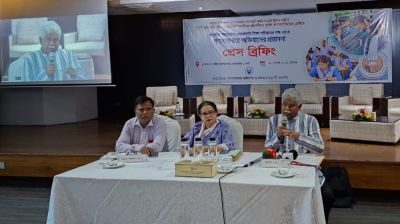
Transparency International Bangladesh (TIB) Executive Director Iftekharuzzaman said experience, research and media reports suggested that a significant portion of block allocations risked being used for partisan purposes in the name of development.
Local projects were often undertaken and implemented under the control of party leaders and activists affiliated with the MPs concerned, creating opportunities for political influence, corruption, embezzlement and waste of public money, he said.
There had been expectations that the current government would break with such practices. Before approving any special allocation, it should have assessed its necessity and potential benefits impartially and introduced clear guidelines for project selection and implementation.
However, substantial opportunities for public spending were now being created without such safeguards, raising concerns that partisan influence and misuse of public money could continue, he added.
Where will the money come from?
Of the proposed Tk1,500 crore, Tk1,320 crore would come from the annual development funds of upazila parishads for 264 MPs representing constituencies outside city corporation areas. Each would receive Tk5 crore.
The remaining Tk180 crore would be drawn from the City Corporation Development Assistance Fund for 36 MPs representing constituencies within city corporation areas, also at Tk5 crore each.
The current fiscal year’s budget has allocated Tk3,255 crore in development assistance to local government institutions. The proposed allocation for MPs would be drawn from this amount through the development funds of upazila parishads and city corporations.
These funds are normally used by local government institutions to build and repair roads, develop educational institutions, renovate religious and social establishments, and improve public service infrastructure.
If approved, the proposal would give MPs a separate opportunity to influence spending according to their priorities, alongside existing development plans of local government institutions.
More development funds planned for MPs
The proposed Tk1,500 crore allocation is not the only initiative to channel additional funds into parliamentary constituencies.
According to relevant sources, the Local Government Division is planning 16 new projects across the country’s eight divisions, with two projects in each division – one covering urban constituencies and the other constituencies outside urban areas.
Under the plan, each parliamentary constituency would receive Tk10 crore annually, or Tk50 crore over five years.
The money would be spent on roads, bridges, culverts, marketplaces and ferry terminals. MPs would submit lists of priority projects, which would be implemented by the Local Government Engineering Department (LGED).
Last month, the Local Government Division also approved a block allocation of Tk51.18 crore from the Union Parishad Development Assistance Fund for 3,159 union parishads.
The move to allow MPs to influence development spending has also triggered political controversy. Previous governments had provided special allocations of Tk15 crore to Tk20 crore for constituency development, including during the Awami League’s tenure.
However, allegations of irregularities, nepotism and political influence in the use of these funds and project implementation have surfaced repeatedly.
Austerity drive raises questions
The government’s financial constraints are also reflected in the guidelines for preparing the revised budget for the current fiscal year.
In a 10 November budget circular, the Finance Division instructed ministries and agencies to keep revised expenditure within the limits set in the original budget and not seek additional allocations under any circumstances.
Restrictions were also imposed on constructing new residential and non-residential buildings, purchasing motor vehicles, acquiring land and sending officials abroad for training programmes, seminars and workshops at public expense.
The proposed allocation for MPs has therefore drawn attention to an apparent contradiction between the government’s austerity drive and plans for additional development spending.
The government is heavily dependent on domestic and foreign borrowing to finance the deficit in the Tk9.38 lakh crore budget for the current fiscal year, with substantial borrowing planned from the banking system.
Against this backdrop, the proposed Tk1,500 crore allocation has intensified scrutiny of how public money is prioritised and whether adequate safeguards will prevent its misuse.