


 For all latest news, follow the Daily Sun's Google News channel.


Banking sector’s defaulted loans surge to Tk6.27 lakh crore
Daily Sun Report, Dhaka
Published: 24 Nov 2026, 12:00 AM
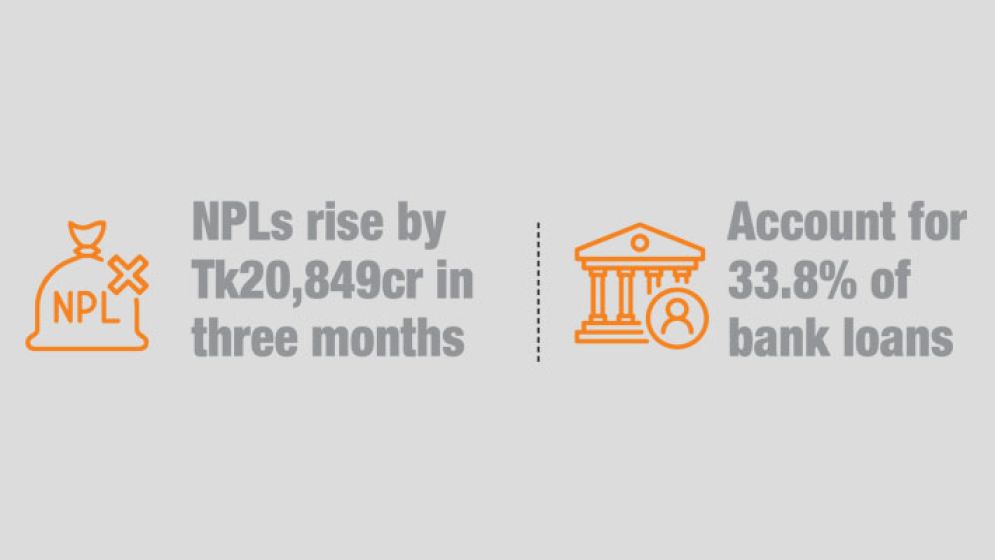
Non-performing loans (NPLs) in Bangladesh’s banking sector rose by Tk20,849 crore in just three months to reach Tk6,27,404 crore at the end of September, accounting for 33.80% of total outstanding loans and highlighting the deepening fragility of the country’s financial sector.
The latest figures, released by Bangladesh Bank (BB) on Monday, show that the volume of classified loans increased from Tk6,06,555 crore at the end of June, when the NPL ratio stood at 32.78%. At the end of September, total outstanding loans in the banking system stood at around Tk18,56,200 crore, compared with Tk18,50,600 crore three months earlier, indicating that bad loans grew significantly faster than overall lending.
The latest increase comes despite various policy concessions and loan restructuring facilities offered by the banking regulator to facilitate loan recovery and support genuine borrowers.
According to Bangladesh Bank data, classified loans stood at Tk5,57,217 crore at the end of December 2025. NPLs in the first quarter of this year (January-March) reached Tk5,88,704 crore.
The banking sector's deteriorating loan quality has largely been attributed to widespread irregularities, loan scams, fraud and corruption during the 15-and-a-half-year rule of the Awami League government, according to banking sector insiders.
When the alliance government led by the Awami League, whose activities are currently banned, assumed office in January 2009, classified loans stood at Tk22,481 crore. The figure had surged to Tk2,11,391 crore by June 2024, shortly before the government was ousted.
After the fall of the Awami League government, the interim administration began bringing the actual condition of the banking sector to light. The absence of many politically influential borrowers and the identification of previously concealed bad loans contributed to a sharp rise in classified loans. The interim government subsequently introduced special loan rescheduling concessions, which temporarily reduced the volume of NPLs.
However, the latest Bangladesh Bank data indicate that bad loans have continued to rise under the current government.
Arief Hossain Khan, executive director and spokesperson of Bangladesh Bank, told the Daily Sun that classified loans had not increased significantly in the latest quarter, but the outstanding bad loans were not declining as expected.
He said policy support, including loan rescheduling facilities for genuine entrepreneurs, was taking time to receive approval and become effective.
"Some banks have approved the facilities, while others are at the implementation stage. We expect classified loans to come down after December, once genuine entrepreneurs are able to regularise their loans," he said.
Banks also continued to face a substantial provisioning shortfall. The shortfall stood at Tk2,18,339 crore at the end of September.
Zahid Hossain, former lead economist of the World Bank, told the Daily Sun that politically motivated lending and large-scale loan diversion over the years had made a substantial portion of the bad loans unlikely to be recovered.
He stressed that genuine business borrowers should receive necessary policy support, while loans obtained through political influence and fraudulent means should be dealt with separately.
He also called for strict punishment for those responsible for loan scams and deliberate defaults to prevent moral hazard and discourage similar irregularities in the future.
"Punishment must be imposed; otherwise, borrowers will not repay," he said, adding that deliberate defaulters should also face social boycotts.
Bank-wise breakdown
The Bangladesh Bank data show that state-owned banks had Tk1,49,712 crore in classified loans at the end of September, accounting for 46.59% of their total outstanding loans.
Private commercial banks accounted for the largest volume of bad loans, with Tk4,55,473 crore, or 32.02% of their total lending.
Foreign commercial banks reported Tk3,915 crore in classified loans, representing 5.92% of their total loans.
Read More