



 For all latest news, follow the Daily Sun's Google News channel.


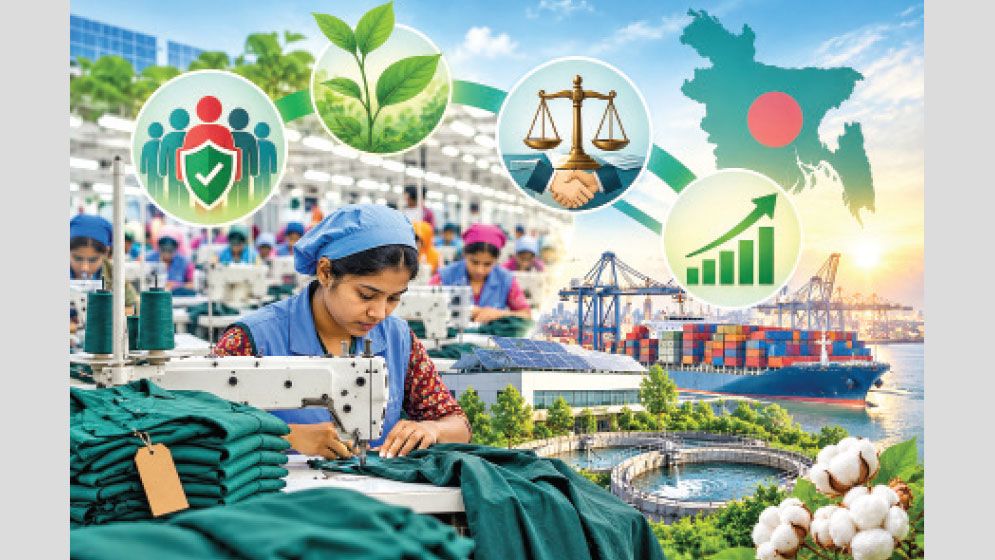
Bangladesh’s ready-made garment (RMG) industry is one of the country’s greatest economic success stories. Over four decades, it has transformed Bangladesh into a major global apparel manufacturing hub. The sector generates over 80% of the country’s export earnings while supporting millions of livelihoods, making it a cornerstone of the national economy and industrialization.
Bangladesh’s ready-made garment (RMG) industry is one of the country’s greatest economic success stories, transforming it into a major global apparel manufacturing hub and generating over 80% of export earnings while supporting millions of livelihoods. Its competitiveness has long rested on cost efficiency, a large workforce, manufacturing capacity and scale. Yet global competition is changing. Buyers, investors and regulators increasingly demand ESG performance, supply-chain due diligence and credible sustainability data. As Bangladesh approaches LDC graduation, responsible production is becoming central to market access, resilience and competitiveness. Responsible Business Conduct (RBC) is therefore no longer simply a compliance expectation, but an emerging business imperative.
The question, therefore, is no longer whether responsibility matters, but how Bangladesh can turn responsible business practices into a source of long-term industrial strength, competitiveness and resilience.
From Compliance to Responsibility
The OECD Guidelines for Multinational Enterprises on Responsible Business Conduct provide an important international reference for this transition. RBC encourages businesses to identify social and environmental risks, prevent or mitigate adverse impacts, monitor performance, communicate transparently and address problems when they arise. For Bangladesh’s RMG sector, this means moving from “meeting requirements” to “managing responsibility.” Compliance focuses on meeting standards, passing audits and fulfilling buyer requirements. RBC goes further by identifying risks, managing impacts, addressing problems and driving continuous improvement. The emphasis is on factory-level performance: worker wellbeing, human rights, environmental management, climate resilience, traceability and transparent, credible reporting.
The Business Imperative
For Bangladesh’s RMG sector, Responsible Business Conduct (RBC) is becoming a critical factor in international competitiveness, investment and market access. It should no longer be viewed as a business cost, but as a strategic investment that strengthens competitiveness, builds resilience and secures long-term market access. Poor labour practices, unsafe workplaces, environmental incidents, weak governance and limited supply-chain transparency can expose manufacturers to financial, operational and reputational risks. Conversely, responsible practices can improve resource efficiency, worker retention, productivity, resilience and buyer confidence. Integrating ESG and RBC into factory-level strategies can strengthen Bangladesh’s position as a responsible, competitive and resilient global sourcing destination.
The Factory Floor: What RBC Looks Like in Practice
Responsible Business Conduct (RBC) must be visible in everyday factory operations. It is not merely a policy, an audit certificate or a sustainability report. It should shape how workers are treated, resources are used, risks are managed, and decisions are made. For Bangladesh’s RMG sector, responsibility must translate into measurable factory-level performance.
People, workers and human rights are at the heart of responsible business. A responsible factory should ensure a safe and healthy workplace, uphold workers’ rights, prevent discrimination and harassment, promote fair treatment, and provide accessible and trusted grievance mechanisms. Bangladesh has made significant progress in workplace safety, particularly since Rana Plaza, through stronger fire and building safety, improved occupational health and safety systems, worker training and factory committees. Yet RBC requires continuous improvement. Freedom of association, collective bargaining, fair wages, reasonable working hours, social protection and non-discrimination must remain priorities. Human rights due diligence can help factories identify risks, prevent harm and take corrective action.

Climate and environmental responsibility are equally central to building a responsible and resilient RMG sector. Bangladesh has made notable progress in green manufacturing, with around 270 LEED-certified green factories. Environmental practices increasingly include Effluent Treatment Plants, Higg Index assessments, ZDHC guidelines, water-efficient dyeing technologies, low liquor ratio machines, digital process controls, wastewater recycling, rainwater harvesting, Zero Liquid Discharge systems and renewable energy. These measures can reduce freshwater dependence, improve resource efficiency and lower environmental impacts. Climate resilience also requires preparing for floods and cyclones, protecting workers from heat stress, strengthening biodiversity management, diversifying raw material sourcing and investing in resource-efficient technologies.
Ultimately, RBC must move beyond policies and commitments to measurable performance on the factory floor. Integrating worker wellbeing, human rights, environmental management, climate resilience, traceability and reliable ESG data can strengthen operational resilience, buyer confidence and the long-term competitiveness of Bangladesh’s RMG industry.
Challenges: The Cost of Falling Behind
Despite significant progress, several structural challenges continue to limit Responsible Business Conduct (RBC) in Bangladesh’s RMG industry. The journey from compliance to genuine responsibility is not always straightforward. Finance remains one of the biggest barriers. The sector faces an estimated USD 4.8 billion financing gap, against approximately USD 6.6 billion required to halve sector emissions by 2030. High financing costs, collateral requirements and limited access to suitable financial instruments, including GTF, make the transition especially difficult for smaller suppliers.
The challenge becomes more apparent when factories move from sustainability commitments to measurable action. Many SMEs still struggle with data management and sustainability reporting because of limited systems, skills and technical capacity. As a result, reporting remains fragmented and largely compliance-driven, rather than serving as a meaningful tool for business decision-making. Resource efficiency and environmental performance also face persistent challenges, including dependence on fossil fuels, high upfront investment requirements and limitations in grid capacity. Bangladesh’s low share of renewable energy further highlights the gap between ambition and implementation, pointing to the need for stronger data systems, cleaner energy, targeted investment and practical technical support across the RMG sector.
On the factory floor, responsibility means addressing wages, worker representation, skills development and human rights due diligence. Growing buyer requirements, certifications and regulations add compliance costs and audit fatigue. Complex licensing, unreliable energy supply, inadequate grid capacity and limited access to renewable energy continue to hold back Bangladesh’s RMG sector from achieving more responsible, resilient and competitive production.
Way Forward: Building a Responsible and Competitive RMG Sector
Bangladesh must move beyond audit-driven compliance towards integrated Responsible Business Conduct, with shared accountability across government, business and society. The recommendations below set out a pathway to make this shift meaningful and lasting.
l Policy & Shared Responsibility: Develop a coordinated, practical, and industry-informed 5-year transformation roadmap, supported by a Responsible Business Hub that brings together government, businesses, industry associations, development partners, workers, and civil society to strengthen factories’ capacity to meet evolving due diligence, sustainability, and reporting requirements.
Finance: Make green finance more accessible, understandable and appropriately structured across the RMG supply chain. Provide targeted financial support to help both large and small enterprises adopt responsible practices without undermining competitiveness.
l Green Transition: Strengthen environmental governance by expanding renewable-energy policy beyond rooftop solar to corporate and virtual PPAs and other off-site mechanisms; reviewing fiscal incentives for complete renewable-energy systems, including batteries; establishing a national sludge-management policy; strengthening chemical management and ZDHC alignment; and shifting ETP/STP oversight towards outcome-based performance and verified functioning.
l Decent Work: Strengthen labour standards, ensure fair wages and safe workplaces, empower worker representation, improve grievance mechanisms, and enforce zero tolerance for discrimination, harassment, and abuse.
l Data Management: Develop standardised, digital, and verified ESG data systems, supported by a national framework for sustainability reporting, verification, and disclosure to improve decision-making, transparency, access to finance, and competitiveness.
l Capacity Building: Develop certified and practical technical programs with factory-based coaching, competency assessment, shared specialist services, and peer learning, extending support to Tier-2 and Tier-3 suppliers while integrating decarbonization, data, finance, and practical implementation.
For Bangladesh’s RMG sector, Responsible Business Conduct is no longer merely about passing audits or meeting compliance requirements. It is about building the foundations of future competitiveness. By embedding responsibility into business decisions and factory operations, Bangladesh can strengthen resilience, secure market access and position its garment industry for sustainable, long-term growth.
______________________________________________________
Dr Ahmad Kamruzzaman Majumder is Professor, Department of Environmental Science, Dean-Faculty of Science, Stamford University Bangladesh, Environmental Scientist, and Mohammad Rabiul Kabir is Associate Professor, Stamford University Bangladesh, ESG & Sustainability Professional