


 For all latest news, follow the Daily Sun's Google News channel.


IUB Dialogue Urges Equitable Medical Oxygen Access in Bangladesh
Daily Sun Report, Dhaka
Published: 20 Aug 2026, 01:24 PM
Courtesy
Investment in medical oxygen has failed to keep pace with rising demand in Bangladesh, and much of the supply infrastructure built during the COVID-19 pandemic now sits idle – a gap that speakers at a policy dialogue at Independent University, Bangladesh (IUB) said the country can no longer afford to ignore.
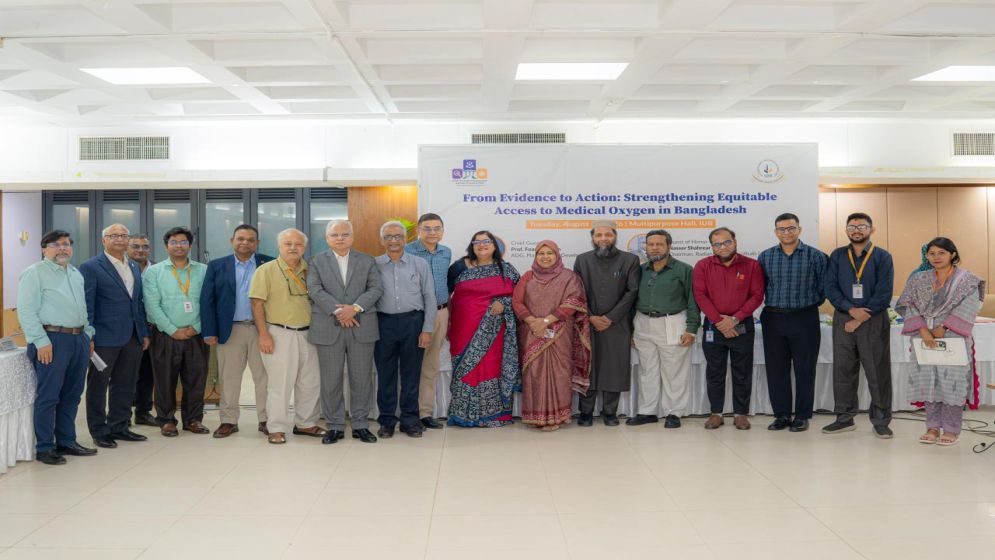
The dialogue, titled “From Evidence to Action: Strengthening Equitable Access to Medical Oxygen in Bangladesh”, took place on August 18, 2026 at the IUB Multipurpose Hall. It was organized by the Center for Health, Implementation and Policy Sciences (CHIPS) at IUB, with support from the university’s School of Pharmacy and Public Health.
Speakers said medical oxygen plants and supply systems set up during the pandemic have largely fallen dormant, with the losses felt most acutely in remote areas. The discussion also drew attention to the strain on medicine, gynaecology and obstetrics patients, and to the difficulty clinicians face in securing a steady oxygen supply – a reminder that the shortfall is not only a matter of hardware but of everyday clinical care.
Participants called for oxygen therapy to be included into MBBS and master's-level medical education and for field workers to be given basic knowledge and tools to extend care. For off-grid areas where conventional concentrators cannot operate, speakers pointed to solar-powered oxygen concentrators – already in use in Somalia – as a means to widen access and reduce mortality.
Prof. Dr. Foara Tasmim, Additional Director General (Planning and Development) at the Directorate General of Health Services (DGHS), attended the event as the Chief Guest. Md. Nasser Shahrear Zahedee, Founder and Chairman of Radiant Pharmaceuticals Limited, was the Guest of Honour. Didar A Husain, Chairman of the IUB Board of Trustees, was the special guest. Prof. M. Tamim, Vice Chancellor of IUB, presided over the discussion.
Prof. Dr. Foara Tasmim said the dialogue has given her a clear idea of what her role as a government official should be in ensuring equitable access to oxygen. She also stressed the importance of translating research into policy interventions. Until now, the government had been thinking of repairing the dormant oxygen supply infrastructure to bring it back into operation; but training local manpower is more important, so that they can identify who needs oxygen most. She requested the scientists and experts to guide government in incorporating the global and local good practices in providing low-cost quality oxygen therapy.
Md. Nasser Shahrear Zahedee said, medical oxygen is recognized as an essential medicine under government’s Essential Drug Policy and stressed that the quality of oxygen and safety of supply infra-structure must be ensured. He also said the government, private sector, philanthropic organizations and universities all had a part to play. He pointed to a possible collaboration between IUB and his organization Zahedee Foundation for a situation study in Jhenaidah district on the scope for producing oxygen locally.
Dr. SM Moazzem Hossain, Director of CHIPS, said, the dialogue would culminate in a policy brief to be shared with the relevant authorities, translating the day's discussions into concrete recommendations for strengthening equitable access to medical oxygen. He added that IUB is also planning to host an Oxygen Summit in October in collaboration with ICDDR,B and under the umbrella of Oxygen Network to engage stakeholders for every relevant sector to push the agenda forward.
Dr. Ehsanur Rahman, Scientist at ICDDR,B, delivered the keynote presentation on “Reducing Global Inequities in Medical Oxygen Access: The Lancet Global Health Commission on Medical Oxygen Security.” He highlighted on identifying who needs oxygen, getting Oxygen through proper channel and when to stop oxygen therapy.
The keynote presentation followed a panel discussion, which featured Prof. Dr. Md. Abid Hossain Mollah, Head of the Department of Pediatrics/Neonatology at BIRDEM General Hospital and Ibrahim Medical College, Dhaka; Dr. Shams El Arifeen, Emeritus Scientist in the Maternal and Child Health Division of ICDDR,B; Dr. Mamunur Rahman Malik, physician and epidemiologist; and Shishir Moral, Special Correspondent at Prothom Alo.
The dialogue brought together participants from the Bangladesh Medical Research Council (BMRC), Dhaka Medical College, professional bodies including the Bangladesh Society of Medicine and Obstetric and Gynaecology Society of Bangladesh. Development partners like UNICEF, UNOPS and UNDP also took part, alongside faculty and students from IUB's School of Pharmacy and Public Health.
The vote of thanks was delivered by Dr. Kamran Ul Baset, Dean of IUB’s School of Pharmacy and Public Health. Also present were IUB Trustees Rashed Chowdhury and Dr. Husne Ara Ali.
The Centre for Health, Implementation and Policy Sciences (CHIPS) of IUB is a platform for evidence-informed public health advocacy, implementation researh and capacity building. It works across four areas: policy influence, capacity building, implementation research, and knowledge management. Priority themes include maternal and child health, non-communicable diseases, adolescent and mental health, district-level medical oxygen supply, urban and emergency health.