


 For all latest news, follow the Daily Sun's Google News channel.


8 DU MCJ students receive Ali Riaz postgraduate research awards
Daily Sun Report, DU
Published: 07 Oct 2026, 02:44 PM
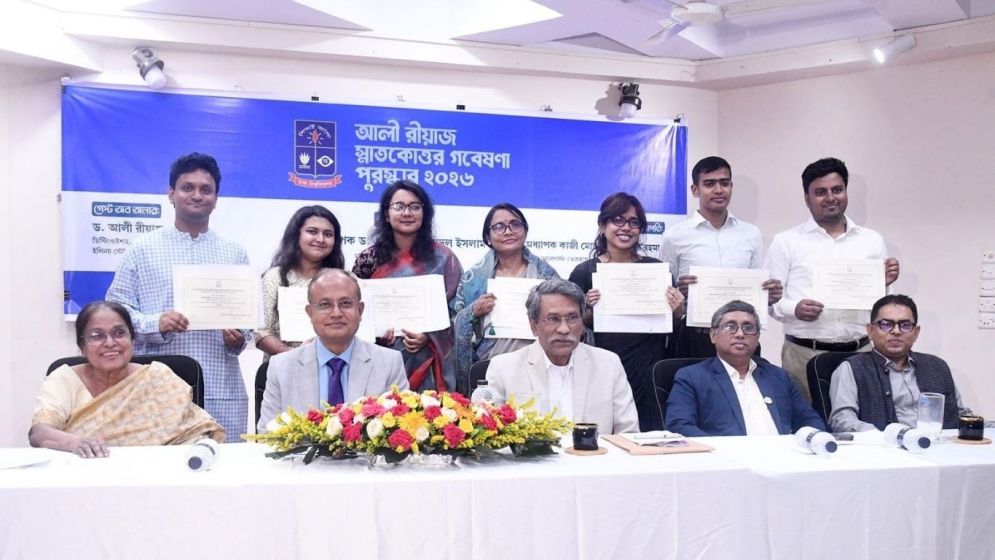
Photo: Daily Sun
Eight students from different academic years of the Department of Mass Communication and Journalism (MCJ) at Dhaka University have received the ‘Ali Riaz Postgraduate Research Award and Scholarship’.
Of them, two students received the Ali Riaz Postgraduate Research Award, while six received postgraduate research scholarships. The awards and scholarships were presented at a ceremony held at the Professor Muzaffar Ahmed Chowdhury Auditorium on Wednesday.
DU Vice-Chancellor Prof ABM Obaidul Islam attended the programme as the chief guest and handed over the award and scholarship cheques to the recipients. The Department of Mass Communication and Journalism organised the event.
Prof Kazi Mohammad Mahbubur Rahman, dean of the Faculty of Social Sciences and acting chairman of the Department of Mass Communication and Journalism, presided over the programme. Distinguished Prof Ali Riaz of Illinois State University in the US attended the event as the guest of honour. Prof Robayet Ferdous moderated the programme.
Speaking at the event, Prof Ali Riaz urged young people to cultivate open-mindedness, critical thinking, research skills and respect for differing opinions.
“Your greatest strength is your ability to ask questions. You have to ask ‘why’,” he said, stressing that the habit of questioning is particularly important for students of journalism and researchers.
He said courage was necessary to question established ideas, but such courage should not turn into arrogance. People should address differences of opinion with reason, and they should not treat those with opposing views as enemies.
“We have to understand the logic behind a different opinion. Our task is to understand that logic,” he said, adding that researchers and students should maintain mutual respect while engaging in intellectual debates.
Prof Ali Riaz said the world was passing through a turbulent and rapidly changing period, with major changes taking place in the global order that emerged after the Second World War.
“Events in one part of the world can now affect your everyday life, even if you have no direct connection with those events,” he said, urging young people to remain aware of developments around the world and consider how those developments could affect their lives and future.
Speaking about Bangladesh’s democratic transition, he said the fall of an authoritarian system was only the first step towards democracy.
“Democratic transition is not merely an election. It means establishing your rights as a citizen,” he said.
He said Bangladesh’s young people had demonstrated courage by taking to the streets during the July-August movement in 2024, but the process of democratic transition was not complete.
“The responsibility of the youth is now to ensure that the democratic transition actually leads to democracy,” he said, adding that accountable institutions, protection of citizens’ rights and freedom from discrimination were essential to establishing meaningful democratic participation.
Prof Ali Riaz also highlighted the growing influence of technology and artificial intelligence on young people’s lives. He urged students to understand the impact of algorithms and ensure that technology remained under human control.
“Technology should be controlled by you; technology should not control you,” he said.
He called on young people to remain active in matters concerning their own interests, the interests of the people and the country.
“Change does not come through inaction,” he said, adding that knowledge, free thinking, reason, mutual respect and active participation could help young people contribute to building an accountable state based on citizens’ rights.
In his speech, DU Vice-Chancellor Prof ABM Obaidul Islam congratulated the award and scholarship recipients.
He said the success of a student depended not only on individual effort but also on the contributions and support of family members, parents and society.
“Students must repay these contributions by becoming good citizens and skilled human resources,” he said, urging them to contribute to building a happy, prosperous and inclusive society and country.
Prof Obaidul Islam said the university could not advance by relying solely on government funding. He stressed the need for private partnerships and greater involvement of alumni to improve the quality of education and research at the university.
“Through the collective efforts of all, it is possible to take the education and research of Dhaka University to international standards,” he said.
The vice-chancellor also called for establishing large-scale ‘endowment funds’ in every department with the involvement of alumni. He urged all members of the university community to work from their respective positions to improve students’ quality of life and ensure their overall welfare.
The Ali Riaz Postgraduate Research Award went to Arthi Nabhanita and Farah Jahan Shuchi.
The six recipients of the Ali Riaz Postgraduate Research Scholarship are Farah Zahan Shuchy, Usama Rafid, Azra Humayra, Kouritra Poddar Tirtha, Mohammad Al Mukit and Muhammad Muzzammil Haque.