


 For all latest news, follow the Daily Sun's Google News channel.


84 children killed, nearly 700,000 people displaced amid Israeli strikes on Lebanon
Reuters, Beirut
Published: 10 Mar 2026, 09:35 PM
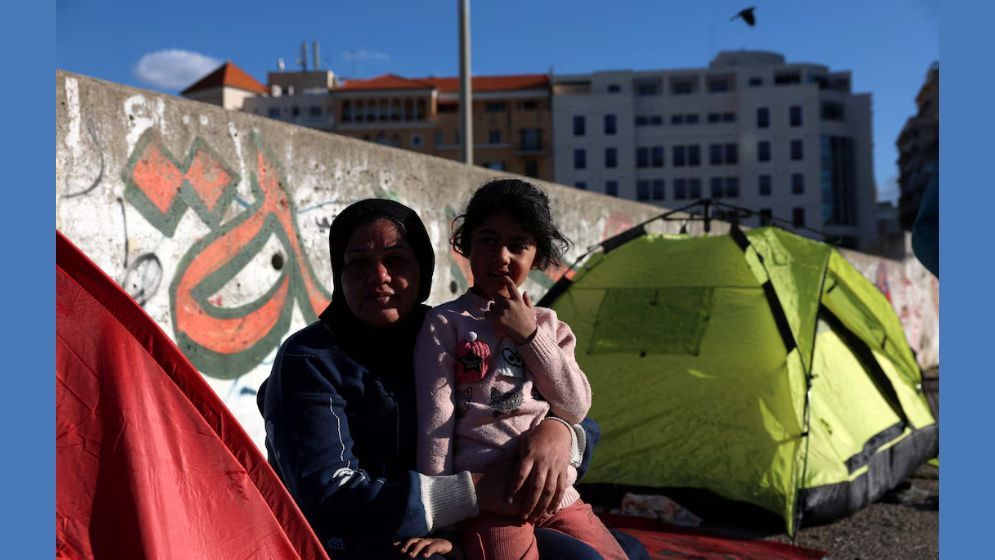
A displaced woman and her daughter sit outside a tent, following an escalation between Hezbollah and Israel, amid the US-Israeli conflict with Iran, in Beirut, Lebanon, 8 March 2026. Photo: Reuters
The humanitarian crisis in Lebanon has deepened amid the
wider Middle East war, with 84 children killed and more than 667,000 people
displaced, two UN agencies said on Tuesday, as lives are upended on a massive
scale across the country.
Lebanon was dragged into the US-Israeli war on Iran this
month when Iran-backed Lebanese militant group Hezbollah launched rockets and
drones into Israel, which has responded with heavy bombardment across the country.
A total of 486 people have been killed in the war so far and
1,313 injured, of which 259 are children, according to the World Health
Organization.
"This is only seven-days conflict, and we are already
seeing that almost 100 children that have lost their lives," said
Abdinasir Abubakar, WHO representative in Lebanon.
"One reason why we have a high number of children is
that most of the attacks that we see actually is, it's urban centers, like in Beirut,"
he said, adding that Israel's airstrikes, which it says target Hezbollah
infrastructure, are putting civilian lives at risk.
The current rate of displacement in Lebanon is outpacing
levels seen during the 2023-24 war between Hezbollah and Israel, the UN Refugee
Agency said on Tuesday. During that conflict, 886,000 people were internally
displaced in Lebanon, while tens of thousands of Israelis were evacuated from
northern towns near the Lebanese border.
Israel orders evacuation
Lebanon's sharp rise in displacement this week stems from
large-scale evacuation orders issued by the Israeli army for southern Lebanon
and Beirut's densely populated southern suburbs, which the UN human rights
chief said on Friday raised serious concerns under international law.
The WHO warned that Lebanon's hospitals and frontline
responders were under "extraordinary strain" trying to manage the
rising number of patients.
Five hospitals are now out of service, four partially
damaged, and 43 primary healthcare centers are closed - mostly in the south,
which has been largely evacuated, Abubakar said.
"Many of the people fleeing were also fleeing back in
2024. We met many who then had their homes completely destroyed, family members
killed and so on. So this means that people are not waiting to see what will
happen next. They leave immediately," said Karolina Lindholm Billing,
UNHCR representative in Lebanon.
Some 120,000 people are staying in government-designated
shelters, while others are still looking for somewhere to stay, the UNHCR said,
citing government figures.
"Many others are staying with relatives or friends or
still searching for accommodation, and we see cars lined along the street with
people sleeping in them and also on the sidewalks," Billing said.