


 For all latest news, follow the Daily Sun's Google News channel.


Trump warns US will end war by 'obliterating' Iran's energy sources if deal not reached
Reuters, Washington
Published: 30 Mar 2026, 10:38 PM
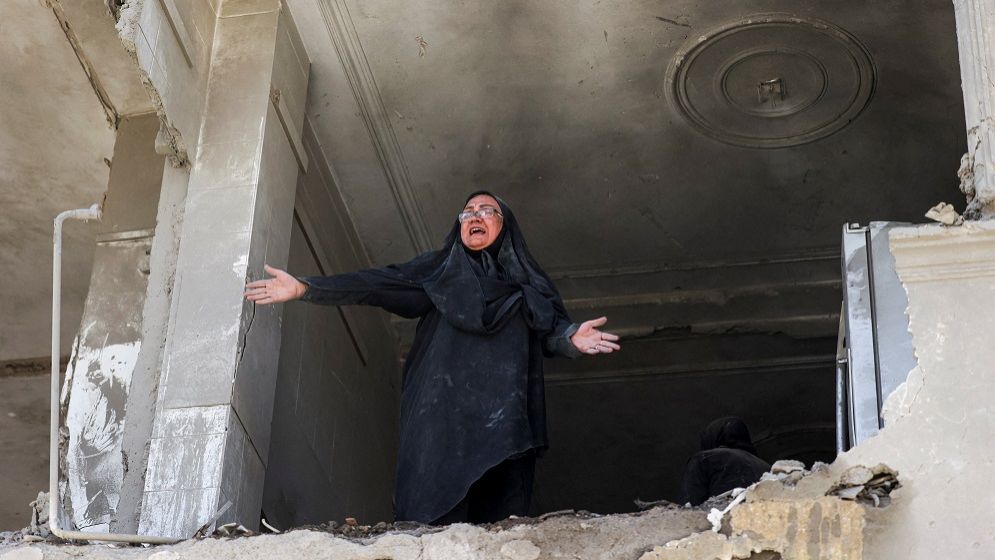
A woman reacts inside her brother's home, which was damaged by a strike, as the US-Israeli conflict with Iran continues, in Tehran, Iran, 30 March 2026. Photo: Reuters
President Donald Trump warned on Monday that Iran's energy
plants and oil wells would be obliterated as the final blows to end the war if
it did not open the Strait of Hormuz, after Tehran described US peace proposals
as "unrealistic" and fired waves of missiles at Israel.
“Great progress has been made on peace talks but, if for any
reason a deal is not shortly reached, which it probably will be, and if the
Hormuz Strait is not immediately ‘Open for Business,’ we will conclude our
lovely ‘stay’ in Iran by blowing up and completely obliterating all of their
Electric Generating Plants, Oil Wells and Kharg Island (and possibly all
desalinization plants!), which we have purposefully not yet ‘touched,’” the
president said in a Truth Social post on Monday morning.
Israel's military said two drones from Yemen had also been
intercepted on Monday, two days after the Iran-aligned Houthis entered the war
by firing missiles at Israel, and that Lebanon's Hezbollah had fired rockets at
Israel.
Israeli forces carried out missile strikes on what they
called military infrastructure in Tehran and infrastructure used by Iran-backed
Hezbollah in Beirut, leaving black smoke hanging over the Lebanese capital.
Turkey's defence ministry said a ballistic missile launched
from Iran entered Turkish airspace before being shot down by NATO air and
missile defences deployed in the eastern Mediterranean.
Iran defiant
Tehran remained defiant in the month-old war, which began
with US-Israeli attacks on Iran on 28 February and has spread across the
region, killing thousands, disrupting energy supplies and hitting the global
economy. The majority of those reported killed were in Iran and Lebanon, and
many were civilians.
Iran confirmed on Monday the death of Revolutionary Guards
Navy Commander Alireza Tangsiri, the latest of its leaders killed including
Supreme Leader Ayatollah Ali Khamenei, who has been replaced by his son Mojtaba
Khamenei.
The Iranians have effectively blocked the Strait of Hormuz,
a narrow waterway which normally carries about a fifth of global oil and
liquefied natural gas supplies.
Iran said on Monday it had received US peace proposals via
intermediaries, following talks on Sunday between the foreign ministers of
Pakistan, Egypt, Saudi Arabia and Turkey.
But Iranian Foreign Ministry spokesperson Esmaeil Baghaei
said the proposals were "unrealistic, illogical and excessive".
"Our position is clear. We are under military
aggression. Therefore, all our efforts and strength are focused on defending
ourselves," he told a press conference.
Soon after Baghaei's remarks, Trump said in a social media
post that the United States was in talks with a "more reasonable
regime" to end the war in Iran, but he also issued a new warning over the
Strait of Hormuz.
"Great progress has been made but, if for any reason a
deal is not shortly reached, which it probably will be, and if the Hormuz
Strait is not immediately 'Open for Business,' we will conclude our lovely
'stay' in Iran by blowing up and completely obliterating all of their Electric
Generating Plants, Oil Wells and Kharg Island," Trump wrote.
Trump also threatened to attack the desalination plants that
supply clean water in Iran. He said last week he would pause attacks on Iran's
energy plants for 10 days, which would be until April 6, US time.
A Pakistani security official, whose country is trying to
mediate in the war, said that at this stage it appeared unlikely there would be
direct US-Iran talks this week.
Baghaei also said Iran's parliament was reviewing a possible
exit from the Nuclear Non-Proliferation Treaty, which recognises the right to
develop, research, produce and use nuclear energy as long as nuclear weapons
are not pursued.
Trump has cited preventing Iran obtaining nuclear weapons as
one of the reasons for attacking Iran on February 28. Tehran denies it is
seeking a nuclear arsenal.
On Sunday, Trump said the US and Iran had been meeting
"directly and indirectly". But he has also been sending more US
troops to the region and Iran has remained defiant, maintaining its blockade of
the Strait of Hormuz.
Fears of escalation
Iran has fired on Arab Gulf states during the conflict and
war has been reignited between Israel and Hezbollah in Lebanon, where a UN
peacekeeper from Indonesia was killed when a projectile exploded at one of its
positions in southern Lebanon on Sunday. Another peacekeeper was critically
injured.
Brent crude futuresLCOc1 rose 66 cents or 0.6% to $113.23 a
barrel at 1431 GMT after settling 4.2% higher on Friday, and were on course for
a record monthly rise of almost 60%.
The Houthis' attacks on Israel raised the prospect that they
could target and block a second important shipping route, the Bab el-Mandeb
Strait.
The oil market has all but discounted the prospect of a
negotiated end to the war and "is bracing for a sharp escalation in
military hostilities," said Vandana Hari of oil-market provider Vanda
Insights.
The Financial Times quoted Trump on Sunday as saying in an
interview that the US could seize Kharg Island, from where Iran exports much of
its oil.
Taking control of Kharg would require ground troops. The US
Department of Defense is dispatching thousands of troops to the Middle East,
giving Trump the option of launching a ground offensive, but he has not
approved any of those plans, according to several news outlets.
Economic consequences
The International Monetary Fund warned that war in the
Middle East has caused serious disruption to the economies of frontline
countries, and is dimming the outlook for many economies that had just started
to recover from previous crises.
G7 finance leaders also said they were ready to take
"all necessary measures" to safeguard energy market stability and
limit broader economic spillovers from recent volatility.